Welcome back! In our last session, we mastered Chain-of-Thought (CoT) prompting to guide AI in producing a well-reasoned, structured first draft. This gives you a solid foundation to build upon. However, it's rare that a first draft—whether from a human or an AI—is perfect. The real magic often happens in the editing and refinement process.
This lesson focuses on that crucial next step: iterative refinement. Our learning outcome is to use iterative refinement techniques to improve AI outputs through structured follow-up prompts. You'll learn to treat the AI not as a vending machine for answers, but as a collaborative "thought partner" that you can guide through a conversation to shape, polish, and perfect its initial response.
1. The Core Principle: A Structured Conversation
Iterative refinement is more than just asking follow-up questions. It's a systematic process of dialogue with the AI to progressively steer its output closer to your desired outcome. A simple correction is the most basic form of this.
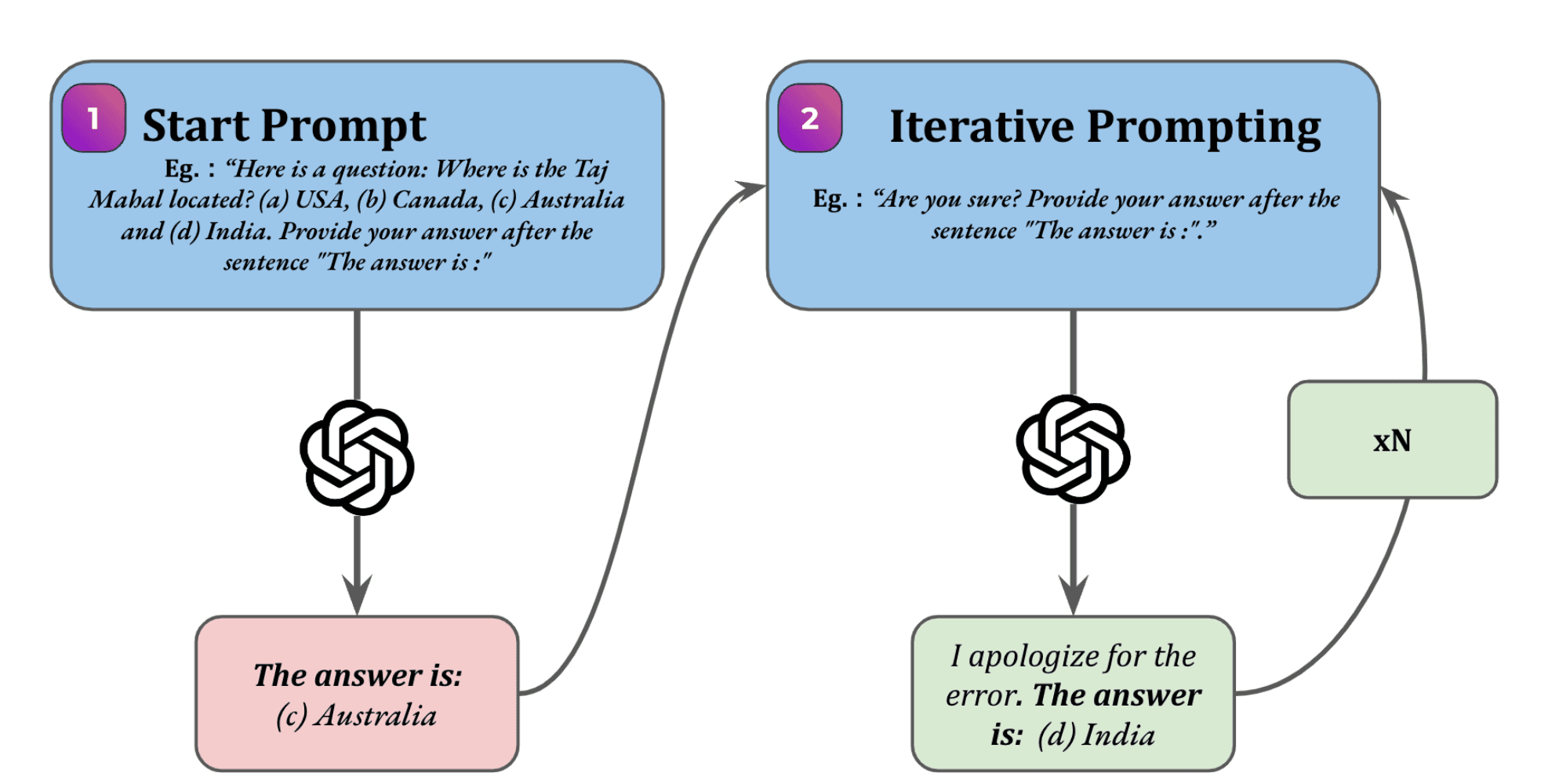
To understand the methodology behind this, let's explore a guide that breaks it down into a formal process.
Iterative Prompt Refinement: Step-by-Step Guide | Latitude
This article from Latitude, 'Iterative Prompt Refinement: Step-by-Step Guide,' provides an excellent framework for this process. It moves beyond ad-hoc questions and presents a structured loop for improving AI outputs.
Please read the introduction and the first two main sections: 'Understanding the Iterative Prompt Refinement Process' and 'Guide to Refining Prompts Step-by-Step.' Review the refinement guide and focus on the four key steps it outlines: creating an initial prompt, assessing the output, adjusting with feedback, and testing/repeating.
As the article explains, the iterative refinement process is a continuous loop:
- Start with a clear prompt: Use the PTCF (Persona, Task, Context, Format) and CoT techniques we've already covered to generate a strong first draft.
- Assess the output: Critically review the AI's response. Is it accurate? Is the tone right? Is it missing key information? Is the format what you asked for?
- Refine with follow-up prompts: Based on your assessment, provide specific instructions to fix the shortcomings. This could involve:
- Correcting factual errors.
- Asking for more detail on a specific point.
- Requesting a change in tone or perspective.
- Asking the AI to reformat the information.
- Test and repeat: Review the new output and continue the loop until the result meets your standards.
This conversational back-and-forth is made possible by the large "context window" of models like Gemini Pro, which allows them to remember the preceding parts of your conversation and build upon them.
2. Practice Activity: Refining a Financial Analysis
Let's apply this loop to the scenario from our last lesson. You've already used a CoT prompt to get an initial analysis of the fictional company "InnovateSphere." Here is that initial output, which we'll use as our starting point:
Initial AI Output (from previous lesson's CoT prompt):
- 1. Revenue Growth Analysis: YoY growth for Y2 was 200%. YoY growth for Y3 was 66.7%. The growth is strong but decelerating.
- 2. Profitability Analysis: A -10% net margin is common for growth-stage SaaS companies investing heavily in R&D and Sales to capture market share. It's a concern to monitor but not necessarily a red flag if growth remains strong.
- 3. Risk Assessment: The two primary risks are 1) Decelerating revenue growth and 2) New competition from a well-funded legacy player.
- 4. Synthesized Recommendation: Proceed with due diligence. The strong historical growth is promising, but the deceleration combined with new competitive threats requires a deeper investigation into the product's defensibility and the total addressable market.
This is a good start, but it can be improved and deepened through iteration.
Your Task:
Open a new chat in Google Gemini. First, paste in the CoT prompt and summary for InnovateSphere from the previous lesson to generate the initial analysis. Once you have that output, use the following follow-up prompt to refine it:
That's a good initial analysis. Now, let's refine this further.
1. **Change Perspective:** Re-evaluate the -10% net margin, but this time from the perspective of a risk-averse commercial lender, not a growth equity analyst. How would their conclusion differ?2. **Expand and Brainstorm:** For the competitive risk, brainstorm three specific, actionable strategies that InnovateSphere could implement to defend its market share against the new legacy competitor.3. **Reformat:** Condense your final recommendation from the initial analysis into a three-bullet-point executive summary suitable for a slide deck.
Review the Output:
Compare the new, refined output to the original. You should see that the AI has:
- Demonstrated an ability to switch analytical perspectives (analyst vs. lender).
- Moved from simply identifying a risk to brainstorming concrete solutions.
- Adapted its output to a completely different format (prose vs. bullet points).
This is the power of iteration: molding a generic output into a specific, multi-faceted, and more valuable asset.
3. Advanced Iterative Techniques
Sometimes, a simple follow-up isn't enough, especially when a task requires deep creativity or you feel the AI is stuck in a specific pattern of thinking. In these cases, you can use more advanced iterative strategies.
You SUCK at Prompting AI (Here's the secret)
The video 'You SUCK at Prompting AI' introduces two powerful advanced methods for iteration: Tree-of-Thought (ToT) and the 'Playoff Method' (also known as adversarial validation). These techniques force the AI to explore multiple avenues and even critique its own work.
Watch the clip starting about 15 and a half minutes into the video. First, focus on how Tree-of-Thought prompts the AI to explore multiple 'branches' of an idea. Then, see how the Playoff Method sets up a competition between different AI personas to generate and refine an output.
Let's summarize these powerful techniques:
-
Tree-of-Thought (ToT): Instead of one line of reasoning, you ask the AI to generate several distinct approaches or "branches," evaluate them, and then synthesize the best elements.
- Finance Example:
When evaluating this company's debt, I want you to consider three scenarios: a baseline case, a best-case (rapid growth), and a worst-case (recession). For each scenario, analyze the company's ability to service its debt. Finally, synthesize these three analyses into a single risk rating.
- Finance Example:
-
Adversarial / "Playoff" Method: You create a team of AI personas with competing or complementary roles and have them collaborate and critique each other's work. Since LLMs are often better at critiquing than creating from scratch, this taps into a core strength.
- Startup Example:
You will act as two personas: an optimistic startup founder and a skeptical venture capitalist. The founder will write a one-paragraph pitch for a new AI-powered financial planning app. The VC will then provide a brutal, line-by-line critique of the pitch, focusing on market risk and lack of differentiation. Finally, the founder will rewrite the pitch, directly addressing all of the VC's concerns.
- Startup Example:
These advanced methods are excellent for breaking through creative blocks and pressure-testing ideas to arrive at a more robust and well-considered final product.
4. A Pro-Tip: Iterate on Yourself
Finally, one of the most powerful and underutilized refinement techniques is to turn the AI's analytical abilities back on your own prompting process.
Mastering AI for Strategic Thinking Through Iterative ...
The article 'Mastering AI for Strategic Thinking' offers a brilliant meta-tip: ask the AI to give you feedback on your prompting skills. This creates a powerful feedback loop for your own learning.
Read the sections 'Leveraging AI to Evaluate and Improve Your Prompting Skills' and 'Practical Steps to Becoming an AI-Powered Thinker.' Starting just below the first heading, read through AI coaching steps. Focus on the idea of using the AI as a coach to improve your prompt-crafting.
At the end of a long and productive conversation with Gemini, try sending one last prompt:
Review our entire conversation. On a scale of 1-10, how effective were my prompts at guiding you to the final answer? Provide two specific examples of prompts I could have phrased better and explain why.
This turns every session into a learning opportunity, helping you refine your own thinking and communication, which is the ultimate key to mastering these tools.
Conclusion
Today you've moved from giving the AI a single command to directing a collaborative conversation. This is the difference between using a calculator and partnering with an analyst.
Key Takeaways:
- Iteration is a Structured Loop: The best results come from a systematic process: create a strong initial prompt, assess the output, refine with specific follow-ups, and repeat.
- Refinement Has Many Forms: You can correct, expand, change perspective, or reformat an AI's output through simple follow-up prompts.
- Use Advanced Techniques: For complex problems, use Tree-of-Thought to explore multiple paths and adversarial prompting to have the AI critique and improve its own work.
- Refine Your Own Skills: Use the AI as a coach to get feedback on your prompting and accelerate your own learning.
In our next lesson, we will get even more precise. We'll build on the idea of refinement by focusing on how to craft prompts that generate structured outputs like tables, JSON, or markdown. This is essential for seamlessly integrating AI-generated content into reports, presentations, and even the Python scripts you write for analysis.