Hello! Welcome back to your course on designing retro doilies.
In the last module, you mastered the art of integrating organic shapes like pineapples, learning to use transition stitches to manage the "stitch economy" and keep your doily flat. You learned that the fabric between motifs plays an active role, expanding and contracting to compensate for the main design elements.
Today, we shift our focus from flowing, organic forms to structured, geometric patterns. We are entering the world of filet crochet, a technique central to many mid-century designs. This lesson tackles the fundamental challenge of this style: making a flat grid expand into a perfect circle. Your learning outcome is to calculate the required increases within a filet crochet grid to maintain the flat expansion of a circle. This is the mathematical foundation you'll need before you can start designing the beautiful imagery in our next lesson.
The Unique Challenge of Circular Filet Crochet
In previous lessons, we established that a flat circle in double crochet typically requires 12 evenly spaced increases per round. You might think we could simply apply this rule to filet crochet, but the grid structure introduces a complication.
In filet crochet, our basic unit isn't a single stitch; it's a block (or mesh). A standard open mesh block is made of a post stitch and a chain space (e.g., dc, ch 2). This block has its own width and height. The core problem, as you'll see from swatching, is that a standard double crochet stitch is not as tall as two double crochet stitches are wide. This means a standard filet block (dc, ch 2) is a rectangle, not a square.
This presents a two-part problem for us as designers:
- How do we calculate the number of blocks (not just stitches) we need to add in each round to create a flat circle?
- How do we physically add these new blocks into the grid structure in a way that is both structurally sound and visually appealing?
Let's tackle the math first.
Method 1: The Precise Calculation (The "Engineer's" Approach)
This method uses the same geometric principles we've touched on before, but applies them to the dimensions of a filet block. This requires you to create a gauge swatch first, which perfectly aligns with your hands-on, pen-and-paper approach.
To start, let's review the excellent mathematical breakdown provided in the article "How to crochet a flat circle in any crochet stitch or pattern."
How to crochet a flat circle in any crochet stitch or pattern
This article from Dora Does explains the geometry behind flat circles. We will use the same logic, but adapt it for filet blocks instead of single stitches.
Please read the section titled 'The math of crocheting a flat circle.' Focus on the 3-step process: calculating diameter, then circumference, and finally the required number of stitches. We will be substituting 'stitch' with 'filet block'.
Now, let's adapt that 3-step process for our filet grid.
Step 1: Measure Your Block Gauge
Crochet a small, flat swatch of filet crochet using the stitch you intend to use (e.g., double crochet with ch-2 spaces). Block it lightly so it lies flat, and carefully measure:
- Block Height (
h_block): The height of one row. - Block Width (
w_block): The width of one mesh, from the center of one post to the center of the next.
Step 2: Calculate the Required Circumference for a Given Round
For any given round, which we'll call Round R:
- The radius of the circle at that round is
R × h_block. - The diameter is
2 × R × h_block. - The circumference is
Diameter × π, or(2 × R × h_block) × 3.14.
Step 3: Calculate the Total Blocks Needed and the Increase
- The total number of blocks needed for Round
RisCircumference / w_block. - The number of blocks you need to increase in Round
Ris the total blocks for RoundRminus the total blocks you had in RoundR-1.
Worked Example:
Let's imagine your gauge swatch gives you these measurements:
- Block Height (
h_block): 0.8 cm - Block Width (
w_block): 1.2 cm
Now, let's calculate the increases needed to go from Round 5 to Round 6.
-
For Round 5:
- Diameter =
2 × 5 × 0.8 cm= 8 cm - Circumference =
8 cm × 3.14= 25.12 cm - Total Blocks Needed =
25.12 cm / 1.2 cm= 20.9 blocks (let's round to 21)
- Diameter =
-
For Round 6:
- Diameter =
2 × 6 × 0.8 cm= 9.6 cm - Circumference =
9.6 cm × 3.14= 30.14 cm - Total Blocks Needed =
30.14 cm / 1.2 cm= 25.1 blocks (let's round to 25)
- Diameter =
-
Increase for Round 6:
25 blocks - 21 blocks= 4 blocks.
So, in Round 6 of your doily, you would need to add 4 new blocks, spaced as evenly as possible. You'll notice this is not a constant number; as the circle grows, the number of increases per round will also need to adjust.
Method 2: The "Rule of Thumb" Approach
While the precise calculation is empowering, many designers use a reliable shortcut based on the standard flat circle formula. This method is faster and often sufficient for typical doily designs.
Here is a great visual summary of the standard increase counts.
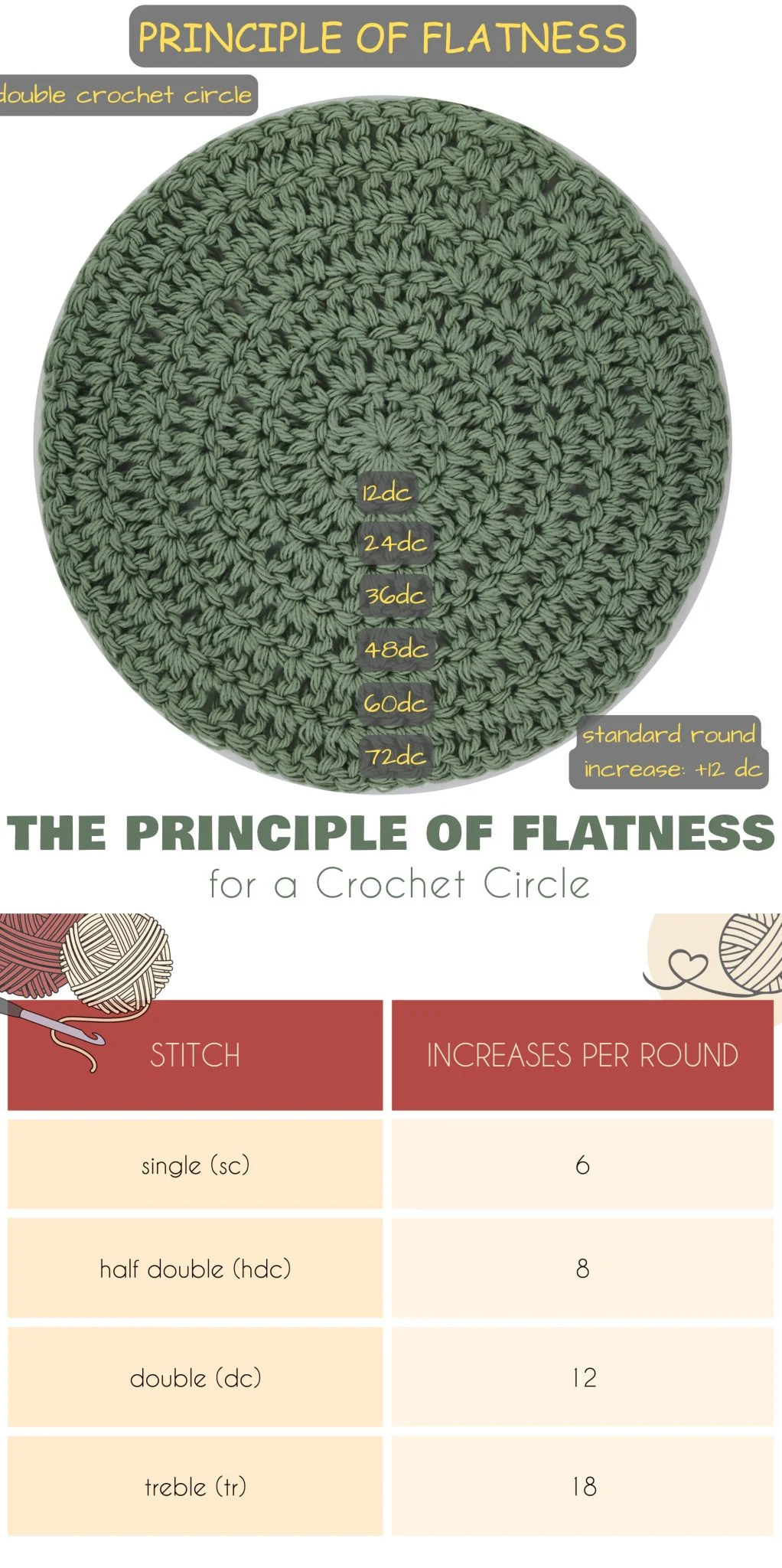
We can adapt this principle for filet crochet. A standard filet mesh (dc, ch 2) takes up the space of approximately 3 stitches.
Therefore, we can estimate the number of block increases needed per round:
Block Increases ≈ (Standard Stitch Increases) / (Stitches per Block)
-
For a double crochet (dc) filet circle:
- Standard
dcincrease is +12 stitches per round. 12 / 3= 4 block increases per round.
- Standard
-
For a treble crochet (tr) filet circle:
- Standard
trincrease is ~18 stitches per round. 18 / 3= 6 block increases per round.
- Standard
This "Rule of Thumb" gives you a consistent target for each round and is an excellent starting point for a design. You might find you need to add an extra increase round occasionally if you notice cupping, or skip an increase round if you see ruffling, but it provides a very solid framework.
The Mechanics: How to Add a Block
Now that you know how many blocks to add, let's look at how you physically create an increase within a round of filet crochet. The goal is to turn one block into two.
The most common method is to work an extra mesh block within a chain space of the round below.
Imagine a section of your previous round was: ...- dc - ch 2 - dc -...
To increase in that ch-2 space, your new round would be: ...- dc - ch 2 - dc - ch 2 - dc -...
You effectively replace the single ch-2 space with (ch 2, dc, ch 2). The new dc becomes a post that splits the old block into two new blocks.
When charting this on your radial grid, an increase point would show two blocks in one round emerging from a single block in the round below.

Test your understanding!
You are designing a doily using double crochet filet crochet (open mesh = dc, ch 2). You are using the "Rule of Thumb" method. You have just completed Round 8, which has a total of 32 blocks.
- How many blocks should Round 9 have in total?
- How would you describe the repeating pattern of stitches and increases for Round 9?
Show answer
- Using the rule of thumb for
dcfilet, you need to add 4 blocks. Therefore, Round 9 should have a total of32 + 4 =36 blocks. - To add 4 increases evenly over 32 blocks, you would place one increase every
32 / 4 = 8blocks. The pattern would be: Work 7 normal blocks, then work an increase in the 8th block. You would repeat this sequence 4 times to complete the round.
Conclusion
You have now built the mathematical toolkit required to design filet crochet sections that expand into flat circles. You can choose between a precise, gauge-based calculation for ultimate accuracy or a reliable rule of thumb for faster drafting.
Key Takeaways:
- Filet crochet in the round requires increasing by a set number of blocks, not individual stitches.
- The rectangular nature of standard filet blocks is a key design consideration that the math must account for.
- The precise number of block increases can be calculated using the block's gauge (width and height) and the formula for a circle's circumference.
- A practical rule of thumb is to increase by ~4 blocks per round for double crochet filet and ~6 blocks per round for treble crochet filet.
- The physical mechanism for increasing is typically to work
(dc, ch 2, dc)into ach-2space from the round below, turning one block into two.
Next Lesson:
With the math and structure now firmly in hand, we can move on to the artistic application. In the next lesson, you will design a filet crochet section using open and solid meshes to create imagery or texture within a circular band. We will look at how to plot geometric designs and simple pictures onto your expanding radial grid.