Hello! Welcome to the final lesson in our first module, "Anatomy of a Retro Doily."
In our previous lessons, we established a framework for analyzing doily designs. We first learned to break them down into their primary zones (center, body, border) and then explored the two fundamental ways the body can be structured: through radial (wedge-based) or concentric (band-based) growth.
Today, we complete our anatomical study by building a visual library of the decorative "words" that form the language of mid-century doily design. This lesson focuses on identifying common decorative motifs: pineapples, shells, fans, and filet work. Think of the previous lessons as learning the grammar and sentence structure of doily design; today, we learn the vocabulary. Mastering this will allow you to look at a vintage pattern and not just see a beautiful object, but understand the specific elements the designer used to create it.
Shells and Fans: The Rhythmic Curves
Shells and fans are perhaps the most ubiquitous decorative elements in crochet. They create texture, rhythm, and elegant, curving edges. While often used interchangeably in casual conversation, they have a distinct technical difference.

As the image above illustrates:
- A Shell is a group of stitches (typically 3 or more) all worked into the same stitch or space. This creates a solid, dense, fan-like shape.
- A Fan is similar, but it incorporates chain spaces between the stitches or groups of stitches. This creates a more open, lacy effect.
In mid-century doilies, you will see these used everywhere:
- As the primary repeat in a radial design, creating a star-like effect.
- Arranged in concentric bands to form textured rings.
- As the foundation for elaborate borders.
The "Sheer Witchery" doily from 1950, which you can see in the resource below, uses shell-like clusters in its border to create points. The "Shell Motif" medallion shows how shells can be the central feature of a design.
My Vintage Crochet Projects | Free Vintage Crochet Patterns
To see these motifs in the context of vintage patterns, please browse the following blog post. You don't need to read it in detail, but scroll through the images to familiarize yourself with the look of these authentic mid-century patterns.
Scan through the entire post. Pay attention to the "Sheer Witchery Doily" (top of the page) and the "Shell Motif" (about halfway down). Notice how clusters of stitches form shells and fans to create texture and shape.
The Pineapple: A Quintessential Retro Motif
The pineapple motif is an icon of vintage crochet, especially from the 1940s and 50s. Its combination of a solid base, delicate netting, and a decorative top or "crown" makes it incredibly versatile. It can be small and dainty or large and dramatic.
Since you are already comfortable with reading charts, the structure of a pineapple is best understood by looking at a motif and its chart side-by-side.
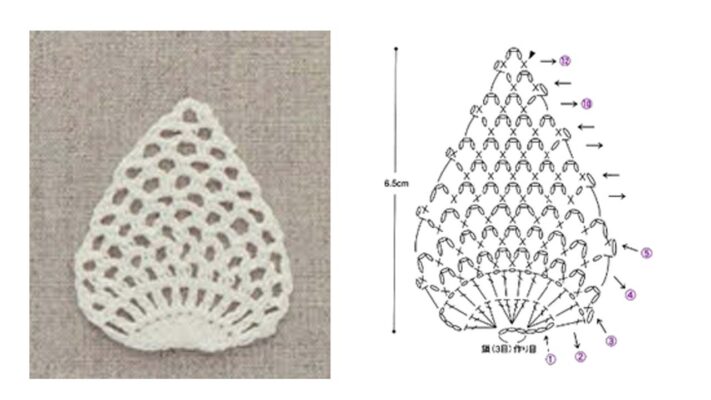
Notice the key parts:
- The Base: A solid shell or fan that opens the pineapple.
- The Netting: The body of the pineapple, formed by an expanding and then contracting series of chain-loops.
- The Crown: A final shell, cluster, or picot group that "closes" the top of the motif.
The "Popcorn & Pineapples Doily" from the blog post you just viewed is a perfect example of how these motifs are integrated into a full design, often arranged radially. We will dedicate an entire module later in the course to designing and charting these beautiful motifs, but for now, the goal is to be able to spot them instantly.
Filet Work: Weaving Pictures with Thread
Unlike shells and pineapples, which are stitch clusters, filet crochet is a complete technique for creating gridded fabric. The design is formed by filling in parts of the grid to create an image, much like pixels on a screen. This was extremely popular in the early-to-mid 20th century for everything from tablecloths and curtains to doily inserts.
The core principle is simple:
- Open Mesh (an empty square): Usually formed by
double crochet, chain 2, skip 2 stitches. - Solid Block (a filled square): Usually formed by
3 double crochet stitches.
By arranging these open and solid blocks, you can chart out any image.
To understand the theory behind filet crochet, please read the following introductory guide.
Read the sections 'Filet Crochet – The Basics,' 'Filet Patterns / Charts,' and 'How to read a Filet chart.' This will explain the concept of using open and closed mesh to create designs and how to interpret the corresponding grid-based charts.
Now that you understand the concept, let's see it in practice.
How to Filet Crochet | 3 Methods + Troubleshooting | Crochet Friday
The following video provides a clear, modern demonstration of how to work the basic open and closed blocks. This will help solidify the concept from the article.
Watch the first two sections of the video. The 'Introduction' (00:04 - 01:33) explains the concept with a vintage example. Then, watch the demonstration of the 'Traditional Method' (01:33 - 11:18) to see exactly how open and filled blocks are crocheted.
This technique allows for incredible detail. While the video showed a simple heart, vintage patterns often featured intricate floral motifs, birds, or geometric designs. The video below shows a crocheter working on a more complex, authentic 1930s pattern. You don't need to follow along stitch-by-stitch; just observe how the rows of blocks and spaces build upon each other to form the "Fairy Ring" image.
How To Filet Crochet The Vintage 1930s Fairy Ring & Butterfly Motif Set
To see a more complex vintage filet pattern in action, watch parts of the following video.
Watch the introduction (00:00 - 04:23) where the presenter introduces the vintage chart. Then, skim through the demonstration of Row 2 (06:15 - 10:47), paying attention to how she alternates between working 'spaces' (open mesh) and 'blocks' (solid mesh) according to the chart.
Test your understanding!
Let's return to the "My Vintage Crochet Projects" blog post (resource_id: [LINK](https://vintagepatternsdazespast.wordpress.com/2014/05/05/my-vintage-crochet-projects-free-vintage-patterns/)). Examine the image and scanned pattern for the "Sheer Witchery" doily from 1950 at the very top of the page.
Based on what you've learned, what distinct decorative motifs or techniques can you identify in its design?
Show answer
The "Sheer Witchery" doily incorporates several elements:
- Shells/Fans: The border is created with prominent points that are built from shell-like clusters of stitches separated by chain spaces, making them technically fans.
- Openwork/Mesh: The body of the doily, between the solid center and the border, is composed of simple mesh or netting (similar to the open mesh of filet crochet, but used here for texture rather than to form an image).
- Picots: The very edge of the doily is finished with picots (small decorative loops) on the tips of the border fans, giving it a delicate, pointed finish. While we didn't cover picots explicitly as a major motif, they are a common finishing detail you'll see often.
Conclusion
This lesson concludes our initial analysis of retro doily anatomy. You can now look at a complex design and deconstruct it on multiple levels: its overall zones, its structural growth pattern, and its specific decorative motifs.
Key Takeaways:
- Shells and Fans: Common curving motifs. Shells are solid groups of stitches; Fans are more open, incorporating chain spaces.
- Pineapples: A classic retro motif with a distinct structure of a base, netting, and crown.
- Filet Work: A technique using a grid of open and solid blocks to create images within the crochet fabric.
You now possess the foundational knowledge to dissect almost any vintage doily pattern and understand its core components.
With this analytical toolkit complete, we will pivot from deconstruction to creation. The next module, "The Mathematics of Flat Circles," will provide the essential formulas that underpin everything we've observed. Our first lesson will be "Explain the relationship between Pi, stitch height, and the number of increases needed per round to create a flat circle." This will be our first step into the practical math of drafting your own designs from scratch.