Hello! Welcome to our new lesson.
In our previous lessons, we focused on man-made optical instruments like microscopes and telescopes, mastering the calculations for their magnification and tube length. Today, we turn our attention to the most sophisticated optical instrument of all: the human eye.
This lesson addresses the learning outcome: Describe common defects of vision (myopia and hypermetropia). We will explore what happens when the eye cannot form a clear image, leading to these common conditions. We'll examine their causes, symptoms, and the principles behind their correction. This conceptual foundation is essential for our next lesson, where we'll tackle the NEET-style numerical problems of calculating the power of corrective lenses.
1. The Normal Eye: Our Baseline
To understand defects, we first need a clear picture of a healthy, or "emmetropic," eye. The eye works like a sophisticated camera. Its primary components for focusing light are the cornea and the eye lens, which together act as a converging lens system. Their job is to form a real, inverted image on the light-sensitive layer at the back of the eye, the retina.
Before we proceed, let's watch a short segment that explains the key features of a normal eye.
Defects of Vision and Their Correction
This video from Manocha Academy provides an excellent overview of how a normal eye functions, introducing crucial concepts like accommodation, near point, and far point.
Watch the section from 01:13 to 04:09. Focus on understanding these three key terms: Power of Accommodation: The ability of the eye lens to change its focal length. Far Point: The maximum distance at which the eye can see objects clearly (infinity for a normal eye). Near Point: The minimum distance at which the eye can see objects clearly without strain (about 25 cm for a normal eye).
Key Points from the Video:
- Accommodation: The ciliary muscles change the curvature of the flexible eye lens, altering its converging power. This allows the eye to focus on objects at varying distances.
- Normal Vision Range: A person with normal vision can see objects clearly from their near point (25 cm) all the way to their far point (infinity).
Any deviation from this ideal functionality results in a refractive error, or a defect of vision. Let's now discuss the two most common defects.
2. Myopia (Nearsightedness)
As the name "nearsightedness" suggests, a person with myopia can see nearby objects clearly, but distant objects appear blurry.
What Causes Myopia?
Myopia occurs when the eye's optical system converges light too strongly. This causes parallel light rays from a distant object (e.g., a faraway tree or writing on a blackboard) to come to a focus in front of the retina, not on it. By the time the light reaches the retina, the rays have started to diverge again, creating a blurred image.
This excessive convergence is typically due to one of two reasons:
- Elongated Eyeball: The distance from the lens to the retina is too long.
- Excessive Curvature: The cornea or the eye lens is too curved, making it too powerful (i.e., it has too short a focal length).
The image below perfectly illustrates this.

The "Far Point" in Myopia
A key concept for a myopic eye is that its far point is not at infinity. It is at some finite distance. This is the farthest point an object can be from the eye and still be focused clearly on the retina. Any object beyond this far point will appear blurry. This concept is crucial for calculating the power of corrective lenses.
Correcting Myopia
To correct myopia, we need to reduce the overall converging power of the eye. We achieve this by placing a diverging lens (a concave lens) in front of the eye. This lens spreads out the parallel rays from a distant object slightly before they enter the eye. The eye's overly powerful lens system can then correctly focus these pre-diverged rays onto the retina.
The video below explains and visualizes the causes and correction of myopia very effectively.
Defects of Vision and Their Correction
Let's watch the segment on myopia from the same Manocha Academy video.
Watch the section from 04:40 to 10:06. Pay close attention to the ray diagrams that show the image forming in front of the retina and how the concave lens pushes the focal point backward.
Test your understanding!
An eye is unable to see distant objects clearly because the light rays are being focused to a point in front of the retina. To correct this defect, what type of lens should be used, and what is its primary function in this context?
Show answer
A concave (diverging) lens should be used. Its function is to diverge the incoming parallel rays from a distant object before they enter the eye. This effectively moves the final focus point backward, onto the retina.
3. Hypermetropia (Farsightedness)
Hypermetropia is, in many ways, the opposite of myopia. A person with this condition can often see distant objects clearly, but has difficulty focusing on nearby objects. Reading a book or a phone screen would be challenging without correction.
What Causes Hypermetropia?
Hypermetropia occurs when the eye's optical system is too weak to converge the diverging rays from a nearby object onto the retina. Instead, the rays tend to converge at a theoretical point behind the retina.
This insufficient convergence is typically due to:
- Shortened Eyeball: The distance from the lens to the retina is too short.
- Insufficient Curvature: The cornea or eye lens is too flat, making it not powerful enough (i.e., it has too long a focal length).
The "Near Point" in Hypermetropia
For a hypermetropic eye, the near point is farther away than the normal 25 cm. The person has to hold a book, for example, at arm's length to see it clearly.
Correcting Hypermetropia
To correct hypermetropia, we need to supplement the eye's focusing power. This is done by placing a converging lens (a convex lens) in front of the eye. This lens partially converges the rays from a nearby object before they enter the eye, giving the eye's lens the "head start" it needs to finish the job and focus the image correctly on the retina.
Now, let's watch the explanation for hypermetropia.
Defects of Vision and Their Correction
This segment explains the causes and correction for hypermetropia.
Watch from 10:06 to 15:43. Observe how the rays from a near object focus behind the retina and how the convex lens helps bring the focus forward.
4. Summary and Comparison
For quick revision, especially for exams like NEET, it's useful to have a clear comparison of these two defects. The image below provides a great visual summary.
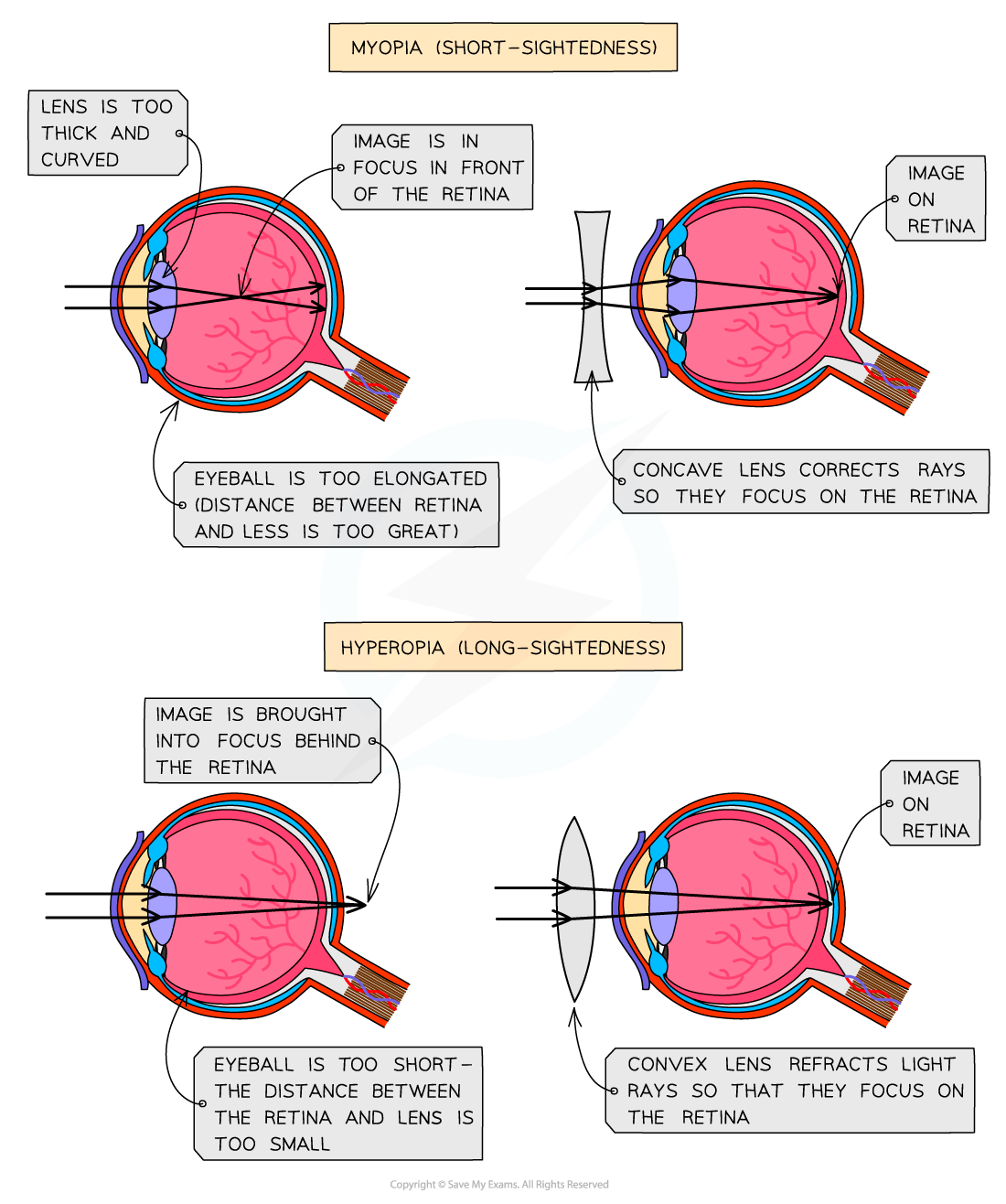
To solidify these concepts, please study the following brief text, which provides concise definitions and clear diagrams.
The following text from Lumen Learning concisely defines and illustrates myopia and hyperopia.
Read the sections titled 'The need for some type of vision correction...' and the text accompanying Figure 1. This will reinforce the definitions of nearsightedness (myopia) and farsightedness (hyperopia), and their relation to the far point and near point.
Here is a summary table for your quick reference:
| Feature | Myopia (Nearsightedness) | Hypermetropia (Farsightedness) |
|---|---|---|
| Symptom | Distant objects are blurry | Near objects are blurry |
| Cause | Eyeball is too long, or lens is too powerful (too convergent) | Eyeball is too short, or lens is too weak (not convergent enough) |
| Image Focus | In front of the retina | Behind the retina |
| Far Point | Less than infinity | At infinity |
| Near Point | Normal (25 cm) | Greater than 25 cm |
| Corrective Lens | Concave (Diverging) Lens | Convex (Converging) Lens |
| Lens Power | Negative (in Diopters) | Positive (in Diopters) |
Test your understanding!
An elderly person complains that they can see the mountains in the distance perfectly, but they have to hold their newspaper far away from their eyes to read it. What vision defect do they have, and what is the physical reason for their difficulty?
Show answer
The person has hypermetropia (farsightedness). The physical reason is that their eye's lens system does not have enough converging power to focus the divergent rays from the nearby newspaper onto their retina. The image is trying to form behind the retina.
Conclusion
Today we have built a solid conceptual understanding of the two most common vision defects.
Key Takeaways:
- Myopia (Nearsightedness): Caused by over-convergence of light, focusing the image in front of the retina. It is corrected with a concave (diverging) lens.
- Hypermetropia (Farsightedness): Caused by under-convergence of light, focusing the image behind the retina. It is corrected with a convex (converging) lens.
- The goal of any corrective lens is to form a virtual image at a point where the defective eye can see it clearly (i.e., at the eye's far point for myopia, or at its near point for hypermetropia).
Preview of the Next Lesson:
Now that we can describe these defects and their corrections conceptually, we are ready for the mathematical application. In our next lesson, we will learn how to calculate the power of corrective lenses required for vision correction. We will use the lens formula to solve numerical problems of the type you will encounter in the NEET exam.