Hello! Welcome to our lesson on analyzing systems of lenses.
In our last session, we mastered how to handle thin lenses placed in direct contact, combining them into a single equivalent lens with an effective focal length and power. The key principle was that the image formed by the first lens acts as the object for the second.
Today, we extend this principle to a more general and practical scenario: analyzing image formation for systems of lenses separated by a distance. This is the fundamental setup for real-world optical instruments like microscopes and telescopes. Your goal for this lesson is to master the step-by-step method to calculate the final image's position, nature, and magnification for any two-lens system. This is a critical skill for your NEET preparation.
1. The Method: Breaking It Down
The strategy for separated lenses is the same as for lenses in contact: we treat it as a sequence of two single-lens problems. The crucial difference lies in how we calculate the object distance for the second lens.
The general procedure is:
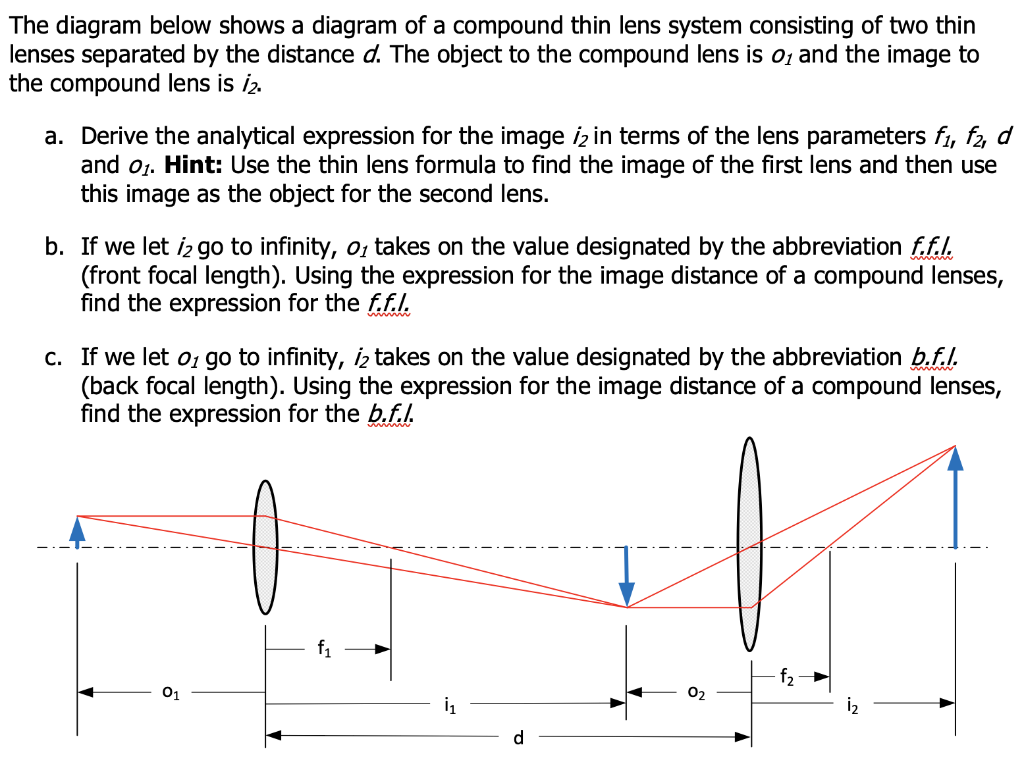
- Solve for Lens 1: Ignore the second lens completely. Use the thin lens formula to find the position () and magnification () of the image () formed by the first lens ().
- Transition to Lens 2: This image, , now becomes the object () for the second lens ().
- Calculate the New Object Distance: If the distance between the lenses is , the object distance for the second lens () is calculated as:
Pay close attention to the signs here, as we'll see shortly. - Solve for Lens 2: With and the focal length , use the thin lens formula again to find the final image position () and magnification ().
- Find the Overall Magnification: The total magnification of the system is the product of the individual magnifications:
This process is summarized nicely in the following resource.
44.8 Image in Two-lens Systems
The article 'Image in Two-lens Systems' from Physics Bootcamp clearly outlines the procedure for analyzing lens combinations.
Please read the introduction and the 'Procedure' paragraph just under the main heading. This will reinforce the step-by-step method we just outlined.
The diagram below illustrates the key variables involved.
2. Worked Example: Two Converging Lenses
Let's see this method in action. The best way to learn is to watch a problem being solved from start to finish, including the ray tracing that you find helpful.
This video provides a clear, step-by-step solution for a system of two converging (convex) lenses.
Example: Two-Lens Imaging with converging lenses
This video from Jordan Edmunds Chetty provides an excellent walkthrough for a two-lens system. It perfectly demonstrates how to break the problem into two separate, manageable parts.
Watch the entire video (around 12 minutes). Pay close attention to these key moments: (01:19): How the problem is first treated as a single lens imaging problem. (06:35): The crucial calculation of the object distance for the second lens. (11:00): How the total magnification is calculated by multiplying the individual magnifications.
Summary of the video's method:
- Lens 1: Given cm and cm, the thin lens formula gives the intermediate image position cm. The magnification is . The image is real, inverted, and reduced.
- Lens 2: The lens separation is cm. The object distance for the second lens is cm.
- Final Image: With cm and cm, the thin lens formula gives the final image position cm. The magnification is .
- Total Magnification: .
The final image is upright (relative to the original object) and reduced. Since is positive, the final image is real.
3. A Crucial Case: The Virtual Object
What happens if the first lens would have formed its image behind the second lens? This occurs if .
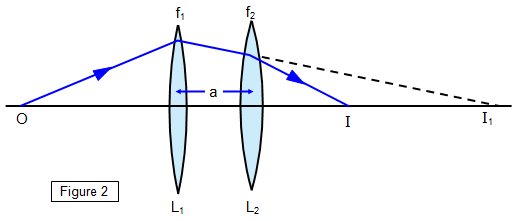
In this situation, the light rays hit the second lens before they have a chance to converge. The point where they would have converged becomes a virtual object for the second lens.
According to our sign convention (light travels left to right):
- Real objects (to the left of the lens) have positive object distances.
- Virtual objects (to the right of the lens) have negative object distances.
Let's apply our formula . If , the result for will be negative, which perfectly matches our sign convention for a virtual object.
The resource "Image in Two-lens Systems" has an excellent worked example of this scenario.
44.8 Image in Two-lens Systems
Let's examine a problem where a virtual object is created. This is a common scenario in more complex NEET problems.
Read 'Exercise 2. Image by Two Convex Lenses with Intermediate Image Behind Second Lens.' Follow the solution step-by-step. Notice how they calculate p_2 (which is our u_2) as -(|q_1| - d), which results in a negative object distance.
Analysis of the example:
- Lens 1: cm, cm. This gives an image at cm.
- Lens 2: The lens separation is cm.
- Object for Lens 2: The intermediate image at 40 cm is far behind the second lens at 5 cm. So, we have a virtual object.
cm. The negative sign correctly indicates a virtual object. - Final Image: Using cm and cm, the final image is formed at cm. The final image is real.
Test your understanding!
A converging lens with cm is placed 5 cm in front of a diverging lens with cm. An object is placed 20 cm in front of the converging lens. Where is the final image?
Show answer
-
Lens 1 (Converging):
cm, cm.
.
So, cm. -
Object for Lens 2 (Diverging):
The lens separation is cm.
The object for lens 2 is at cm. It's a virtual object. -
Lens 2 (Diverging):
cm, cm.
.
So, cm.
The final image is formed 6 cm to the left of the diverging lens. Since is negative, the image is virtual.
4. Application to NEET Problems: The Astronomical Telescope
Your ability to analyze two-lens systems is directly tested in questions about instruments like telescopes. Let's look at a previous year's question.
NEET 2016 Question:
An astronomical telescope has an objective and eyepiece of focal lengths 40 cm and 4 cm respectively. To view an object 200 cm away from the objective, the lenses must be separated by a distance...
(a) 46.0 cm
(b) 50.0 cm
(c) 54.0 cm
(d) 37.3 cm
Analysis and Solution:
This is a two-lens system problem. Lens 1 is the objective, and Lens 2 is the eyepiece. We need to find the distance between them, .
-
Objective Lens (Lens 1):
- Object distance, cm.
- Focal length, cm.
- Find the image position formed by the objective.
The objective lens forms a real, inverted image 50 cm away from it.
-
Eyepiece Lens (Lens 2):
- This image at 50 cm becomes the object for the eyepiece.
- For a telescope in "normal adjustment" (viewing with a relaxed eye), the final image is formed at infinity. This happens when the object for the eyepiece is placed exactly at its focal point.
- Therefore, the image from the objective must form at the focal point of the eyepiece.
-
Separation Distance (d):
- The distance between the lenses, , must be the sum of the objective's image distance and the eyepiece's focal length.
- The distance between the lenses, , must be the sum of the objective's image distance and the eyepiece's focal length.
The correct answer is (c) 54.0 cm. You can find this question and solution in the provided resource LINK, section "2016", Q6/Q7.
Conclusion
You have now extended your skills from lenses in contact to the more general and powerful case of lenses separated by a distance. This is the final piece of the puzzle before we start building and analyzing real optical instruments.
Key Takeaways:
- The analysis of a two-lens system is a two-step process: solve for the first lens, then use its image as the object for the second.
- The object distance for the second lens is critically dependent on the lens separation, , and is given by .
- Be vigilant for virtual objects, which occur when . In this case, will be negative.
- The total magnification of the system is the product of the individual magnifications ().
Preview of the Next Lesson:
With the tools from today's lesson, we are fully equipped to understand how optical instruments work. In our next session, we will start by analyzing the working principle and calculating the angular magnification of a simple microscope, putting our knowledge of image formation to practical use.