Hello! Let's dive into today's lesson.
In our last session, we established the fundamental principles of standing waves. We saw that they are formed by the superposition of two identical waves traveling in opposite directions and are characterized by nodes (points of no motion) and antinodes (points of maximum motion). The most important takeaway was that these waves can only exist at specific resonant frequencies, which are dictated by the boundaries of the medium.
Today, we will apply that core concept to analyze the specific systems that are central to your NEET syllabus. Our learning outcome is to analyze standing waves on strings and in air columns (open/closed pipes) to find their normal modes. We will derive the precise mathematical formulas for the series of allowed frequencies (harmonics) for each system and, as you've requested, focus on applying these formulas to solve problems.
1. Standing Waves on a Stretched String
This is the classic example, relevant to instruments like guitars, violins, and sonometers. Consider a string of length that is fixed at both ends (e.g., nailed down).
Boundary Conditions and Visualizing Harmonics
Since the ends are fixed, they cannot oscillate. Therefore, for any standing wave on this string, the two ends must be nodes. This is the fundamental boundary condition that determines which wavelengths, and thus which frequencies, are allowed.
Let's start by visualizing how waves can fit onto this string while obeying this rule.
Standing waves on strings | Physics | Khan Academy
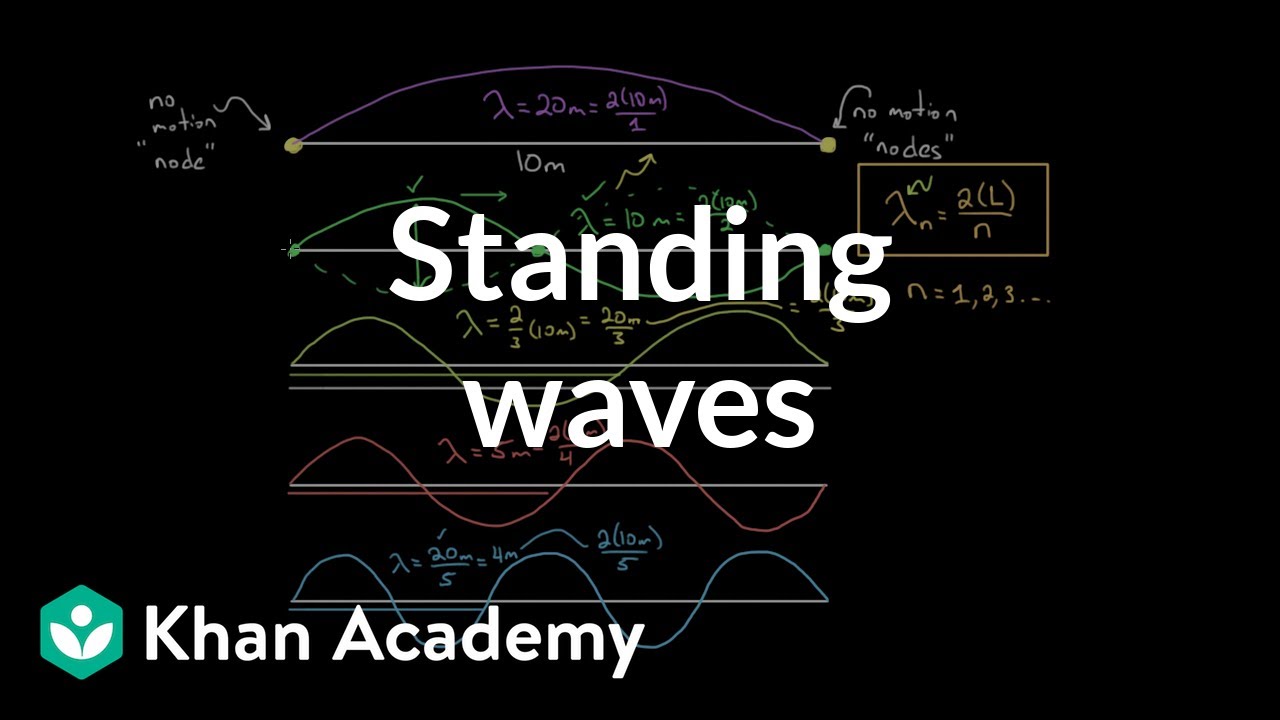
The following video from Khan Academy provides an excellent visual demonstration of how to 'draw' the possible standing waves on a string fixed at both ends.
Watch the segment from 03:52 to 06:22. Focus on how the shapes of the first three 'harmonics' are constructed to ensure there is a node at each end.
As you saw, the allowed wave patterns, or normal modes of vibration, look like this:
Mathematical Analysis
Now, let's translate these visual patterns into mathematical formulas.
-
Fundamental (First Harmonic, n=1): This is the simplest mode. It consists of a single loop. The length of the string contains exactly half of a full wavelength.
-
Second Harmonic (n=2): This mode has two loops. The length of the string contains exactly one full wavelength.
-
Third Harmonic (n=3): This mode has three loops. The length of the string contains one and a half wavelengths.
Seeing the pattern, we can write the general formula for the allowed wavelengths :
This gives us the possible wavelengths:
To find the allowed frequencies (the normal modes), we use the wave speed equation , which gives .
Key Terminology for NEET:
- Harmonics: The allowed frequencies are called harmonics. is the 1st harmonic, is the 2nd harmonic, and so on. For a string fixed at both ends, all harmonics () are present.
- Fundamental Frequency (): The lowest allowed frequency (), given by .
- Overtones: These are the harmonics with frequency greater than the fundamental. The first overtone is the second harmonic (), the second overtone is the third harmonic (), and so on. The -th overtone corresponds to the -th harmonic.
For a deeper dive into the derivation and terminology, you can refer to the NCERT textbook.
The NCERT textbook provides a formal derivation of the normal modes for a stretched string. This will reinforce the formulas we just developed.
Read the section titled 'Standing Waves and Normal Modes', starting from the paragraph that begins 'Eq. (14.38) can be applied to the case of a stretched string...' until the end of that subsection (before the example). This corresponds to pages 291-292.
Test your understanding!
A string of length 1 m has a wave speed of 60 m/s. What is its fundamental frequency?
Show answer
The fundamental frequency corresponds to n=1. The formula is .
Plugging in the values:
This is question 16 from Exercise 1 in the Disha Publication notes (LINK).
2. Standing Waves in Air Columns (Organ Pipes)
Just like waves on a string, sound waves can form standing waves inside a column of air, such as in a flute or an organ pipe. The analysis is very similar, but the boundary conditions are different.
- A closed end of a pipe is a rigid barrier where air molecules cannot oscillate. It must be a displacement node.
- An open end of a pipe is open to the atmosphere, allowing maximum freedom of movement for the air molecules. It must be a displacement antinode.
Case A: Pipe Closed at One End, Open at the Other
Consider a pipe of length closed at and open at .
- Boundary Conditions: Node at the closed end, Antinode at the open end.
Let's visualize the modes:
- Fundamental (n=1): The simplest pattern that fits is a single quarter-wavelength.
- Next Mode (First Overtone): The next pattern must also have a node at the closed end and an antinode at the open end. This fits three quarter-wavelengths.
- Second Overtone: The next pattern fits five quarter-wavelengths.

The general formulas for a closed pipe are:
Allowed Wavelengths:
Allowed Frequencies:
Crucial Point: Notice that can only take odd integer values.
This means a pipe closed at one end produces only odd harmonics.
- Fundamental (1st harmonic):
- First Overtone (3rd harmonic):
- Second Overtone (5th harmonic):
Case B: Pipe Open at Both Ends
Consider a pipe of length open at both ends.
- Boundary Conditions: Antinode at both ends.
The allowed modes are:
- Fundamental (n=1): The simplest pattern is half a wavelength between the two antinodes.
- First Overtone (n=2): The next mode fits one full wavelength.
The general formulas are:
Allowed Wavelengths:
Allowed Frequencies:
Crucial Point: Here, can be any positive integer.
This means a pipe open at both ends produces all harmonics, just like a string fixed at both ends.
Summary and Problem Practice
The following resource provides a fantastic summary of the organ pipe formulas and includes worked examples. The table comparing the modes of vibration is particularly useful for quick revision.
Concept Notes on Waves for NEET
These concept notes from Disha Publication clearly lay out the formulas for open and closed pipes. Pay close attention to the worked examples and the comparison table.
First, read the section 'Stationary Waves in an Organ Pipe' (page 323). Then, review the 'Comparative Study' table on page 324, which contrasts strings, open pipes, and closed pipes. Finally, analyze Example 11 on page 324, which is a typical NEET-style comparison problem.
Now, let's tackle a problem that requires you to use these formulas together.
Test your understanding! (NEET-Style Problem)
A closed organ pipe and an open organ pipe have their first overtones identical in frequency. What is the ratio of their lengths?
Show answer
Let be the length of the closed pipe and be the length of the open pipe. Let be the speed of sound.
-
First overtone of the closed pipe:
In a closed pipe, only odd harmonics are present. The fundamental is the 1st harmonic. The first overtone is the 3rd harmonic. -
First overtone of the open pipe:
In an open pipe, all harmonics are present. The fundamental is the 1st harmonic. The first overtone is the 2nd harmonic. -
Equate the frequencies:
The problem states these frequencies are identical.
Cancel from both sides: -
Find the ratio:
We need to find the ratio of their lengths. Let's find .
So, the ratio of the length of the closed pipe to the open pipe is 3:4. The question is a bit ambiguous, but this is a standard interpretation. If it asked for open to closed, the ratio would be 4:3.
This is similar to question 17 from Exercise 1 in the Disha notes.
To see more complex problems solved step-by-step, the following video is an excellent resource.
Standing Waves on a String, Fundamental Frequency, Harmonics, Overtones, Nodes, Antinodes, Physics
The Organic Chemistry Tutor channel provides numerous worked examples. Watching one of these can solidify your problem-solving process.
Watch the multi-part problem starting at 24:56. It's a comprehensive example that involves calculating length, tension, and wave speed, connecting many concepts together.
Conclusion
Today we have built upon the general theory of standing waves and derived the specific, practical formulas for the normal modes of strings and air columns. These are essential tools for your NEET preparation.
Key Takeaways:
- Boundary Conditions are Key: The first step is always to identify whether the ends are nodes (fixed string, closed pipe) or antinodes (open pipe).
- String (fixed at both ends): Produces all harmonics.
- Pipe (open at both ends): Also produces all harmonics.
- Pipe (closed at one end): Produces only odd harmonics.
- Overtones vs. Harmonics: Be precise with terminology. The first overtone is the next possible frequency above the fundamental, which is the 2nd harmonic for open pipes/strings but the 3rd harmonic for closed pipes.
Preview of the Next Lesson:
In all of our calculations today, we've taken the wave speed, , as a given value. But what determines the speed of sound in a gas, or the speed of a wave on a string? In our next lesson, we will delve into the factors that affect wave speed, such as the tension and linear density of a string, and the temperature and molar mass of a gas. This will add another layer to the problems you can solve.