Hello! Welcome back to our study of Ray Optics.
In our last lesson, we focused on the mathematics of light bending at a single curved surface. We derived the formula and saw how the image from one surface can act as the object for the next—a crucial skill for understanding lenses.
Today, we shift our focus to intensive problem-solving, which is at the heart of your NEET preparation. The learning outcome for this lesson is to solve a variety of NEET-style problems based on Snell's law and Total Internal Reflection (TIR). We will tackle problems that require not just formula application, but also geometric reasoning and a solid conceptual understanding of the conditions that govern refraction and reflection.
1. Recapping the Core Concepts: Snell's Law and TIR
Before we dive into complex problems, let's quickly refresh the two fundamental principles we'll be using today.
Snell's Law: At any interface between two media, the relationship between the angle of incidence () and the angle of refraction () is given by:
Total Internal Reflection (TIR): This phenomenon occurs only when two conditions are met:
- Light must travel from an optically denser medium to an optically rarer medium (i.e., ).
- The angle of incidence () must be greater than the critical angle ().
The critical angle is the specific angle of incidence for which the angle of refraction is 90°. It can be calculated using Snell's law:

To start, let's watch a short video that walks through the calculation of the critical angle in a few common scenarios. This will warm up our problem-solving mindset.
Total Internal Reflection of Light and Critical Angle of Refraction Physics
The video 'Total Internal Reflection of Light and Critical Angle of Refraction Physics' by The Organic Chemistry Tutor provides a clear explanation and worked examples for calculating the critical angle. It's a great warm-up.
Please watch from 04:23 to 08:20. Focus on: The definition of the critical angle (when the refracted angle is 90°). The setup of Snell's law to solve for the critical angle for the air-water interface.
2. Solving Multi-Step Refraction Problems
NEET problems rarely involve a single, simple application of a formula. They often present scenarios with multiple layers or complex geometries. The key is to apply Snell's Law systematically at each interface.
Snell's Law & Index of Refraction Practice Problems - Physics
Let's now watch some worked examples from 'Snell's Law & Index of Refraction Practice Problems - Physics'. This video demonstrates how to handle more complex situations, which is excellent practice for the NEET.
Please watch from 08:08 to 17:58. Pay close attention to two key problems: Multi-layer Refraction (08:08 - 14:08): Notice the shortcut for parallel layers: n_1 \sin heta_1 = n_{final} \sin heta_{final}. The middle layers don't affect the final angle of refraction if the first and last media are the same. Complex Geometry (14:08 - 17:58): This problem is crucial. It shows how geometry (identifying a right-angled triangle and complementary angles) is essential to find the angle of incidence at the second interface. This combination of physics and geometry is very common in competitive exams.
Worked Example: A Classic NEET-style Problem
Let's apply these strategies to a typical problem that combines Snell's Law and TIR.
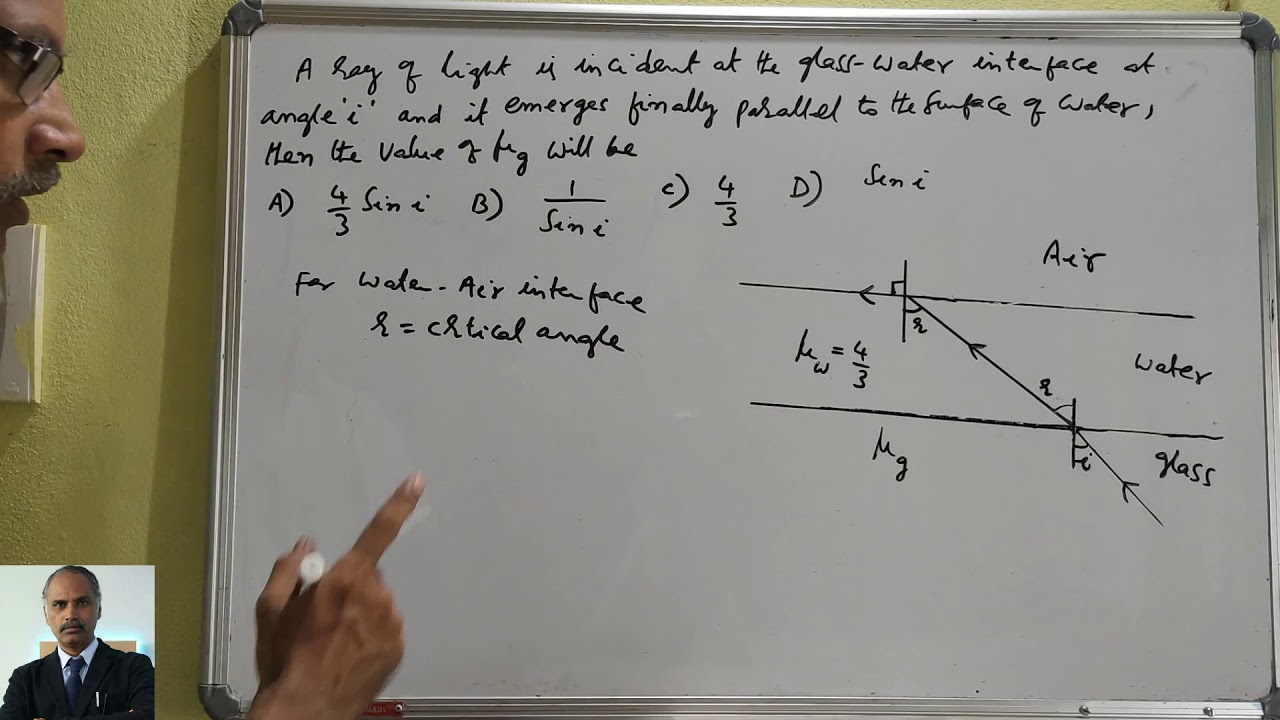
Strategy: Work backwards from the known information.
-
Analyze the water-air interface: The ray "emerges parallel to the surface," which means the angle of refraction in air is 90°. This tells us the angle of incidence in the water is the critical angle, , for the water-air interface.
-
Calculate the critical angle :
Using Snell's Law for the water-air interface: -
Use geometry to relate the angles: Look at the diagram. The refracted ray from the first surface becomes the incident ray for the second. The angle of refraction at the glass-water interface is . From the right-angled triangle formed by the ray, the normal, and the horizontal surface, we can see that and are alternate interior angles. Therefore, .
-
Apply Snell's Law at the glass-water interface:
Now we can analyze the first boundary. The angle of incidence is given as . The angle of refraction is , which we now know is equal to .
The problem statement in the image implies the incident angle is such that . Let's assume the question meant the angle of incidence inside the glass onto the glass-water interface isi(this is a common ambiguity in diagrams, but let's follow the ray path shown). The ray enters glass, hits the glass-water interface at anglei, refracts at anglerinto the water, and then hits the water-air interface at angleC. From the diagram's geometry, the angle of incidence at the glass-water interfaceiis the same as the critical angleC. This seems to be a slight mislabeling in the diagram text vs the drawing. Let's re-interpret based on a more standard problem type.Let's assume the angle of incidence at the first (air-glass, not shown) interface creates the ray inside the glass. This ray hits the glass-water interface at an angle we'll call . It refracts into the water at an angle . This ray then hits the water-air interface at the critical angle . From the geometry with parallel interfaces, .
Let's re-examine the image text: "A ray of light is incident at an angle
ion the glass-water interface...". This clarifies things.iis the angle in the glass.- Angle of incidence in glass =
- Angle of refraction in water = (from diagram geometry, )
Applying Snell's Law at the glass-water interface:
We already found .
The question has a missing piece of information, which is the value ofi. However, looking at the provided options, this structure is common. Often, the problem implies a specific value fori, such as 30°, 45°, or 60°. If we assume , then . If , . Let's check the likely answer. Given the context of TIR problems, a common value for is often related to the refractive indices. The solution in the image itself has(μg) sin i = (μw) sin r. If we assume the angleiin the diagram is what is intended, and from the geometryr = C, then(μg) sin i = (μw) sin C. Sinceμw sin C = μair sin 90 = 1, it simplifies toμg sin i = 1. This leads back toμg = 1/sin(i). A common setup is a right-angled prism, whereimight be 45 degrees. Let's assume that was the implicit condition.
This exercise shows how crucial it is to dissect a problem: identify all interfaces, apply the correct laws, use geometry, and work step-by-step.
3. Vigorous Practice: NEET Problem Drill
As you requested, here is a vigorous drill with questions mirroring the style and difficulty of the NEET exam. Attempt to solve these problems on your own first.
I have selected them from the resources Problems on Ray Optics... (Disha Publication) and NEET Previous Year Questions... (Edurev).
Problem Drill (20 Minutes)
Question 1 (Conceptual Application)
A ray of light from a denser medium strikes a rarer medium at an angle of incidence . The reflected and refracted rays make an angle of 90° with each other. The angles of reflection and refraction are and . The critical angle is:
(a)
(b)
(c)
(d)
(This is Q82 from resource LINK)
Question 2 (Numerical Application)
Two transparent media A and B are separated by a plane boundary. The speed of light in those media are 1.5 × 10⁸ m/s and 2.0 × 10⁸ m/s, respectively. The critical angle for a ray of light for these two media is:
(a)
(b)
(c)
(d)
(This is Q5 from the 2022 section of resource LINK)
Question 3 (Wavelength Dependence)
A beam of light consisting of red, green and blue colours is incident on a right-angled prism. The refractive indices of the material of the prism for the red, green and blue wavelengths are 1.39, 1.44 and 1.47, respectively. The prism will:
(a) separate the blue colour part from the red and green colours
(b) separate all the three colours from one another
(c) not separate the three colours at all
(d) separate the red colour part from the green and blue colours
(This is Q3 from the 2016 section of resource LINK)
Question 4 (Assertion-Reason)
Assertion: Critical angle is minimum for violet colour.
Reason: Because critical angle and .
(a) Assertion is correct, reason is correct; reason is a correct explanation for assertion.
(b) Assertion is correct, reason is correct; reason is not a correct explanation for assertion.
(c) Assertion is correct, reason is incorrect.
(d) Assertion is incorrect, reason is correct.
(This is Q93 from resource LINK)
Hints & Answers
Answer 1: (b)
Hint: From the law of reflection, . The problem states that the reflected and refracted rays are perpendicular, so . This means , or . Now apply Snell's Law () and the formula for critical angle (). Combine them to find in terms of . The solution is explained in resource LINK under section "DIAGRAM TYPE QUESTIONS", answer 82.
Answer 2: (a)
Hint: First, identify the denser and rarer medium. The medium with the lower speed of light is denser. TIR happens when light goes from denser to rarer. Use the formula to find the refractive indices, then use . The solution is available in resource LINK under the 2022 section.
Answer 3: (d) separate the red colour part from the green and blue colours
Hint: The light is incident normally on the first face, so it passes undeviated and strikes the hypotenuse at an angle of incidence of 45°. Calculate the critical angle for each color using . Compare the 45° angle of incidence with the critical angle for each color. If , TIR occurs. You will find that TIR occurs for green and blue, but not for red. The full solution is in resource LINK under the 2016 section.
Answer 4: (a) Assertion is correct, reason is correct; reason is a correct explanation for assertion.
Hint: The reason provides the two key relationships. Wavelength of violet light is the shortest (). Since , violet light has the highest refractive index (). Since , a larger means a smaller critical angle. Therefore, the critical angle for violet is the minimum. The reason perfectly explains the assertion. The solution is available in resource LINK under section "ASSERTION-REASON TYPE QUESTIONS", answer 93.
Conclusion
Today, we've transitioned from learning concepts to applying them in an exam-oriented context. You've tackled a variety of problems on Snell's Law and Total Internal Reflection, sharpening the analytical and mathematical skills you'll need for NEET.
Key Takeaways:
- Systematic Approach: For any problem, first identify the media and interfaces. Apply Snell's Law at each boundary.
- Geometry is Key: Many problems require you to use geometry (e.g., properties of triangles, parallel lines) to determine angles of incidence and refraction.
- Check for TIR: Whenever light travels from a denser to a rarer medium, always check if the angle of incidence exceeds the critical angle.
- Wavelength Matters: Refractive index () depends on wavelength (). Specifically, . This means the critical angle also depends on color: . This is a frequent source of conceptual questions.
Preview of the Next Lesson:
Our intensive work with Snell's law and geometric interfaces today has perfectly prepared us for our next topic: prisms. In the next lesson, you will learn to trace the path of a ray through a prism and analyze the angle of deviation. You'll see that a prism is essentially a system with two non-parallel interfaces, and the skills you've honed today will be directly applicable. We will then formalize the relationship between the prism angle, deviation, and refractive index.