Hello! Welcome to the next lesson in our journey through Ray Optics.
In our last lesson, we focused on monochromatic light (light of a single color) and derived the prism formula for minimum deviation. We assumed the refractive index, , was a single, constant value for the prism material. Today, we'll explore what happens when this assumption is challenged by using white light, which is a mixture of many different colors.
This leads us directly to our learning outcome: to explain the phenomenon of dispersion of light through a prism. We will uncover why a prism can split sunlight into a beautiful rainbow of colors.
1. What is Dispersion?
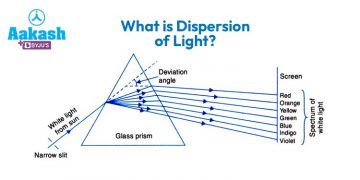
You have almost certainly seen a rainbow or the colorful patterns created when light passes through a crystal. This splitting of white light into its constituent colors is called dispersion. A prism is the classic tool for demonstrating this effect.
To begin, let's watch a short video that introduces the concept visually and connects it to real-world phenomena like rainbows.
Ray optics L5 🔍 Prism, dispersion & combination |One Shot Marathon | Class 12 JEE 2022 | Shreyas sir
This video from Vedantu JEE English provides a great visual introduction to dispersion, showing how white light spreads into different colors when passing through a prism.
Watch the segment from 01:00:40 to 01:05:34. Focus on the definition of dispersion and the examples provided. Note which color is on top and which is at the bottom of the spectrum.
As the video and diagram show, when white light passes through a prism, it separates into a band of colors called a spectrum. The order of colors is famously remembered by the acronym VIBGYOR: Violet, Indigo, Blue, Green, Yellow, Orange, Red.
But why does this happen? Why do different colors follow different paths?
2. The Fundamental Cause: Wavelength-Dependent Refractive Index
The key to understanding dispersion lies in a fundamental property of matter: the refractive index () of a medium is not a constant value; it depends on the wavelength () of the light passing through it.
Different colors of light correspond to different wavelengths. In the visible spectrum, red light has the longest wavelength (~700 nm) and violet light has the shortest wavelength (~400 nm).
The following video provides an excellent and clear explanation of this core principle.
Dispersion | Geometric optics | Physics | Khan Academy
This Khan Academy video explains the fundamental reason for dispersion: the refractive index is a function of wavelength.
Watch the entire clip from 00:00:23 to 00:02:12. Pay close attention to the relationship it describes between wavelength and the refractive index, and consequently, the amount of bending (refraction).
To summarize the crucial point from the video:
- For most transparent materials like glass, the refractive index increases as the wavelength of light decreases.
- This means: .
- The refractive index for violet light () is greater than the refractive index for red light ().
This relationship is described empirically by Cauchy's formula, which gives a mathematical connection between refractive index and wavelength.
Prism - Study Material for IIT JEE
This resource from askIITIans provides the mathematical formulation for the relationship between refractive index and wavelength, known as Cauchy's formula.
Read the subsection titled "Reason for Dispersion". You don't need to memorize the formula itself, but understand what it represents: \mu is inversely related to \lambda.
Cauchy's formula is generally written as:
where A, B, and C are constants for the material. For our purposes, the important takeaway is the inverse relationship: as increases, decreases.
3. Linking Refractive Index to Deviation
Now we can connect all the pieces. In our previous lessons, we established that the angle of deviation () depends on the refractive index ().
Let's recall the formula for the deviation through a thin prism (where the prism angle is small):
This simple formula makes the relationship crystal clear:
- A larger refractive index () results in a larger angle of deviation ().
Combining this with what we just learned about the wavelength dependence of :
- Violet light has a shorter wavelength ().
- Therefore, it experiences a higher refractive index ().
- A higher refractive index leads to a greater angle of deviation ().
The opposite is true for red light:
- Red light has a longer wavelength ().
- Therefore, it experiences a lower refractive index ().
- A lower refractive index leads to a smaller angle of deviation ().
Conclusion:
This is precisely why the prism separates the colors. Each color component of the incident white light is bent by a slightly different amount, with violet light bending the most and red light bending the least.
Test your understanding!
A ray of white light, incident upon a glass prism, is dispersed into its various color components. Which one of the following colors experiences the greatest amount of deviation?
(a) Orange
(b) Violet
(c) Red
(d) Green
Show answer
Answer: (b) Violet
Reasoning:
- The angle of deviation increases as the refractive index increases.
- The refractive index increases as the wavelength decreases.
- Of the colors listed, violet has the shortest wavelength.
- Therefore, violet light experiences the highest refractive index and undergoes the greatest amount of deviation.
Conclusion
In this lesson, we demystified the phenomenon of dispersion. We moved from simply observing it to understanding the chain of cause and effect that produces it.
Key Takeaways:
- Dispersion is the splitting of white light into its constituent colors (spectrum).
- The cause of dispersion is that the refractive index () of a material depends on the wavelength () of light.
- For visible light in glass, shorter wavelengths (like violet) have a higher refractive index than longer wavelengths (like red).
- Since the angle of deviation () increases with the refractive index, violet light deviates the most, and red light deviates the least.
Preview of the Next Lesson:
Now that you can explain dispersion, our next step, crucial for your NEET preparation, is to quantify it. We will introduce two important concepts: angular dispersion (the angle separating the extreme colors of the spectrum) and dispersive power (an intrinsic property of the prism's material that measures its ability to cause dispersion). We will derive the formulas for these quantities and solve numerical problems.