Hello! Welcome to the next lesson in our study of wave optics.
In our last few lessons, we have explored the phenomenon of interference in great detail, focusing on Young's double-slit experiment and thin films. You've become proficient in solving NEET-style problems related to fringe patterns and path differences. We concluded by noting that interference isn't the only way waves create complex patterns.
Today, we introduce a closely related but distinct phenomenon: diffraction. Our goal is to distinguish between interference and diffraction. We'll start by understanding what diffraction is, and then we will systematically compare the causes and resulting patterns of both phenomena. This distinction is a fundamental concept in wave optics and is frequently tested in competitive exams.
1. What is Diffraction? The Bending of Light
You've learned that light travels in straight lines. This is a very useful approximation, but it's not the whole story. When light encounters a very small obstacle or passes through a narrow opening, it has a tendency to bend around the edges. This phenomenon is called diffraction.
To get an intuition for this, let's start with some real-world examples and a helpful analogy.
Diffraction and interference of light | Physics | Khan Academy
This video from Khan Academy provides an excellent conceptual introduction to diffraction. It starts with intriguing visual examples and then uses the analogy of water waves to explain why light bends.
Please watch the video from the beginning until 09:21. Focus on these key points: Observing Diffraction (00:00 - 02:16): Notice the examples like the streaks on stars from telescopes or the pattern created by a hair strand in a laser beam. These are results of diffraction. Water Wave Analogy (02:16 - 05:34): Pay close attention to how water waves bend around islands. This is the core idea of diffraction. The video clearly distinguishes this from refraction. The Role of Wavelength (05:34 - 09:21): Understand why we don't notice diffraction in everyday life. The effect is only significant when the size of the obstacle is comparable to the wavelength of the light.
From the video, we can establish a clear definition:
Diffraction is the bending or spreading out of waves as they pass through a narrow aperture or around the edges of an obstacle.
A crucial takeaway is that the significance of diffraction depends on the ratio of the wavelength to the size of the obstacle or aperture . Diffraction effects become noticeable when is not negligibly small. This is why we don't see a book cast a blurry, diffracted shadow under a lamp—the book is vastly larger than the wavelength of visible light.
2. The Fundamental Difference: Source of Superposition
At first glance, the patterns created by diffraction (like the one from the hair strand in the video) look similar to the interference patterns from a double slit. Both show alternating bright and dark regions. This is because both patterns are ultimately caused by the superposition of waves.
The key difference lies in where the superposing waves originate.
- Interference: The pattern is formed by the superposition of waves from two or more distinct, coherent sources. In Young's double-slit experiment, the two slits act as these two separate sources.
- Diffraction: The pattern is formed by the superposition of secondary wavelets originating from different points of the same wavefront. According to Huygens' principle, every point on a wavefront can be considered a source of secondary wavelets. When the wavefront is obstructed (e.g., by a slit), these wavelets spread out and interfere with each other.
A concise summary of this distinction is provided in the resource below.
Wave Optics Notes for NEET Physics Revision [PDF]
The revision notes from Vedantu contain a section on diffraction that includes a very direct and useful summary of the difference between interference and diffraction.
In this document, find the section titled 'Important Points'. Read the last bullet point in that section, which starts with 'The distinction between interference and diffraction is...'.
This is the most fundamental difference: Interference is the interaction between multiple wavefronts, while diffraction is the self-interaction of a single wavefront.
3. Comparing the Resulting Patterns
Since the origins are different, the resulting patterns also have distinct characteristics. Let's compare the pattern from a double-slit (interference) with the pattern from a single slit (diffraction).
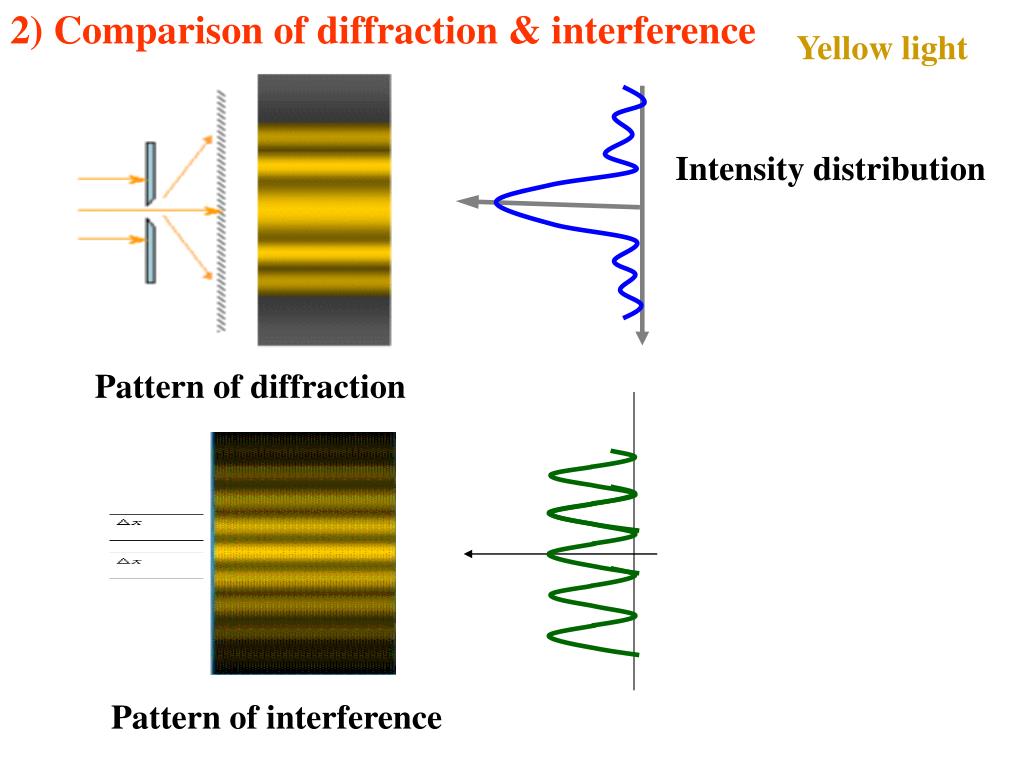
The image above reveals two major differences in the appearance of the fringes (the bright and dark bands):
-
Intensity of Fringes:
- In the interference pattern, all the bright fringes are (ideally) of the same intensity.
- In the diffraction pattern, there is a very bright central maximum, and the secondary maxima on either side are much less intense and their intensity falls off rapidly.
-
Width of Fringes:
- In the interference pattern, all the bright and dark fringes are equally spaced and have the same width.
- In the diffraction pattern, the central bright fringe is twice as wide as the other secondary bright fringes.
These visual differences are a direct consequence of the underlying physics. To consolidate all the points of comparison, please study the following table.
Diffraction vs Interference: Key Differences Explained
This webpage from Vedantu provides a detailed comparison table that summarises all the key differences between diffraction and interference. This is extremely useful for quick revision and for answering 'compare and contrast' type questions in your exam.
Focus on the table under the heading 'Comparative View of Diffraction and Interference Phenomena'. Read through each point of comparison to build a comprehensive understanding of the differences.
Here is a summary of the most important distinctions from that table:
| Feature | Interference | Diffraction |
|---|---|---|
| Cause | Superposition of waves from 2 coherent sources. | Superposition of wavelets from the same wavefront. |
| Fringe Width | Fringes are of equal width. | Fringes are of unequal width. The central maximum is twice as wide as the secondary maxima. |
| Intensity | All bright fringes have the same intensity. | The central maximum is the most intense. The intensity of secondary maxima decreases rapidly. |
| Pattern | A large number of equally intense fringes. | A few bright fringes with decreasing intensity. |
| Zero Intensity | Points of minimum intensity are perfectly dark. | Points of minimum intensity are almost perfectly dark. |
Test your understanding!
You observe a pattern of bright and dark bands on a screen. You notice that all the bright bands appear to have the same brightness and are equally spaced. Are you more likely observing an interference pattern or a diffraction pattern? Why?
Show answer
You are more likely observing an interference pattern. The two key clues are that the bright bands have equal intensity and are equally spaced. These are the characteristic features of a pure interference pattern, such as one from a double-slit experiment. A diffraction pattern would have a very bright central maximum with much weaker and narrower secondary maxima.
4. Can They Occur Together?
A common point of confusion is whether interference and diffraction are mutually exclusive. They are not. In fact, in an experiment like Young's double-slit experiment, both phenomena occur simultaneously.
- Diffraction occurs at each of the two slits. The light passing through each slit spreads out.
- Interference then occurs between the two diffracted beams of light that overlap on the screen.
The resulting pattern is actually an interference pattern whose brightness is "modulated" by a diffraction pattern.
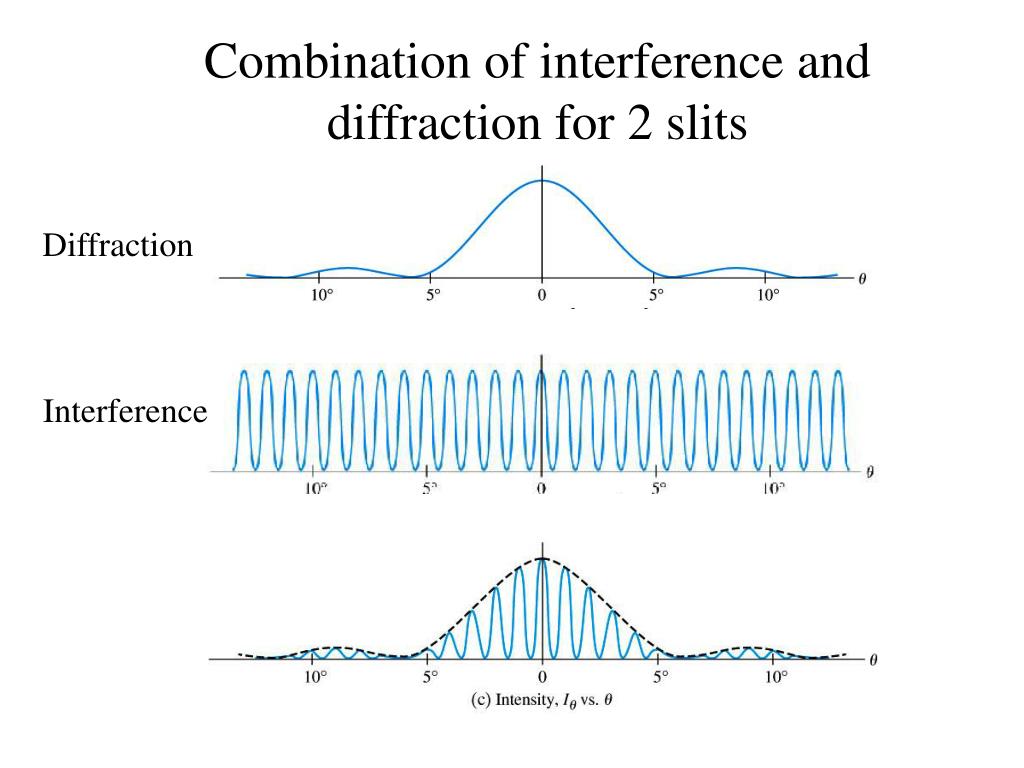
As you can see, the rapidly-spaced interference fringes are still present, but their overall brightness follows the much wider diffraction pattern. Some expected interference fringes might even be "missing" because they fall at a location where there is a diffraction minimum (a dark band in the diffraction pattern).
Conclusion
Today, you've learned to distinguish between two fundamental wave phenomena. While both arise from superposition, their origins and resulting patterns are distinct. Mastering these differences is key to a solid understanding of wave optics.
Key Takeaways:
- Diffraction is the bending of light around obstacles, significant when the obstacle's size is comparable to the light's wavelength.
- The core distinction is the source of superposition:
- Interference = Superposition of waves from two or more coherent sources.
- Diffraction = Superposition of wavelets from a single wavefront.
- The resulting patterns differ significantly:
- Interference fringes are of equal width and intensity.
- A diffraction pattern has a wide, very bright central maximum, with rapidly diminishing, narrower secondary maxima.
- In many experiments, like YDSE, both phenomena occur together, with the diffraction pattern acting as an "envelope" for the interference fringes.
Preview of the Next Lesson:
Now that you can conceptually distinguish diffraction from interference, our next step will be to analyze the diffraction pattern mathematically. We will focus on the single-slit diffraction pattern, deriving the conditions for its minima and calculating the width of the prominent central maximum. This will equip you with the formulas needed to solve numerical problems for your NEET preparation.