Hello! Welcome to the final lesson of our first module, "Foundations of Web Accessibility."
In our previous lessons, we've explored the "what," "who," and "why" of accessibility, culminating in our discussion of the legal and ethical obligations that drive this work. We established that creating accessible experiences is both a moral imperative and a legal requirement.
Today, we'll build on that foundation to address the learning outcome: to explain the business benefits of creating accessible websites and products. We will shift our focus from obligation to opportunity, exploring how accessibility is not a cost to be minimized, but a powerful investment that drives growth, enhances brand reputation, and improves the user experience for everyone.
From Obligation to Opportunity
Thinking about accessibility purely in terms of compliance can lead to a "checklist" mentality. The real magic happens when we see it as a strategic advantage. Let's start by establishing a framework for these benefits from the World Wide Web Consortium (W3C), the main international standards organization for the web.
The Business Case for Digital Accessibility
The W3C's Web Accessibility Initiative (WAI) has published an excellent overview of the business case for accessibility. We will read the introduction to establish the core pillars of the argument.
Please read the 'Summary', 'Is there a Business Case for Accessibility?', and 'Accessibility is good for business' sections. These will introduce the four key advantages we'll explore: Driving Innovation, Enhancing Brand, Increasing Market Reach, and Minimizing Legal Risk.
The W3C article provides a solid, authoritative framework. As it states, "Businesses that integrate accessibility are more likely to be innovative, inclusive enterprises that reach more people with positive brand messaging that meets emerging global legal requirements."
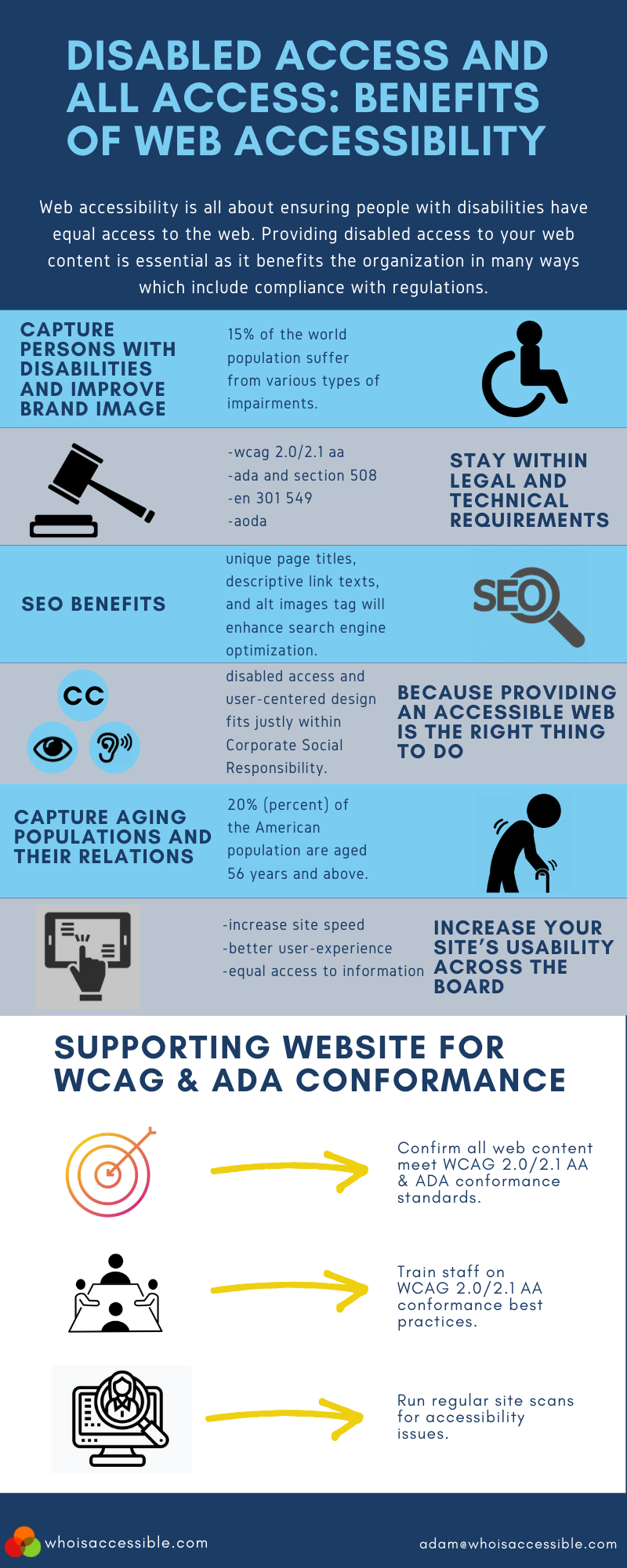
This infographic provides a great visual summary of these interconnected benefits.
Now, let's dive deep into the practical application of these ideas, using a resource that's particularly relevant to your work with WordPress and Elementor.
The Business Case in Action
The following article from the Elementor blog translates the high-level principles from the W3C into concrete, measurable business outcomes related to SEO, user experience, and conversions.
Why Accessibility Pays Off: The Business Case for ...
This article, 'Why Accessibility Pays Off: The Business Case for Inclusive Design', is perfectly aligned with our topic today. It breaks down the return on investment (ROI) of accessibility in a way that is highly relevant for web designers and developers.
We will read this article in sections. For now, please read the sections titled 'Accessibility as a Growth Strategy' and 'The Business ROI: Expanding Markets and Building an Unbeatable Brand'. Pay close attention to the statistics about market size and spending power.
1. Expand Your Market and Drive Revenue
As both articles highlight, the most direct business benefit is gaining access to a massive, underserved market.
- Market Size: Over 1.3 billion people globally live with a disability, with a combined disposable income exceeding $13 trillion. An inaccessible website effectively closes its doors to this market.
- The "Curb-Cut Effect": Features designed for people with disabilities often benefit everyone. Think of video captions, which help users in noisy environments, or high-contrast text, which is easier for anyone to read in bright sunlight.
- Direct ROI: Investing in accessibility isn't just about goodwill; it has a clear financial return.
This chart, based on a Forrester report, visualizes the potential return on investment.

The Elementor article also mentioned case studies, such as the Legal & General group, which saw a 90% increase in online quote requests after their accessibility-focused redesign. This demonstrates a direct link between accessibility and conversion.
2. Improve SEO and User Engagement
As a web designer, you're likely focused on metrics like search engine ranking, bounce rate, and time on page. Accessibility practices directly and positively impact all of these. Let's return to the Elementor article to see how.
Why Accessibility Pays Off: The Business Case for ...
Now let's explore the powerful connection between accessibility, SEO, and user experience.
Please read the sections 'Accessibility and SEO: The Same DNA' and 'Boosting Engagement: Better UX = Better Metrics'. Note how practices like using semantic HTML and alt text serve both screen reader users and search engine crawlers.
The key takeaway here is that accessibility best practices are SEO best practices.
- Semantic Structure: A logical heading hierarchy (
<h1>,<h2>, etc.) helps both screen reader users and Google understand your content's structure. - Alternative Text: Alt text makes images accessible to visually impaired users and provides crucial context for search engine image indexing.
- Descriptive Links: Clear link text like "Read our Q3 Financial Report" is far more useful to both screen reader users and search engines than a generic "Click Here."
These technical improvements lead to a better user experience for everyone, which in turn leads to better engagement metrics (lower bounce rates, longer sessions) that Google rewards with higher rankings.
3. Enhance Your Brand and Reduce Risk
In the last lesson, we discussed legal risk. Proactively addressing accessibility is the best way to mitigate this risk, saving potentially huge sums in legal fees and brand damage.
Beyond risk, a commitment to accessibility builds a powerful brand. It demonstrates Corporate Social Responsibility (CSR) and builds trust. The WAI article you read earlier highlighted Barclays Bank, which has made accessibility a core part of its brand identity, fostering an inclusive culture and improving its public perception.
Test your understanding!
Imagine you are pitching an accessibility audit to a small business owner who is skeptical about the cost. Their primary goal is to get more customers from Google searches. Based on what you've learned, which of the following is the strongest argument to convince them?
- "You could be sued under the ADA if your site isn't accessible."
- "It's the ethical thing to do for users with disabilities."
- "Many accessibility improvements, like proper headings and alt text for images, are also fundamental SEO best practices that will help Google better understand and rank your site."
- "An accessible site will improve your brand's reputation for social responsibility."
Show answer
The best answer is 3. While all the points are valid, this one directly connects accessibility to the client's stated goal (improving Google search traffic). It reframes accessibility not as an extra cost or a legal burden, but as an investment in a core business objective they already have. This is a key skill in advocating for accessibility in a professional context.
Conclusion
This lesson completes our journey through the foundations of web accessibility. We've moved from defining accessibility and understanding its users to exploring the ethical, legal, and now, the compelling business reasons for embracing it.
Here are your key takeaways:
- Accessibility is a Growth Strategy: It opens your products and services to a massive global market with significant spending power.
- It's an SEO Multiplier: The core practices of accessible web design—semantic structure, alt text, and clear navigation—are the same practices that improve search engine rankings.
- Better UX for Everyone: Accessible design removes friction, leading to lower bounce rates, longer user sessions, and higher conversion rates for all users.
- It Builds Trust and Reduces Risk: A proactive approach to accessibility enhances your brand's reputation for inclusivity and provides the best defense against legal challenges.
By seeing accessibility as an investment rather than an expense, you can create better products that serve more people and deliver superior business results.
Preview of the next lesson: With the "why" firmly established, we will begin Module 2, "Understanding WCAG and Core Principles." In our next lesson, we will demystify the structure of the Web Content Accessibility Guidelines (WCAG) and its conformance levels (A, AA, AAA), which serve as the technical blueprint for building the accessible experiences we've been discussing.