Introduction
In our last lesson, we explored how prospect theory shapes individual decision-making by incorporating the psychological weight of losses and gains relative to a reference point. This gave us a more realistic model of the payoffs in a negotiation. Now, we will zoom out from the individual to the collective. This lesson addresses how widespread relationship norms and strategies emerge, stabilize, or disappear within a community over time.
You will learn to model this process using replicator dynamics, a cornerstone of evolutionary game theory. We will move beyond static analysis to see how the frequency of different strategies—like approaches to communication or boundary setting—can evolve. This is directly relevant to your work, as it provides a framework for understanding why certain conventions become dominant in lifestyle communities, while others fade away. We will derive the core equations and apply them to a scenario, seeing how the payoffs individuals receive drive the evolution of the entire system.
From Biology to Culture: The Concept of Fitness
Evolutionary game theory was born from biology, but its "evolution" need not be genetic. It's a powerful tool for modeling cultural evolution, where strategies are passed on not through genes, but through learning, imitation, and social influence.
To begin, please read the following brief sections from the Stanford Encyclopedia of Philosophy's entry on Evolutionary Game Theory. They will set the stage by explaining this conceptual leap and defining what "fitness" means in a cultural context.
This article provides a rigorous philosophical and mathematical grounding for the topic.
First, read the introduction. It explains how the theory has been adapted from biology to the social sciences to model changes in beliefs and norms. Then, jump to section 6.1 to read about the meaning of fitness in cultural evolution. Focus on the idea that "fitness" doesn't have to mean biological reproduction; it can be any measure of success (satisfaction, emotional stability, desirability) that leads others to adopt a strategy.
In our context, a "fitter" relationship strategy is one that leads to more stable, satisfying, or desirable outcomes for the people using it. This success makes the strategy more likely to be observed and imitated by others in the community, causing its frequency to increase. This process of replication is the engine of norm evolution.
The following short video gives a high-level overview of this core idea.
This video from the Systems Innovation Network provides a concise, conceptual introduction to the replicator equation.
Watch the first two minutes, from the beginning up to the explanation of the model's primary elements. Note the central principle: the growth rate of a strategy's prevalence is equal to the difference between its average payoff and the average payoff of the population as a whole.
The Replicator Equation: The Engine of Evolution
Now, let's formalize this. The replicator dynamic is a mathematical model that describes how the proportion of each strategy in a population changes over time. Given your background in stochastic processes, you'll recognize this as a deterministic, continuous-time approximation of a more complex underlying process.
Let's consider a population where individuals can adopt one of two strategies, or .
- Let be the proportion of the population using strategy at time .
- The proportion using is then .
The "fitness" of a strategy is its expected payoff, given the current mix of strategies in the population.
- Let be the expected payoff for an individual using .
- Let be the expected payoff for an individual using .
The average fitness of the entire population, , is the weighted average of the fitness of each strategy:
The replicator equation states that the rate of change of the proportion of a strategy is proportional to the difference between that strategy's fitness and the average fitness of the population. For strategy , this is:
A strategy whose fitness is higher than the average will grow in prevalence (), while a strategy with below-average fitness will shrink ().
The following video provides an excellent, step-by-step derivation of the discrete-time version of this equation, which builds the intuition for the continuous-time model above.
How math brought revolution to evolution : Evolutionary Game Theory (Eng Sub) #SoME3
This video from the channel "Nature's Game" visually breaks down the logic behind the replicator equation.
Watch the segment from viability selection to the final form of the difference equation. This section clearly explains how the proportion of a trait in the next generation (p') depends on its current proportion (p), its fitness (W(A)), and the average fitness (\bar{w}).
For more rigorous work, especially with multiple strategies, it's useful to use a matrix-vector formulation. An introductory paper by Tim Rees presents this cleanly.
An Introduction To Evolutionary Game Theory
This paper provides a concise mathematical treatment of replicator dynamics.
Focus on the section "Replicator Dynamics". Read the subsection that defines the continuous time replicator dynamics for a symmetric game. Pay attention to the equation: \dot{x_i}(t) = x_i(t)(f_i(\vec{x}) - \bar{f}(\vec{x})) Here, x_i is the frequency of strategy i, f_i(\vec{x}) is its fitness (given by (A\vec{x})_i, the i-th row of the payoff matrix multiplied by the strategy vector), and \bar{f}(\vec{x}) is the average fitness (\vec{x}^T A \vec{x}). This is the multi-strategy version of the equation we just discussed.
Scenario: The Evolution of a Communication Norm
Let's apply this to a practical scenario. Imagine a nascent hotwife community where couples are figuring out the best way for the hotwife (let's call her Sarah) to communicate with her partner (David) about her experiences with a bull. Two dominant strategies emerge:
- "Full Disclosure" (FD): Sarah provides a detailed, unprompted account of her date. This strategy values transparency and sharing.
- "Discreet Summary" (DS): Sarah provides a brief summary and waits for David to ask for more details. This strategy values giving the partner space and control over information flow.
The "fitness" of each strategy depends on the preference of the partner. Let's assume the community is composed of couples where both partners have adopted the same preference for a communication style. We can represent the payoffs in a symmetric game matrix, where the payoff is the overall relationship satisfaction derived from the interaction.
| Partner prefers FD | Partner prefers DS | |
|---|---|---|
| Adopt FD | 4 | 0 |
| Adopt DS | 1 | 3 |
- FD meets FD (4): High satisfaction. Both partners want full disclosure and get it.
- DS meets DS (3): Good satisfaction. Both partners want discretion and get it.
- FD meets DS (0): Low satisfaction. The disclosing partner overwhelms the discreet one, causing anxiety.
- DS meets FD (1): Low satisfaction. The discreet partner frustrates the one who desires details, causing feelings of being left out.
Let be the proportion of the population that has adopted the "Full Disclosure" (FD) strategy. The proportion that has adopted "Discreet Summary" (DS) is .
The fitness (expected payoff) for each strategy is:
The average fitness of the population is:
The replicator dynamic for the "Full Disclosure" strategy is:
Analyzing the Dynamics: Finding the Norms
An equilibrium is a state where the population proportions are no longer changing, i.e., . This occurs when:
- : The entire population follows the "Discreet Summary" norm.
- : The entire population follows the "Full Disclosure" norm.
- and : There is a mix of strategies.
We have three equilibria: , , and . But which are stable? A stable equilibrium is one the system returns to after a small disturbance. An unstable one is a tipping point from which the system moves away.
We check the sign of around the mixed equilibrium :
- If (e.g., ), then is positive, so . The proportion of FD users will increase towards .
- If (e.g., ), then is negative, so . The proportion of FD users will decrease towards .
This tells us:
- (All "Discreet Summary") is a stable equilibrium. If a few FD adopters appear, their fitness will be lower than average, and the population will return to pure DS.
- (All "Full Disclosure") is a stable equilibrium. If a few DS adopters appear, they will be "outcompeted," and the population will return to pure FD.
- is an unstable equilibrium. It's a tipping point. If the population is slightly above 50% FD, it will avalanche towards 100% FD. If it's slightly below, it will collapse to 0% FD.
The final community norm depends entirely on which side of the 50% tipping point the community starts. The phase portrait below illustrates this dynamic. The horizontal axis represents , the proportion of one strategy. The arrows show the direction of evolution. The system flows away from the unstable equilibrium (open circle) and toward the stable ones (filled circles).

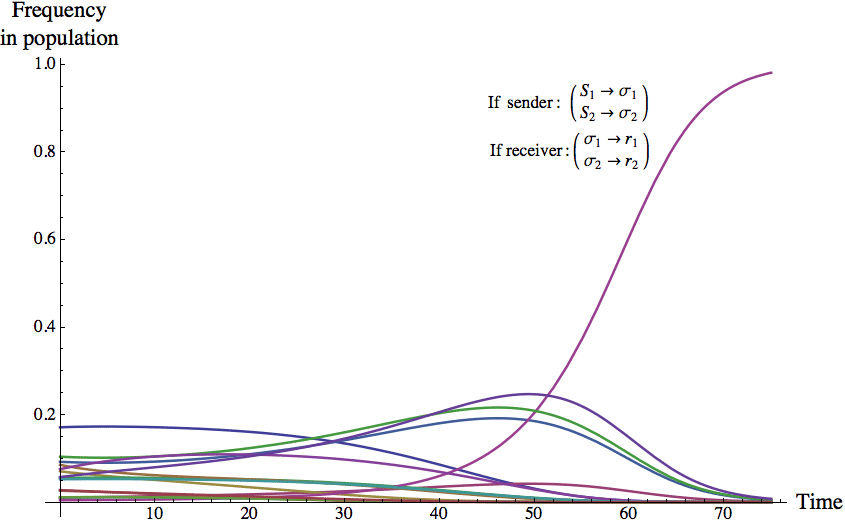
The result of this evolution over time is often an S-shaped curve, where a slightly more successful strategy slowly gains traction, hits a tipping point, and then rapidly takes over the population.
Conclusion
In this lesson, we bridged the gap from individual payoffs to population-level outcomes. You have seen how the simple principle of imitating success, when formalized as the replicator equation, can explain the emergence and stability of social norms. This dynamic modeling approach provides a powerful lens for understanding why certain rules and behaviors become entrenched in a community.
Key Takeaways:
- Replicator dynamics models cultural evolution by tracking the changing frequencies of strategies in a population.
- A strategy's frequency increases if its expected payoff (fitness) is higher than the population average, and decreases if it's lower.
- The core equation is , where is the proportion of strategy , is its fitness, and is the average fitness.
- Analyzing these dynamics allows us to identify stable equilibria (robust social norms) and unstable equilibria (societal tipping points).
Preview of the Next Lesson:
We have now explored conflict (Hawk-Dove), individual psychology (Prospect Theory), and the evolution of strategies in a population (Replicator Dynamics). But a community is not just a collection of strategies; it's a network of relationships. In our next lesson, we will begin our module on cooperative games and stability by examining how stable partnerships form in the first place. We will explore the Gale-Shapley algorithm, a classic tool for creating stable pairings in "two-sided matching markets," a model surprisingly well-suited to analyzing partner selection.