Welcome to the penultimate lesson of our course. Last time, we built a Monte Carlo simulation to forecast the long-term health of a single relationship, treating it as a dynamic system in isolation. We saw how different "rulesets" could be translated into model parameters to predict the probability of success or failure over time. However, couples do not exist in a vacuum. They are part of a larger community where behaviors are observed, successful strategies are copied, and social norms take shape.
Today, we shift our focus from the individual system to the collective. Your learning outcome is to use an agent-based model (ABM) to simulate the evolution of norms in a community of couples with different interaction strategies. We will move from a "top-down" model of a single entity to a "bottom-up" simulation of an entire artificial society. This will allow us to explore how macro-level social patterns—such as the prevailing attitudes towards openness, jealousy, or conflict within the hotwife community—can emerge from the simple, micro-level decisions of its individual members.
From a Single System to a Society of Agents
In our last lesson, we modeled the relationship as a single unit with a state variable, . This is often called a system dynamics approach. An Agent-Based Model (ABM) takes a different perspective. Instead of modeling the whole system with one set of equations, we model the individual actors—the agents—and the rules that govern their interactions. The large-scale behavior of the system then emerges from the aggregation of these small-scale interactions.
This conceptual shift is illustrated perfectly in the diagram below. We start with the complex "Real world," simplify it into an "Agent-based model" of interacting individuals, and from that model, we can sometimes derive or observe "Population-level" dynamics, which can often be approximated by Ordinary Differential Equations (ODEs).
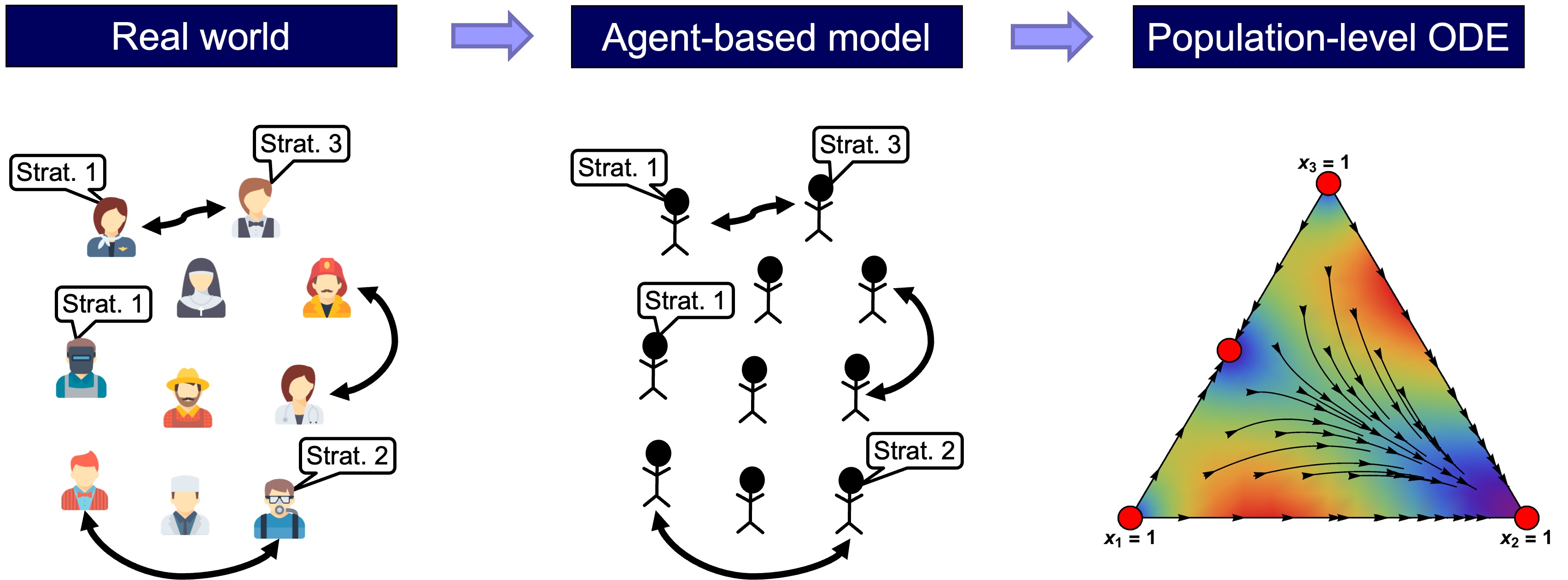
The core components of any ABM are:
- Agents: The autonomous, decision-making entities in our model. In our context, an agent could be an individual person or, more simply for our purposes, a couple represented as a single unit.
- Attributes and State: The properties that define an agent at any given time. For a "couple" agent, this could include their chosen relationship strategy (e.g., "Strict," "Laissez-Faire"), their current "Relationship Health," and their accumulated payoffs.
- Behavioral Rules: The logic that agents use to make decisions. This includes how they interact with each other and, crucially, how they might change their behavior over time.
- Environment & Interactions: The context in which agents operate. This defines who interacts with whom. It could be a simple "well-mixed" population where anyone can interact with anyone else, or a more structured social network.
The Evolution of Strategies: An Interactive Example
The "evolution of norms" is simply the change in the distribution of strategies within the population over time. If a particular strategy is successful (i.e., it leads to high payoffs for the agents using it), other agents will tend to adopt it. Unsuccessful strategies will be abandoned. Over time, the population may converge to a state where one strategy is dominant, or it might sustain a stable mix of different strategies.
This process is brilliantly illustrated in a short, interactive game. It uses the Prisoner's Dilemma, but the principle applies to any strategic interaction.
🟩This videogame is about Game Theory and Agent-based Modeling!🟩
This video, based on a game by Nicky Case, provides a fantastic visual and interactive introduction to the concept of evolutionary game theory, which is the engine behind many agent-based models of social norms.
Please watch the segment from the evolutionary simulation. Focus on how the population composition changes from one "tournament" to the next. The key mechanism is that low-scoring agents are "eliminated" and high-scoring agents are "reproduced." In a social context, this isn't about literal birth and death, but about imitation: people abandon failing strategies and copy successful ones.
As you saw, the "Always Cheat" strategy thrived initially by exploiting the "Always Cooperate" agents. But once the cooperators were driven out, the cheaters were left to face each other, leading to poor outcomes for everyone. This created an opening for the "Copycat" (or Tit-for-Tat) strategy to invade and eventually dominate. The environment, which consists of the other agents, changed, and so did the optimal strategy. This is the essence of norm evolution.
Simulating a Community: The Hawk-Dove Model of Conflict
Let's apply this to a scenario directly relevant to relationship boundaries. In our Module 4, we analyzed the Hawk-Dove game as a model for conflict. Let's now place that game into an ABM to see what kind of community norm emerges.
Imagine a community of couples. From time to time, a conflict arises over a boundary (e.g., an un-planned encounter, a miscommunication about rules). Each couple has a default strategy:
- Dove: Prioritize harmony. In a conflict, they will compromise or back down to avoid escalation, ensuring a peaceful but perhaps less-than-ideal outcome for themselves.
- Hawk: Prioritize personal gain. They will aggressively assert their preference, risking a major fight but potentially "winning" the conflict if the other party is a Dove.
What happens when you simulate a population of these agents?
Simulating the Evolution of Aggression
The YouTube channel Primer creates excellent educational simulations. This video models the evolution of aggression using the Hawk-Dove game, providing a clear visual demonstration of the principles we are discussing.
Please watch two key segments: First, watch the simulation in action from the introduction of Hawks. Observe how, regardless of whether you start with mostly Doves or mostly Hawks, the population doesn't converge to a single strategy. Instead, it settles into a fluctuating, stable mixture. Next, watch the segment from the mathematical calculation. This will connect the visual simulation to the underlying math. It shows how to calculate the expected payoff for each strategy based on the current population mix, and how the stable equilibrium is the point where the expected payoffs of being a Hawk and a Dove are equal.
The key takeaway is that neither "always be aggressive" nor "always be passive" is a universally optimal strategy. The best strategy depends on the composition of the population. The simulation shows the emergence of a stable social norm that is not a pure strategy, but a specific, predictable mixture of Hawks and Doves. A change in the game's payoffs—for instance, making the cost of a Hawk-Hawk fight more severe—would directly change the resulting equilibrium mix, and thus, the community's prevailing norm regarding conflict.
Formalizing the Analysis: Simulation and Mathematics
The visual simulations are intuitive, but your background in statistics and stochastic processes allows us to connect them to a more rigorous mathematical foundation. An ABM like the ones we've seen can be analyzed in two complementary ways.
II-5. Analysis of these models – Agent-Based Evolutionary Game Dynamics
This online textbook chapter on Agent-Based Evolutionary Game Dynamics provides an excellent bridge between intuitive simulation and formal analysis. It uses concepts that should be familiar from your studies in stochastic processes.
Please review the following sections to understand the formal underpinnings of our simulations: Start with "Two complementary approaches" to see the distinction between simulation and direct mathematical analysis. Briefly look at "Computer simulation approach". This section describes the methodology used to generate the statistical results from the visual simulations we just saw (running the model many times and averaging the results). Now, focus on the section "Markov chains". This is the key insight. An ABM with a finite number of states (e.g., the number of couples playing "Hawk") can be formally described as a Markov chain. The state of the system at time t+1 depends only on the state at time t. This provides a powerful analytical tool. Read the subsection "Infinite-horizon behavior". This connects the Markov chain model to the concept of an evolved norm. For a system with even a tiny amount of noise (randomness), the Markov chain will have a unique limiting distribution. This distribution tells us the long-run probability of finding the system in any given state. The states with the highest probability in this distribution are the stochastically stable states—they represent the most likely emergent norms. Finally, read about the "Mean dynamic" approximation. This powerful idea states that for large populations, the average behavior of the noisy, stochastic ABM can be well-approximated by a deterministic Ordinary Differential Equation (ODE). This is the "Population-level ODE" shown in our first image. It describes the macro-level trend that emerges from the micro-level randomness.
This formal framework gives us a deep understanding of what our simulations are actually doing. The emergent "norm" is the limiting distribution of an underlying Markov process, and the large-scale trends we observe can be described by a deterministic mean dynamic.
A State-of-the-Art Modeling Framework
To conclude, let's look at how these concepts are being used at the research frontier to model exactly the kinds of complex relationship systems that interest you. The following paper, while speculative, proposes an advanced computational framework that integrates ABM with machine learning to simulate a hypothetical "Stratified Polyamory System" (SPS).
You don't need to absorb the paper's social arguments or technical details, but I want you to see its architecture as a sophisticated blueprint for the kind of modeling we're discussing.
AI-Driven Multi-Agent Simulation of Stratified Polyamory Systems
This research paper outlines a comprehensive framework for modeling a complex non-monogamous social system using ABM, Multi-Agent Reinforcement Learning (MARL), and other advanced techniques. It serves as an excellent example of how to structure a sophisticated social simulation.
Please focus on Section 10: Computational Framework. This section lays out a complete design for a cutting-edge ABM. Read the subsection "Agent-Based Model Architecture". Note how it defines the core components: Agent attributes: mate value, economic resources, fertility, etc. Agent strategy/policy: Rules governing partner search and relationship decisions. Environment constraints: The SPS rules (partner limits, etc.). Simulation cycle: The sequence of actions agents take in each time step (Search, Propose, Match, Update). Next, read the subsection on the "Multi-Agent Reinforcement Learning (MARL) Formulation". This is a significant step beyond simple imitation. Instead of just copying successful agents, the agents in this model learn their optimal strategies over time by trying actions and receiving rewards, guided by algorithms like Proximal Policy Optimization (PPO). This allows for the discovery of non-obvious emergent strategies.
This framework demonstrates the full power of the ABM approach. By defining agents, their possible actions, their goals (utility functions), and the environment's rules, we can create a computational laboratory to explore how different rule-sets might lead to vastly different social outcomes and emergent norms.
Conclusion
Today, we have expanded our toolkit from modeling single, isolated systems to simulating entire communities. We have seen that complex, macro-level social norms can and do emerge from the simple, repeated interactions of autonomous agents at the micro-level.
Key Takeaways:
- Agent-Based Models (ABMs) are a "bottom-up" simulation method where collective behavior emerges from the interactions of individual agents following simple rules.
- The evolution of norms can be modeled as an evolutionary process where agents adopt more successful strategies (e.g., through imitation or learning), changing the overall distribution of strategies in the population over time.
- The stable outcomes of these simulations—the emergent norms—can be either a single dominant strategy or a stable mixture of multiple strategies, depending on the payoff structure of the underlying interactions.
- These stochastic processes can be formally analyzed using the mathematics of Markov chains, with the emergent norm corresponding to the chain's limiting distribution.
Preview of the Next and Final Lesson:
Throughout this course, we have built a powerful set of mathematical and computational tools to model complex human relationships. But models are, by definition, simplifications. In our final lesson, we will take a step back and critically evaluate the limitations and assumptions of applying rational game theory models to complex human emotional dynamics. We will discuss what these models can tell us, what they can't, and the ethical considerations of applying them.