Welcome to the final module of our course. Over the past six modules, you have assembled a powerful toolkit of game-theoretic concepts, from analyzing simple strategic interactions to designing complex, incentive-compatible mechanisms. Now, we begin the capstone project: synthesizing these tools to model and analyze complete, realistic relationship scenarios from start to finish.
In this first lesson of the final module, your learning outcome is to synthesize concepts by building a multi-stage game model of a complete relationship scenario, from signaling interest to ongoing negotiation. We will construct a single, coherent game that captures the entire arc of a potential new connection: the initial uncertain signals, the decision to engage, and the subsequent negotiation of rules and boundaries. This process will require us to weave together signaling games, sequential bargaining, and Bayesian belief updating into one integrated model.
The Challenge of Modeling a Relationship Arc
A relationship doesn't begin with a formal negotiation. It often starts with ambiguous signals, tentative actions, and a great deal of uncertainty about the other person's true intentions and preferences. As actions are taken and information is exchanged, parties update their beliefs and decide whether to proceed to more explicit negotiation. This entire sequence can be modeled as a multi-stage game.
To provide a formal structure for this kind of modeling, researchers have developed frameworks for sequential decision-making. The "Bazaar" model, for example, conceptualizes negotiation as a process where agents exchange proposals, update their beliefs about each other, and make decisions to maximize their expected payoffs at each stage. This provides a robust foundation for building our own integrated model.
[PDF] Bayesian Learning in Negotiation 1 Introduction
This paper by Zeng and Sycara presents Bazaar, a formal model for negotiation that is particularly well-suited for our task. It treats negotiation as a sequential process with learning.
Please read Section 3.1, "Bazaar: a formal description". Focus on the 10-tuple that defines the model. Don't worry about memorizing every component; the key is to grasp how it formalizes the elements of a multi-stage interaction: players (N), issues (M), actions (A), histories (H), beliefs (\Omega), and payoffs (G). This provides the "blueprint" for the model we are about to build.
A Case Study: The First Encounter
Let's construct our multi-stage game around a common scenario.
- The Setting: Clara (Hotwife) and her husband David have an established hotwife relationship. At a social gathering without David, Clara strikes up a conversation with Ethan, a man she finds attractive.
- The Game: We will model the progression from this initial conversation to a potential agreement for a first date.
This scenario unfolds in distinct stages:
- Signaling: Clara sends a signal to Ethan. Is she just being friendly, or is she indicating interest in a hotwife dynamic? Ethan must interpret this signal under incomplete information.
- Engagement: Based on his interpretation of the signal, Ethan decides whether to pursue a connection or disengage.
- Negotiation: If Ethan pursues and Clara is genuinely interested, a new stage of negotiation begins, this time involving David, to set the terms for a first meeting.
Stage 1 & 2: The Signaling Game
The initial interaction between Clara and Ethan is a classic signaling game. Clara knows her true intentions (her "type"), but Ethan does not. He can only observe her action (the "signal") and use it to update his beliefs about her type.
To get a firm grasp on the mechanics of this first phase, let's review the structure of signaling games.
This video from the "Game Theory 101" series provides an excellent primer on signaling games.
Please watch the following segments: The introduction explains the basic structure: Nature assigns a type, the Sender sends a signal, and the Receiver acts based on that signal. The next section defines the strategies for both players, crucially noting that the Receiver's strategy includes a set of beliefs about the Sender's type. Finally, watch the explanation of a separating equilibrium. This is where the Sender's signal truthfully reveals their type, resolving the information asymmetry.
Now, let's apply this to our scenario.
-
Nature's Move: Determines Clara's type.
- Type 1 (T1): "Genuinely Interested." She is actively looking for a potential partner for a hotwife encounter. Let's assume the prior probability of this is .
- Type 2 (T2): "Just Flirting." She enjoys the attention but has no intention of things going further. The prior probability is .
-
Clara's Move (Sender): She observes her type and chooses a signal.
- Signal 1 (S1): "Overt." She might say, "My husband and I have an open arrangement, and I find you very compelling."
- Signal 2 (S2): "Subtle." She might say, "It's been great talking with you. I wish my husband were here, he'd enjoy your company too."
-
Ethan's Move (Receiver): He observes the signal (S1 or S2) but not the type (T1 or T2). He then chooses an action.
- Action 1 (A1): "Pursue." He asks for her number to arrange a meeting with her and David.
- Action 2 (A2): "Disengage." He politely ends the conversation.
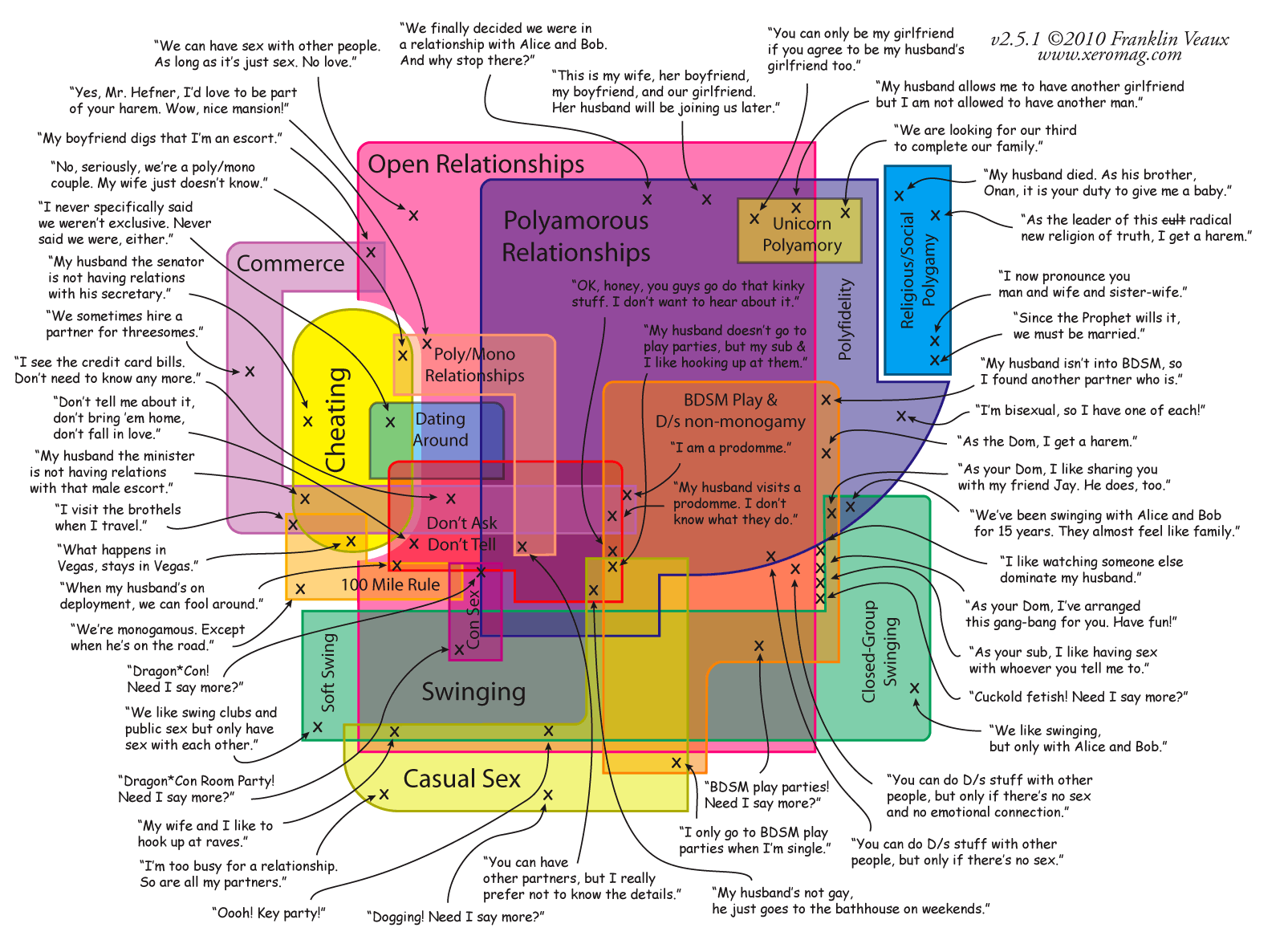
The ambiguity of signals is a central feature of navigating non-monogamous circles. A phrase intended one way can easily be interpreted another, as illustrated by the complex overlaps in relationship types.
Stage 3: The Negotiation Subgame
What happens if Ethan "Pursues" and Clara is "Genuinely Interested"? The game doesn't end. Instead, we transition to a new stage: a sequential negotiation subgame. Here, the moves are explicit offers and responses, and the core concept is Subgame Perfect Equilibrium (SPE), which relies on the principle of backward induction.

To solve such a game, we analyze the last player's optimal move and work our way backward, assuming rational players will anticipate these future actions. This process allows us to eliminate "non-credible threats"—actions a player claims they will take but which would be against their interest to carry out if actually called upon to do so.
Game Theory 101 (#16): Subgame Perfect Equilibrium
This video, also from "Game Theory 101", explains Subgame Perfect Equilibrium and the crucial idea of credible threats.
Please watch from this segment. The key insight is that when analyzing a sequential game, we must consider what is rational for a player at the moment they have to make their decision. A threat to "declare a price war" is non-credible because, if the entrant actually enters, it is more profitable for the incumbent to "accept" rather than fight.
Let's model the negotiation between David and Ethan as such a subgame:
-
David's Move: Having been contacted by Ethan (following Clara's introduction), David sets the terms for a first meeting.
- Move D1: "Strict Rules." (e.g., meet in a public cafe, for one hour only).
- Move D2: "Flexible Rules." (e.g., come over for dinner).
-
Ethan's Move: Ethan decides whether to agree to the proposed terms.
- Move E1: "Accept."
- Move E2: "Decline."
Synthesizing the Full Model and Using Bayesian Updating
Now, we combine these stages into a single extensive-form game. The negotiation subgame we just defined is attached to a specific branch of the initial signaling game: the outcome where Clara is T1 ("Genuinely Interested") and Ethan chooses A1 ("Pursue").
The solution to this entire multi-stage game is a Perfect Bayesian Equilibrium (PBE). A PBE is a set of strategies for each player and a set of beliefs for the receiver (Ethan) such that:
- Strategies are optimal given the beliefs.
- Beliefs are updated from the priors according to Bayes' rule whenever possible.
Let's focus on the crucial role of Bayesian updating. When Ethan sees Clara's signal, he refines his initial belief () about her being "Genuinely Interested."
Suppose Clara plays a separating strategy: she sends an "Overt" signal (S1) if she's T1 and a "Subtle" signal (S2) if she's T2.
- If Ethan observes S1, he can deduce her type is T1 with 100% certainty. His belief updates to . He knows for sure that pursuing will lead to the negotiation subgame.
- If he observes S2, he deduces her type is T2. His belief updates to . He knows pursuing will lead to rejection.
More realistically, the signals might be noisy. Perhaps even a T2 "Flirter" might occasionally send an "Overt" signal, and a T1 "Interested" person might be shy and send a "Subtle" one. This is where Bayes' rule becomes indispensable for calculating the posterior probabilities. The Bazaar paper provides a clear, numerical example of this process.
[PDF] Bayesian Learning in Negotiation 1 Introduction
Let's return to the Zeng and Sycara paper to see a concrete application of Bayesian updating.
Please read the first part of Section 4, "Learning in Negotiation," starting from the beginning of the section up to the start of 4.1. This section walks through a buyer-supplier example where the buyer uses the supplier's offers (signals) to update their belief about the supplier's hidden reservation price (type). Pay close attention to the numerical example that shows the calculation of the posterior probability using Bayes' rule. This is precisely how Ethan would update his belief about Clara's type based on her signal.
Solving the Full Game
To find the PBE of our complete scenario, we work backward:
-
Solve the Negotiation Subgame: We use backward induction. At the final node, Ethan decides to "Accept" or "Decline" David's terms. He will choose the action that gives him the higher payoff. Anticipating this, David will choose the set of rules ("Strict" or "Flexible") that leads to the outcome that maximizes his own payoff. This gives us the Subgame Perfect Equilibrium of this subgame and, crucially, the expected payoff for all three players from entering this negotiation. Let's call Ethan's expected payoff .
-
Solve Ethan's Engagement Decision: Now, move back to Ethan's decision to "Pursue" or "Disengage". He has observed a signal, say S1, and has an updated belief .
- His expected utility of "Disengaging" is .
- His expected utility of "Pursuing" is .
Ethan will choose the action with the higher expected utility.
-
Solve Clara's Signaling Decision: Finally, we move back to Clara's initial move. Knowing how Ethan will interpret her signals and act upon them, she (of each type) will choose the signal ("Overt" or "Subtle") that leads to the final outcome she prefers. For example, if Clara is "Genuinely Interested" (T1), she will choose the signal that is most likely to make Ethan pursue, leading to the negotiation she desires.
This step-by-step process, combining backward induction on subgames and Bayesian updating of beliefs, allows us to analyze the entire strategic arc of a potential relationship from a single, unified model.
Conclusion
In this lesson, we have laid the groundwork for our capstone module by constructing our first integrated, multi-stage game. You have seen how to synthesize concepts from across the course to model a complete scenario that progresses from ambiguous signaling to explicit negotiation.
Key Takeaways:
- Complete relationship scenarios can be modeled as multi-stage games that combine elements of signaling and bargaining.
- Frameworks like the Bazaar model provide a formal structure for representing these sequential interactions, involving players, actions, histories, beliefs, and payoffs.
- The initial phase of a relationship, characterized by asymmetric information, is best modeled as a signaling game, solved with the concept of Perfect Bayesian Equilibrium.
- Subsequent phases involving explicit offers and counter-offers are modeled as sequential subgames, solved using backward induction to find a Subgame Perfect Equilibrium.
- Bayesian updating is the mathematical engine that links these stages, allowing players to rationally update their beliefs about others' types as they observe new actions and signals.
Preview of the Next Lesson:
Building a deterministic model like the one we've outlined is a crucial first step. However, real-world negotiations are filled with uncertainty—not just about player types, but about payoffs, outside events, and noisy communication. In our next lesson, we will learn how to take our game model and embed it within a Monte Carlo simulation. This will allow us to introduce randomness and forecast the long-term stability and success rates of different relationship strategies under a wide range of possible conditions.