Introduction
In our last lesson, we explored simultaneous-move games and discovered how the Nash Equilibrium helps identify stable outcomes. However, we also encountered a challenge: games like the "Battle of the Sexes" can have multiple equilibria, leaving the final outcome uncertain. This ambiguity often resolves when one person can act first, a common dynamic in relationship negotiations.
Today, we transition from simultaneous to sequential decision-making. We will analyze situations where actions unfold in a specific order, and players can observe what has happened before making their own move. Our goal is to apply the concept of Subgame Perfect Equilibrium (SPNE) to parse these scenarios. This powerful tool refines the Nash Equilibrium by eliminating outcomes that rely on empty threats or hollow promises, allowing us to predict the rational path of play and understand the strategic weight of credible commitments.
Why Nash Equilibrium Isn't Enough: The Problem of Non-Credible Threats
In sequential games, not all Nash Equilibria are equally plausible. Some may depend on a player threatening to take an action that, if the time came, they would have no incentive to actually perform. Such a threat is non-credible. Rational players should anticipate this and call the bluff.
Imagine a negotiation scenario: A wife, Anna, tells her husband, Ben, "If you text me more than once while I'm on a date with a bull, I will come home immediately." This is a threat. If Ben believes it, he will likely restrain himself. This might look like a stable equilibrium. But is the threat credible? If Anna is having a wonderful time on her date, would she really want to cut it short just to punish Ben for a second text? If her payoff from staying is higher than her payoff from coming home, a rational Anna would not follow through. Ben, anticipating this, might conclude the threat is empty.
To formally distinguish between plausible and implausible equilibria, we need to ensure that players' strategies are optimal not just at the beginning of the game, but at every possible stage. This leads us to the idea of subgames.
4.1 — Subgame Perfection - Game Theory
These presentation slides from Ryan Safner introduce the core problem that Subgame Perfection solves: non-credible threats. They then provide the formal definitions needed to build our analysis.
First, read the introductory slides to understand the motivating problem of non-credible threats. Then, focus on the formal definitions of Subgame Perfect Nash Equilibrium and a subgame.
As the slides explain, a subgame is a smaller part of the overall game that starts at a single decision node and includes all subsequent moves. A strategy profile is a Subgame Perfect Nash Equilibrium (SPNE) if it constitutes a Nash Equilibrium in every one of these subgames. This requirement ensures that all threats and promises are "incentive-compatible"—that is, players would actually want to carry them out if called upon to do so.
Finding the SPNE: The Power of Backward Induction
The primary tool for finding the SPNE in a sequential game with perfect information is backward induction, also known as rollback analysis. The logic is as intuitive as it is powerful: to know what to do today, you must figure out what will happen tomorrow.
The process involves starting at the very end of the game tree—the final possible decisions—and determining the optimal choice for the player at each of those nodes. Once these final actions are determined, we can "prune" the branches that won't be chosen. We then move backward to the second-to-last set of decisions. The players at these nodes can now treat the pre-determined final moves as the fixed outcomes of their choices, allowing them to make their own optimal decision. This process is repeated, moving backward step-by-step until we reach the beginning of the game. The path that remains is the Subgame Perfect Equilibrium.
This video provides a clear, step-by-step demonstration of the backward induction algorithm.
Game Theory 101 (#17): Backward Induction
William Spaniel walks through the logic and application of backward induction, showing why we must start at the end of the game and work backward to find the rational outcome.
Watch the entire video. Pay close attention to: The initial explanation for why we must start at the end of the game. The step-by-step process of solving for each player's optimal move by working backward. The final description of the full Subgame Perfect Equilibrium, which specifies an action at every node.
Resolving the "Battle of the Sexes"
Let's apply backward induction to the coordination problem from our last lesson. Recall the scenario: Sarah (Wife) prefers a Hotwife Party (payoff 10) while David (Husband) prefers a Quiet Night In (payoff 10). They both prefer being together to being apart, so coordinating on their less-preferred activity (payoff 5) is better than miscoordinating (payoff 0).
In the simultaneous version, we found two Nash Equilibria: (Party, Party) and (Quiet, Quiet). Now, let's make it sequential: Sarah moves first by declaring her choice. David observes her choice and then decides what he will do. The game tree looks like this:
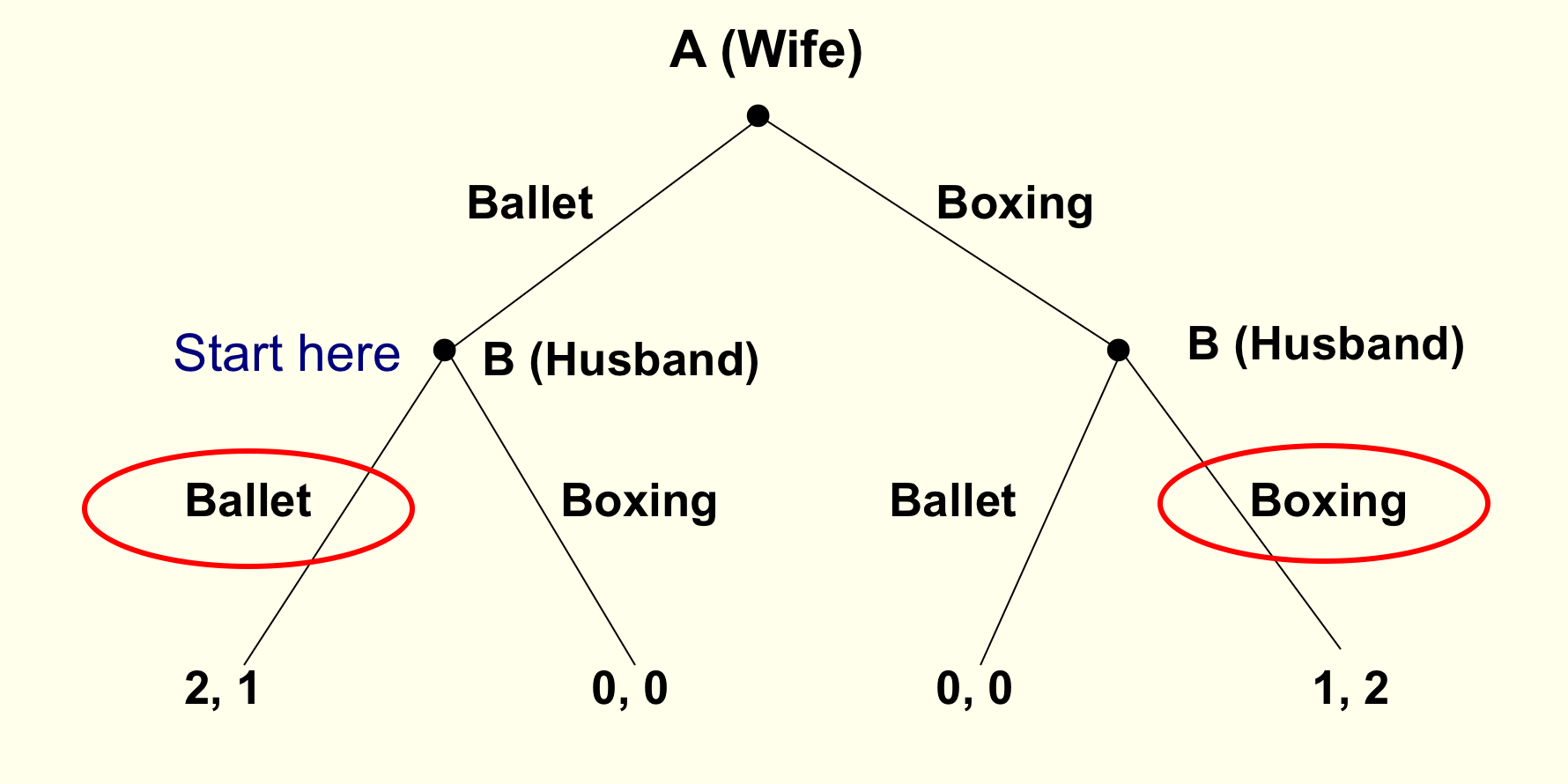
Let's solve this using backward induction:
-
Analyze David's final moves (the subgames):
- Subgame 1 (Top Branch): Sarah has chosen
Ballet(ourHotwife Party). David must now choose. His options areBallet(payoff 1) orBoxing(payoff 0). He choosesBallet. We can cross out theBoxingbranch. The outcome of this subgame is (2, 1). - Subgame 2 (Bottom Branch): Sarah has chosen
Boxing(ourQuiet Night In). David must now choose. His options areBallet(payoff 0) orBoxing(payoff 2). He choosesBoxing. We cross out theBalletbranch. The outcome of this subgame is (1, 2).
- Subgame 1 (Top Branch): Sarah has chosen
-
Analyze Sarah's first move:
- Sarah now looks ahead. She knows that if she chooses
Hotwife Party, David will follow her, and her resulting payoff will be 2. If she choosesQuiet Night In, David will also follow her, and her resulting payoff will be 1. - Comparing her potential outcomes (2 vs. 1), she rationally chooses
Hotwife Party.
- Sarah now looks ahead. She knows that if she chooses
The unique Subgame Perfect Equilibrium path is (Hotwife Party, Hotwife Party). Sarah gets her preferred outcome. This demonstrates a first-mover advantage. By committing to a course of action first, Sarah forces David's hand, resolving the ambiguity of the simultaneous game in her favor.
For another clear walkthrough of solving sequential games, including the Battle of the Sexes, you can review the following slides.
EconS 425 - Sequential Move Games | Wsu
This document provides several worked examples of using backward induction to find the SPNE in different sequential games.
Review the application of backward induction to the sequential Prisoner's Dilemma as a warm-up. Then, focus on the detailed analysis of the Battle of the Sexes, noting how a first-mover advantage emerges.
Application: Credible Threats in Boundary Negotiations
Now, let's use SPNE to dissect a more complex and realistic negotiation over boundaries.
Scenario:
Ben (cuckold) and Anna (hotwife) have an agreement that her interactions with other men are purely physical. However, Anna has met a new bull, Chris, with whom she feels a strong emotional connection. She is considering pursuing it. Ben has previously stated that any emotional connection is a "hard limit" and he would demand she end the relationship if it happened (the "veto").
- Players: Anna, Ben
- Sequence: Anna moves first, deciding whether to
Pursuean emotional connection orLimither interactions to the physical. If she pursues, Ben then decides whether toAcceptthe new dynamic orInvoke Veto.
Payoffs (Anna, Ben):
- If Anna chooses
Limit: The status quo holds. It's stable and secure. Outcome: (5, 8). - If Anna chooses
Pursueand BenAccepts: Anna is thrilled (payoff 10), but Ben is highly anxious, though he also feels some compersion. Outcome: (10, 2). - If Anna chooses
Pursueand BenInvokes Veto: This causes a major relationship crisis. Anna feels controlled and resentful, and Ben feels guilty and has damaged their trust. Outcome: (0, -5).
Let's analyze this with backward induction:
-
Analyze the subgame (Ben's decision): We start at the node after Anna has chosen
Pursue. Ben must decide whether toAcceptorInvoke Veto. He compares his payoffs:Acceptgives him 2, whileInvoke Vetogives him -5. Rationally, Ben will choose toAccept. His threat to invoke the veto is not credible, because when faced with the reality, carrying out the threat makes him worse off. -
Analyze Anna's decision: Anna, reasoning forward, anticipates Ben's rational response.
- She knows that if she chooses
Limit, her payoff is 5. - She knows that if she chooses
Pursue, Ben willAccept, and her payoff will be 10. - Comparing 10 and 5, she chooses
Pursue.
- She knows that if she chooses
The SPNE is (Anna: Pursue; Ben: Accept if Anna pursues). Ben's threat was "cheap talk" and Anna could rationally ignore it.
Making a Threat Credible: The Role of Commitment
How could Ben have made his threat to Invoke Veto credible? He would need to change the game by using a commitment device—an irreversible action taken before the game begins that alters his own payoffs.
4.1 — Subgame Perfection - Game Theory
This final part of the presentation discusses strategic moves and how commitment can lend credibility to threats that would otherwise be empty.
Read the sections on Strategic Moves and Credibility and Credible Commitment. The classical example of Odysseus and the Sirens is a powerful metaphor for this concept.
To make his threat credible, Ben needs to make it more painful for himself to back down than to follow through.
For instance, before Anna's date, Ben could make a commitment by telling their relationship counselor: "My hard limit is no emotional connections. If I fail to enforce this boundary, I will consider it a personal failure to uphold our agreements, and I commit to booking a solo retreat for a month to re-evaluate my place in this relationship."
This action fundamentally changes his payoffs in the subgame:
Invoke Vetonow avoids the high cost of breaking his self-imposed commitment (let's say its payoff is now 1).Acceptnow incurs the original anxiety plus the penalty of breaking his commitment and triggering the painful separation (its payoff might become -10).
With these new payoffs, his threat to Invoke Veto is now credible (1 > -10). Anna, anticipating this, knows that Pursue now leads to the veto and a payoff of 0 for her. Comparing this to the payoff of 5 from Limit, she will now choose to Limit. By strategically tying his own hands, Ben changes the outcome of the game.
Conclusion
In this lesson, we have moved into the realm of sequential negotiations, where the order of play is critical. By understanding how to analyze these situations, you can better predict outcomes and understand the power of strategic positioning.
Key Takeaways:
- Subgame Perfect Equilibrium (SPNE) is a refinement of Nash Equilibrium for sequential games, eliminating outcomes based on non-credible threats or promises.
- The algorithm for finding the SPNE is backward induction: starting from the end of the game and working backward to determine the optimal action at every decision point.
- A threat is only credible if the player has an incentive to carry it out at the moment of decision. "Cheap talk" can and should be ignored by a rational player.
- Commitment devices are strategic moves made before a negotiation that irreversibly alter a player's own payoffs, making threats credible and fundamentally changing the game's outcome.
Preview of the Next Lesson:
Our models have so far used simplified numbers for payoffs. But where do these numbers come from, especially when dealing with complex emotions? In our next lesson, we will address the learning outcome: "Incorporate altruism, compersion, and jealousy into payoff matrices to model interdependent partner utilities." We will explore how to construct more nuanced utility functions that capture the intricate emotional economy of open relationships.