Introduction
Welcome to the first lesson of our course. Given your background in statistics and operations research, you're already familiar with the foundational principles of game theory. Our goal here is not to re-teach the basics, but to immediately pivot towards application, sharpening these tools for your specific interest: analyzing the complex negotiations within cuckold and hotwife relationships.
Today, we will focus on the foundational skill of translating these intricate human interactions into formal game structures. This is the crucial first step before any analysis can be done. We will explore two primary methods of representation:
- Normal-form games, using payoff matrices, are ideal for modeling situations where partners make decisions simultaneously, or without full knowledge of the other's immediate choice.
- Extensive-form games, using game trees, allow us to map out sequential interactions, where one person's move is followed by another's response.
By the end of this lesson, you will be able to take a relationship scenario, identify its strategic structure, and represent it formally, setting the stage for the analytical techniques we will cover in subsequent lessons.
The Core Components of a Strategic Game
Before we build our first models, let's quickly align on the terminology. As you know from your studies, any strategic interaction, or "game," can be broken down into four key components. We will frame these directly in the context of relationship negotiations.
4. Social interactions – The Economy 1.0 - CORE Econ
This reading from the textbook The Economy provides a concise and formal definition of the components of a game. It will serve as a quick refresher, ensuring we're using a consistent vocabulary.
Please read the introduction to section 4.1, starting from the four key terms and the subsequent breakdown in the grey box titled "Game". Focus on how the authors define Players, Feasible Strategies, Information, and Payoffs.
Let's contextualize these terms:
- Players: The individuals involved in the negotiation. In our case studies, this will typically be the Wife, the Husband, and sometimes a third partner (the Bull).
- Strategies (or Actions): The set of possible choices each player can make. This isn't just about verbal agreements; it includes actions, expressions of emotion, or even strategic silence.
- Information: What each player knows at the time they make their decision. A key distinction we'll make is between simultaneous moves (imperfect information about the other's current move) and sequential moves (perfect information about prior moves).
- Payoffs: The outcome or utility each player receives for each possible combination of strategies. In our context, payoffs are rarely monetary. They represent emotional states: happiness, jealousy, compersion, resentment, security, or excitement. We will assign numerical values to these states to model the incentives driving each player's behavior.
Modeling Simultaneous Decisions: The Normal Form
Many pivotal moments in a relationship happen in a flash, with partners reacting simultaneously based on their assumptions about the other's state of mind. For these scenarios, we use the normal-form representation, also known as a payoff matrix.

Imagine a couple, Sarah (the wife) and David (the husband), are deciding how to feel about an upcoming date Sarah has with a bull. Sarah's choice is whether to emotionally commit to the date or to pull back and suggest a night with David instead. Simultaneously, David has to decide whether to show enthusiastic support (compersion) or to express reluctance (effectively a veto). Their emotional satisfaction depends on how their choices align.
Scenario: The Date Night Dilemma
- Players: Sarah (Wife), David (Husband)
- Sarah's Actions: {
Go on Date,Stay Home} - David's Actions: {
Show Compersion,Show Veto} - Information: They are making their internal decisions simultaneously. Sarah doesn't know if David will be genuinely happy or secretly upset, and David doesn't know if Sarah is truly excited or just going through the motions.
We can represent this interaction in a payoff matrix. The convention is that the first number in each cell is the payoff for the row player (Sarah), and the second is for the column player (David).
David: Show Compersion |
David: Show Veto |
|
|---|---|---|
Sarah: Go on Date |
(10, 8) | (2, -5) |
Sarah: Stay Home |
(5, 5) | (-2, 1) |
Interpreting the Payoffs (Sarah, David):
- (Go on Date, Show Compersion) -> (10, 8): The ideal hotwife scenario. Sarah has a thrilling date, and David feels compersion and joy from her happiness. Both win.
- (Go on Date, Show Veto) -> (2, -5): A conflict-ridden outcome. Sarah goes but feels guilty or resentful of his disapproval. David is miserable.
- (Stay Home, Show Compersion) -> (5, 5): A pleasant, secure evening. They have a good time together, but Sarah feels she missed out on an exciting experience. David is happy they are together.
- (Stay Home, Show Veto) -> (-2, 1): A tense evening. David gets what he wanted (no date), but his veto creates resentment. Sarah feels controlled and unhappy. David feels a slight sense of relief but also the tension he created.
This matrix elegantly captures the mixture of mutual dependence and conflict that Thomas Schelling identified as the hallmark of "mixed-motive" games. Both partners want a good outcome, but their individual preferences create tension.
Modeling Sequential Decisions: The Extensive Form
Not all negotiations are simultaneous. Often, they unfold as a sequence of actions and reactions. To model this, we use the extensive-form representation, which is visualized as a game tree.
The video "Extensive Form Games" by Professor Bryce provides a clear visual introduction to game trees.
Please watch the first part of the video from the beginning until the explanation of game trees and the definition of a strategy as a complete contingent plan. This will give you the formal structure for what we are about to build.
Let's consider a negotiation where Sarah wants to propose a new, more adventurous type of play—perhaps inviting two bulls at once. This is a sensitive topic, so the sequence of how it's discussed matters.
Scenario: Proposing a New Boundary
- Players: Sarah, David
- Sequence: Sarah decides whether to bring it up. If she does, David responds.
Here's how we can model this as a game tree:
- Sarah's First Move: Sarah is the first mover. She has two actions:
Proposethe new idea orStay Silent. - David's Response: David only moves if Sarah proposes. His node follows her
Proposeaction. He can thenAcceptthe idea enthusiastically orRejectit. - Outcomes (Payoffs): Each path down the tree leads to a terminal node with payoffs.
Here is a visual representation of this game, similar to the one in the video you just watched:
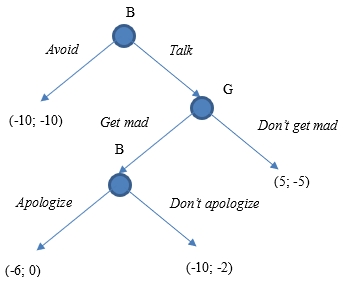
Let's construct the tree for our "New Boundary" scenario:
- Path 1: Sarah chooses
Propose, and David choosesAccept.- Dialogue: Sarah: "I've been thinking... what if we invited Mark and his friend over?" David: "That sounds incredibly hot. Let's do it!"
- Payoff (Sarah, David): (10, 7). Sarah is thrilled her desire is met. David feels compersive and excited by her trust and adventurousness.
- Path 2: Sarah chooses
Propose, and David choosesReject.- Dialogue: Sarah: "I've been thinking... what if we invited Mark and his friend over?" David: "Whoa, that's way too much for me. Absolutely not."
- Payoff (Sarah, David): (-5, -4). Sarah feels hurt and rejected. David feels anxious and defensive, and the relationship suffers from the conflict.
- Path 3: Sarah chooses
Stay Silent. The game ends there.- Dialogue: (Silence. The idea is never broached).
- Payoff (Sarah, David): (0, 0). The status quo is maintained. There is no conflict, but also no growth or exploration. A missed opportunity for Sarah.
This tree structure makes the sequence of decisions explicit. It shows that David's choice only exists because of Sarah's initial move. This is the essence of a sequential game.
From Sequential to Simultaneous and Back
As your background in OR suggests, different mathematical representations can model the same underlying problem. The normal and extensive forms are deeply connected. Any sequential game can be converted into a normal-form matrix, and any simultaneous game can be shown as an extensive-form tree. Understanding this link is key to flexible modeling.
Converting Extensive to Normal Form
To convert our sequential "New Boundary" game into a normal-form matrix, we must define each player's strategies as a complete contingent plan.
- Sarah's strategies are simple: {
Propose,Stay Silent}. - David's strategies must specify what he would do for every possible situation he might face. Since he only acts if Sarah proposes, his strategies are: {
Accept if she proposes,Reject if she proposes}.
The resulting matrix would look like this:
David: Accept if Propose |
David: Reject if Propose |
|
|---|---|---|
Sarah: Propose |
(10, 7) | (-5, -4) |
Sarah: Stay Silent |
(0, 0) | (0, 0) |
Notice how the matrix becomes less intuitive. The payoffs for Stay Silent are the same regardless of David's "strategy," because his decision point is never reached. This conversion, called the induced normal form, can become unwieldy for complex trees but is crucial for certain types of analysis we'll see later.
The-Strategy-of-Conflict-Prospectus-for-a-Reorientation- ...
In his seminal work, Thomas Schelling provides the theoretical logic for this conversion. He demonstrates how strategic moves like threats and commitments, which define a sequential game, can be formally represented in an expanded payoff matrix.
Please read the section titled "Incorporation of Moves". You don't need to follow every number in his complex matrix example, but focus on the core idea: a sequential game with determinate moves can be analyzed as a static, simultaneous-choice game by correctly defining the strategies and payoffs.
Converting Simultaneous to Extensive Form
Conversely, we can model a simultaneous game like our "Date Night Dilemma" using a tree. We do this by introducing an information set.
The second half of the "Extensive Form Games" video explains this concept perfectly.
Please watch from the introduction of imperfect information and information sets. Pay close attention to how a dotted line connecting decision nodes signifies that the player cannot distinguish between them.
To draw the "Date Night Dilemma" as a tree, we would have Sarah move first. Her choice of Go on Date or Stay Home would lead to two different decision nodes for David. However, since David's decision is simultaneous in reality, he doesn't know which node he is at. We represent this by drawing a dotted line between his two nodes, creating an information set. This forces him to choose a single action (Show Compersion or Show Veto) that applies across the entire set. The resulting game is strategically identical to the matrix we drew earlier.
This demonstrates that the fundamental difference is not about players literally acting at the same second, but about the information they have when they choose.
Conclusion
In this lesson, we have established the two primary frameworks for modeling the strategic negotiations in your area of expertise.
Key Takeaways:
- Normal-Form (Matrix): Best for representing simultaneous-move situations, where players choose without knowing the other's current action. The core components are Players, Actions, and Payoffs in a grid.
- Extensive-Form (Tree): Best for representing sequential-move situations. Game trees make the order of play, information at each step, and resulting outcomes explicit.
- Strategy: In a simultaneous game, a strategy is a single action. In a sequential game, a strategy is a complete contingent plan that specifies an action for every possible decision point a player might face.
- Interchangeability: Both forms are related. Extensive-form games can be converted to normal form (the "induced normal form"), and normal-form games can be represented in extensive form using information sets.
You now have the foundational tools to structure any negotiation scenario you encounter. This act of representation is not just academic; it forces clarity about who the players are, what choices they truly have, and what incentives are driving them.
Preview of the Next Lesson:
With our models built, the next logical step is to solve them. In the next lesson, we will learn how to predict the outcomes of these games by finding the Nash Equilibrium. This powerful concept will help us understand why some negotiations lead to stable, predictable outcomes while others remain volatile. We will start by analyzing the simultaneous-move games we built today.