Introduction
In our last lesson, we entered the world of asymmetric information, modeling relationship negotiations as signaling games. We defined the crucial difference between a separating equilibrium, where a partner’s actions truthfully reveal their private information (their "type"), and a pooling equilibrium, where actions are ambiguous and conceal true intentions. We saw how a hotwife might signal her enthusiasm or a bull might signal his long-term interest.
Today, we move from defining these outcomes to understanding the conditions that cause them. Why are some signals credible while others are dismissed? When does strategic ambiguity serve a purpose? This lesson focuses on the mathematical and strategic conditions that determine whether communication in a relationship will be clear (separating) or clouded (pooling). We will analyze a detailed numerical scenario to identify exactly how the payoffs and signal costs for each partner type dictate the equilibrium outcome.
The Anatomy of a Signal: A Numerical Case Study
To understand the conditions for these equilibria, we need to analyze the incentives of each player. Let's model a scenario between a wife (the Sender) and her husband (the Receiver) using the following game tree.
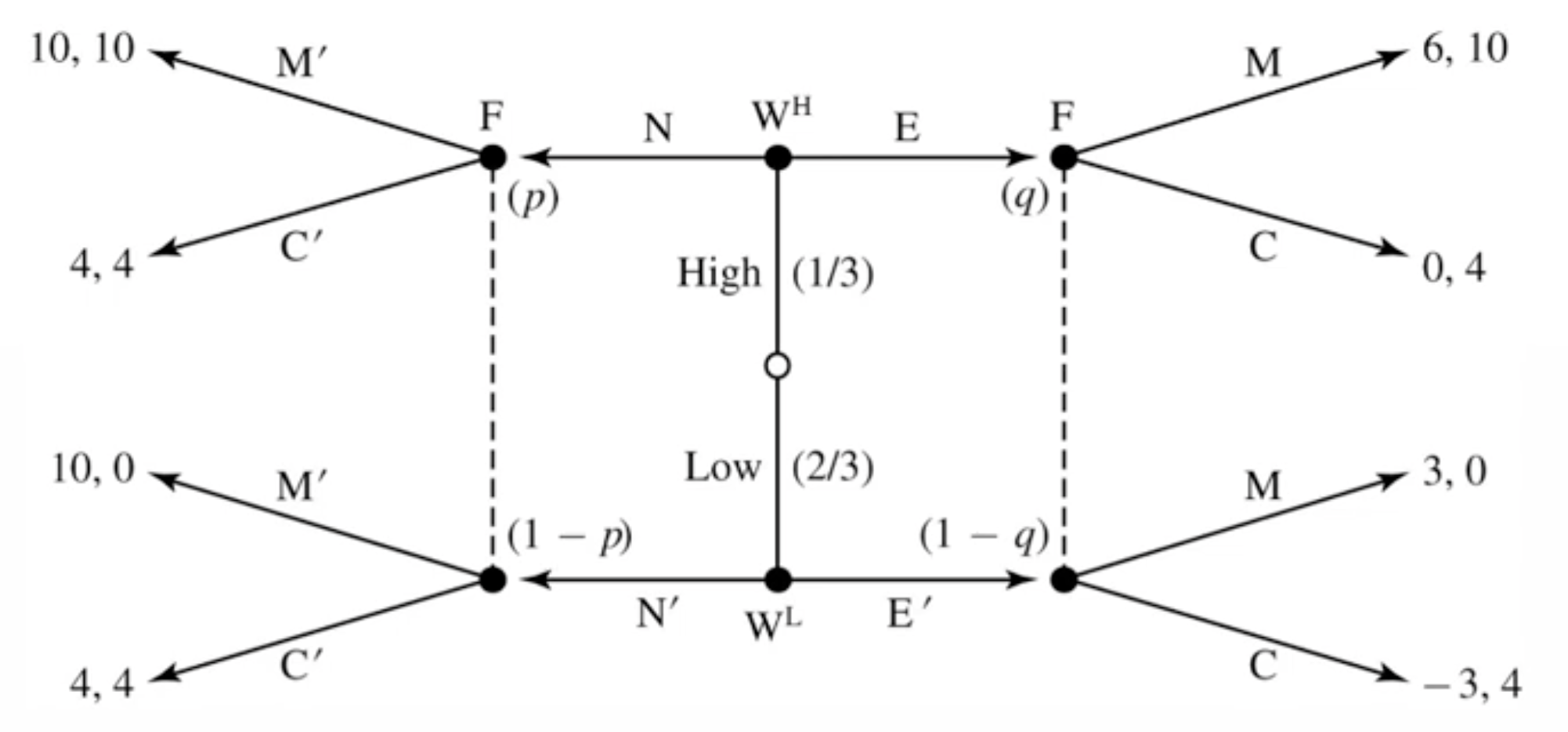
Let's map this abstract game onto a concrete relationship dynamic:
- Players: The Wife (W, the Sender) and the Husband (H, the Receiver).
- Nature: Determines the Wife's true desire or "type."
- High Drive (WH): She has a strong desire for a more adventurous encounter. Nature chooses this type with probability .
- Low Drive (WL): She is more hesitant and prefers a slower, more cautious approach. Nature chooses this type with probability .
- Signals (Wife's Move): The Wife communicates her interest in a potential new partner (a bull).
- Enthusiastic Signal (E/E'): She says, "He seems amazing! I'd love to meet him this weekend."
- Neutral Signal (N/N'): She says, "He seems interesting. Maybe we could talk more about it."
- Actions (Husband's Move): The Husband observes the signal and chooses his response.
- At the left information set (after N/N'), he chooses between Facilitate (M') or Constrain (C').
- At the right information set (after E/E'), he chooses between Facilitate (M) or Constrain (C).
- Payoffs: The numbers at the end of each branch are (Wife's Payoff, Husband's Payoff).
Our goal is to find a Perfect Bayesian Equilibrium (PBE), which consists of a set of strategies and beliefs that are mutually consistent and sequentially rational. We will test for two possibilities: a separating equilibrium and a pooling equilibrium.
Condition for a Separating Equilibrium: Making Truth-Telling Rational
A separating equilibrium requires each type to choose a different signal, allowing the Receiver to perfectly infer the Sender's type. For this to be stable, neither type can have an incentive to mimic the other.
Let's test the following proposed separating strategy:
- The High Drive (WH) wife sends the Enthusiastic (E) signal.
- The Low Drive (WL) wife sends the Neutral (N') signal.
We'll follow a four-step process to verify if this is a PBE.
Game Theory 101 (#78): Separating Equilibrium
To see this verification process in action, watch this "Game Theory 101" video on separating equilibria. It introduces and applies the systematic approach we're about to use.
Focus on the explanation of a separating equilibrium and the four-step path to finding it. Then, watch the detailed application of this method to the first proposed strategy. Pay close attention to how the player's beliefs are updated and how profitable deviations are checked.
Applying this process to our scenario:
Step 1: Propose Separating Strategies
As stated: WH plays E; WL plays N'.
Step 2: Determine the Receiver's (Husband's) Best Response
The Husband updates his beliefs based on the signal he observes.
- If he observes E, he knows it must have come from WH (since WL plays N'). His belief (the probability the wife is WH) becomes 1. At the right information set, he is effectively at the top node. He compares his payoff from Facilitating (M), which is 10, to Constraining (C), which is 4. He chooses M.
- If he observes N', he knows it must have come from WL. His belief (the probability the wife is WH) becomes 0. At the left information set, he is at the bottom node. He compares his payoff from Facilitating (M'), which is 0, to Constraining (C'), which is 4. He chooses C'.
So, the Husband's best response strategy is: Play M if E is observed; play C' if N' is observed.
Step 3: Check for Profitable Deviations by the Sender (Wife)
Now we check if either type of wife would want to deviate, given the Husband's strategy.
- High Drive Wife (WH): Her equilibrium strategy is to play E. The Husband responds with M, and her payoff is 6. If she deviated to N, the Husband would (incorrectly) think she is WL and respond with C'. Her payoff would be 4. Since , she has no incentive to deviate.
- Low Drive Wife (WL): Her equilibrium strategy is to play N'. The Husband responds with C', and her payoff is 4. If she deviated to E', the Husband would (incorrectly) think she is WH and respond with M. Her payoff would be 3. Since , she has no incentive to deviate.
Step 4: Conclusion
Since neither type has a profitable deviation, this set of strategies is a stable Separating Perfect Bayesian Equilibrium. The signals are credible because the payoff structure makes it rational for each type to tell the truth.
The crucial condition that enables this is the single-crossing property. The net benefit of sending the "Enthusiastic" signal is positive for the High Drive type () but negative for the Low Drive type (). When a signal is systematically more attractive to one type than another, it can function as a credible separator.
Signaling Games - UC San Diego Department of Economics
The Sobel paper provides the formal mathematical underpinnings for this concept.
Read the section "6 The Basic Model" (starting on page 8). Focus on Definition 2, which formally defines the single-crossing condition. The key idea is that if a lower type is indifferent between two signal-response pairs, a higher type will strictly prefer the one with the higher signal.
Condition for a Pooling Equilibrium: The Logic of Ambiguity
Now, let's investigate the conditions for a pooling equilibrium, where both types send the same signal, creating strategic ambiguity.
Let's test the following proposed pooling strategy:
- Both the High Drive (WH) and Low Drive (WL) wives send the Enthusiastic (E/E') signal.
Step 1: Propose Pooling Strategies
Both WH and WL play E/E'.
Step 2: Determine the Receiver's (Husband's) Best Response
- If the Husband observes E/E', he learns nothing new about his wife's type. His beliefs must be consistent with the prior probabilities given by Nature. He uses Bayes' rule, but since both types send the signal, his posterior belief is the same as his prior.
- He must now choose the action (M or C) that maximizes his expected utility, given these beliefs.
- Since , the Husband's best response to the Enthusiastic signal is to Constrain (C).
Step 3: Check for Profitable Deviations by the Sender (Wife)
This step is more complex in pooling equilibria because we must define what the Husband would believe if he observed an "off-equilibrium" signal (N/N'). PBE allows for any belief here, but a common assumption is that he holds "pessimistic" beliefs—that the deviation came from the type that would make him worse off.
Let's assume if the Husband sees the unexpected signal N/N', he believes it's the Low Drive wife trying to trick him into playing M' (which would give him a payoff of 0). So he maintains his belief that and plays C' (giving him a payoff of 4).
Now, let's check for deviations given this off-path response.
- High Drive Wife (WH): Her equilibrium strategy is to play E. The Husband responds with C, and her payoff is 0. If she deviated to N, the Husband would play C', and her payoff would be 4. Since , she has a strong incentive to deviate.
- Low Drive Wife (WL): Her equilibrium strategy is E'. The Husband responds with C, and her payoff is -3. If she deviated to N', the Husband would play C', and her payoff would be 4. Since , she also has a strong incentive to deviate.
Step 4: Conclusion
Since both types have a profitable deviation, a pooling equilibrium on the Enthusiastic signal (E/E') does not exist under these payoff conditions. The response it provokes from the Husband (Constrain) is so unfavorable to both types of wife that they would rather send the Neutral signal, breaking the pool.
For a pooling equilibrium to be stable, two conditions must be met:
- The Receiver's best response to the pooled signal (based on prior beliefs) must be acceptable enough to the Senders.
- The consequences of deviating to an off-equilibrium signal must be sufficiently bad for the Senders that they prefer to stay in the pool.
These notes offer another clear definition of pooling equilibria and highlight the role of beliefs.
Read the section titled "Signaling Games". This section reinforces the definitions of separating and pooling equilibria and explicitly states how, in a pooling equilibrium, the receiver's updated beliefs remain the same as their prior beliefs because the signal offers no new information.
Conclusion
In this lesson, we have moved beyond definitions to analyze the precise conditions that allow for separating and pooling equilibria. By working through a concrete example, we've seen that the stability of any communication strategy—truthful or ambiguous—is determined entirely by the payoff structure and the incentives it creates.
Key Takeaways:
- A separating equilibrium is possible when the cost-benefit analysis of sending a "costly" or revealing signal differs significantly between Sender types. This is the essence of the single-crossing condition. The signal is credible because only one type finds it rational to send it.
- A pooling equilibrium can exist when the Receiver's response to the ambiguous signal is sufficiently attractive to all Sender types, and when any deviation from the pool would lead to a worse outcome for the deviator.
- Verifying an equilibrium requires a systematic process: proposing a strategy, determining the Receiver's belief-based best response, and then checking if any player has a profitable deviation.
Preview of the Next Lesson:
Our analysis has centered on costly signals—actions that have a direct impact on payoffs. But what about signals that are costless to send, like simply talking? In the next lesson, we will explore Spence's job-market model to delve deeper into the role of costly signals in demonstrating commitment. We will then contrast this with "cheap talk" to understand when words alone can be credible.