Welcome to the fifth and final lesson of our first module. In our previous lesson, you learned how to sharpen a broad concern about injustice into a specific, evidence-testable public-interest question. This gives your investigation a clear focus. Now, we'll address the next logical step: identifying everyone who has a stake in that question. Who holds the power? Who is most affected? Who is responsible for oversight?
This lesson will equip you to meet the learning outcome: Create a stakeholder map identifying decision-makers, affected communities, independent experts, and accountability bodies for a justice issue. This technique is fundamental to both strategic legal work and investigative journalism. It moves you from a simple list of contacts to a dynamic map of the power and relationships that define a system, helping you to anticipate challenges, identify sources, and plan your approach effectively.
What is Stakeholder Mapping?
A stakeholder is any person, group, or organisation that can affect or be affected by a project or an issue. Stakeholder mapping is the process of identifying these stakeholders and assessing their relative importance and influence. It’s a crucial step before launching any significant piece of work, whether that's a legal case, a policy campaign, or an investigative report.
The UK Government's Analysis Function provides an excellent guide on this process. It frames stakeholder mapping as the foundation for building transparency, strengthening trust, and ensuring your work is understood and perceived positively.
Stakeholder mapping – Government Analysis Function
This guide from the Civil Service explains the core concepts and importance of stakeholder mapping. It provides a structured, professional framework that is widely used in policy and project management.
Please read the first two main sections of the webpage. Start with What stakeholder mapping is and why it's important. Then, review the three-step approach under Which stakeholders to map. Pay close attention to the way it suggests defining and grouping stakeholders before listing them.
As the guide suggests, the first step is always to brainstorm who your stakeholders are. For any given justice issue, this list can be extensive, spanning from government ministers to individuals with firsthand experience of the system. The challenge, and the power of this technique, lies in organising that list into something strategically useful.
The Power/Interest Grid: A Tool for Strategic Analysis
The most common and effective tool for organising stakeholders is the Power/Interest Grid. This simple 2x2 matrix helps you categorise stakeholders based on two key dimensions:
- Power: Their ability to influence the outcome of the issue. This isn't just formal authority; it can also be the ability to block progress, shape public perception, or command media attention.
- Interest: The degree to which they are affected by the issue or motivated to engage with it.
Plotting stakeholders on this grid allows you to visualise the political landscape of your issue and prioritise your engagement efforts.
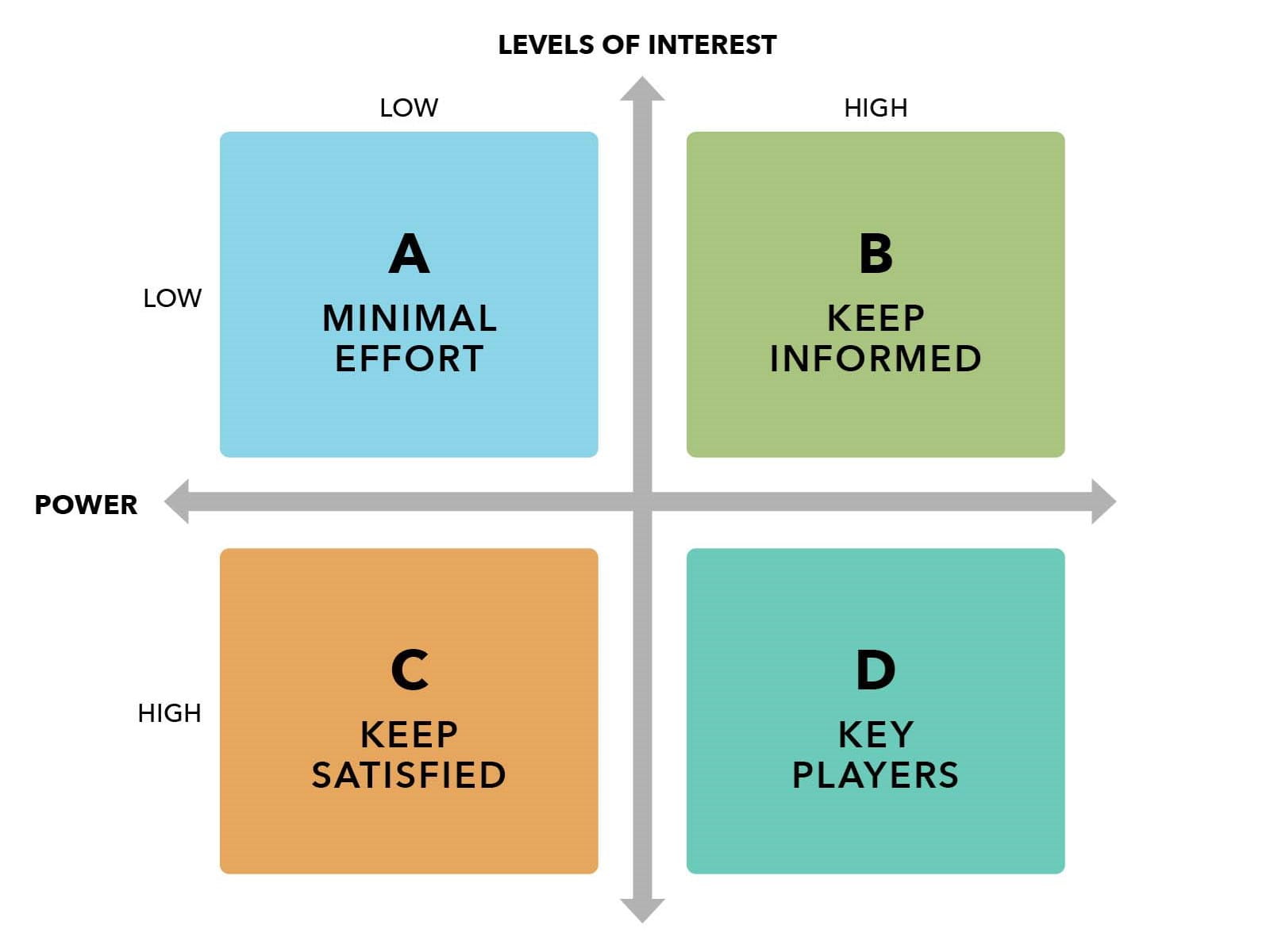
The video below offers a concise explanation of this model, often called Mendelow's Matrix, and how to use it.
Mastering Stakeholder Analysis: A Complete Guide to Effective Stakeholder Mapping
This video provides a clear, step-by-step guide to stakeholder analysis using the four-quadrant model.
Watch the section from the explanation of the four quadrants. The video details the characteristics of stakeholders in each quadrant: High Power/High Interest, High Power/Low Interest, Low Power/High Interest, and Low Power/Low Interest.
The Four Quadrants and Engagement Strategy
As you've just seen, the grid is divided into four quadrants, each suggesting a different approach. Let's explore these in the context of a justice investigation. For this, we'll draw on the detailed descriptions from the Government Analysis Function guidance.
Stakeholder mapping – Government Analysis Function
This part of the guidance details how to assess stakeholders and what to do with them once they are mapped.
First, read the section on assessing power and interest. The bullet points provide excellent prompts for evaluating where a stakeholder might sit on the grid. Next, read the descriptions for each of the four contact levels: the four quadrants. Think about how these strategies would apply when you are trying to gather information for a story or a case file.
Let's summarise the four quadrants from a journalistic or casework perspective:
- High Power, High Interest (Key Players / Manage Closely): These are the most critical stakeholders. They are central to the story and have the power to make decisions that change the outcome. Examples could include the Chief Constable of a police force under investigation, a senior Ministry of Justice policymaker, or the CEO of a private prison company. You must engage with them fully, understand their position, and likely put your allegations to them for a right of reply.
- High Power, Low Interest (Keep Satisfied): These stakeholders have significant power but aren't focused on your specific issue... yet. They could be a government minister with a broad portfolio, a regulatory body with a wide remit, or a senior judge. Your goal is to keep them informed and prevent them from becoming an obstacle. An unexpected intervention from this quadrant could derail your work.
- Low Power, High Interest (Keep Informed / Consult): This quadrant is often where you will find the most compelling human stories and crucial evidence. It includes affected communities, victims, whistleblowers, and campaigning groups. They care deeply but lack the formal power to enact change themselves. For a legal journalist, giving voice to this group is a core function. They are your key sources, but you must also manage their expectations as they cannot single-handedly solve their problems.
- Low Power, Low Interest (Monitor / Minimal Effort): This group is the general public or other actors on the periphery. While they require minimal effort initially, they are the audience you may ultimately be trying to persuade. A successful investigation can raise their interest, moving them into a different quadrant and creating pressure for change.
The video below shows the practical, collaborative process of creating a stakeholder map, emphasising that it is a tool for thinking and discussion.
Design Thinking for Education, Ep 8: Stakeholder Mapping
This video from the Consortium for Public Education demonstrates the hands-on process of creating a stakeholder map.
Watch the section that walks through the practical steps of mapping. Notice the emphasis on starting with a brainstorm, clustering stakeholders, and then using the power/interest matrix to prioritise them.
Identifying Stakeholders in the Justice System
Now that you have the framework, how do you find the specific actors for a justice issue in England and Wales? Your LLB provides you with a strong foundation, but the system is a complex web of interconnected bodies. The learning outcome for this lesson specifically asks you to identify decision-makers, affected communities, independent experts, and accountability bodies.
The report Criminal justice systems in the UK from the Centre for Crime and Justice Studies is an invaluable resource for this. It provides a detailed breakdown of the governance, inspection, and complaints mechanisms for every part of the system.

You don't need to read this whole report now, but you should treat it as a foundational reference text for your future work. When you're investigating an issue, you can turn to the relevant chapter to quickly identify the key institutions.
[PDF] Criminal justice systems in the UK
This report is your detailed guide to the architecture of the UK justice system.
For now, just familiarise yourself with the structure of the document. Skim the summaries and headings for the sections on Policing (p. 10), Prosecution (p. 23), Courts (p. 33), and Prisons (p. 43). Notice how each section is broken down by Governance, Inspection, and Complaints—this maps directly to identifying decision-makers and accountability bodies. Also, note the crucial section on Citizen accountability (p. 18 & 49), which discusses civil society, media, and campaign groups (your independent experts and affected communities).
Practical Application: Mapping a Stop-and-Search Investigation
Let's apply this to the hypothetical scenario from our last lesson: You are investigating claims that a specific police force is disproportionately using stop-and-search powers against young Black men in a particular borough, leading to few arrests.
Here's how you might start mapping the stakeholders:
- Decision-Makers (High Power):
- The force's Chief Constable (High Interest)
- The local Police and Crime Commissioner (PCC) (High Interest)
- Home Secretary (setting national policy) (Low Interest in this specific case, but High Power)
- Accountability Bodies (Power varies, usually High Interest):
- The Independent Office for Police Conduct (IOPC)
- His Majesty's Inspectorate of Constabulary and Fire & Rescue Services (HMICFRS)
- The local Police and Crime Panel that scrutinises the PCC
- Affected Communities (High Interest, Low Power):
- Young Black men in the borough
- Their families
- Local youth workers and community centres
- Independent Experts (Power varies, Interest varies):
- Campaigning NGOs like StopWatch or Liberty
- Local defence solicitors
- Academics specialising in policing and race
- Community leaders and activists
Once brainstormed, you would plot these on the grid. The young men themselves are in the 'Keep Informed/Consult' quadrant – they have the most at stake but little power to force change. The Chief Constable is firmly in 'Manage Closely'. Your job as a journalist or advocate is to bridge that gap: to take the experiences of the high-interest/low-power group and make them a priority for the high-power stakeholders.
Conclusion
In this lesson, we have moved from formulating a question to mapping the human and institutional landscape surrounding it. This is a critical transition from abstract analysis to practical, strategic action.
Key Takeaways:
- Stakeholder mapping is the process of identifying individuals and groups connected to an issue and assessing their power and interest.
- The Power/Interest Grid is the primary tool for this, sorting stakeholders into four quadrants: Key Players, Keep Satisfied, Keep Informed, and Monitor.
- Each quadrant demands a different engagement strategy, from close management to simple monitoring.
- In any justice issue, it is vital to identify the full spectrum of stakeholders: decision-makers, the communities they affect, the independent experts who analyse the system, and the accountability bodies charged with its oversight.
- For a legal journalist or caseworker, this map is a strategic blueprint. It identifies your primary sources (often high-interest, low-power), your targets for inquiry (high-power), and the wider context in which your story will land.
This concludes our first module. You have learned to distinguish roles within the justice system, trace a criminal case, map the accountability landscape, sharpen a broad concern into a testable question, and now, map the stakeholders involved in that question.
In our next lesson, we will begin Module 2: "Court Records, Casework, and Live Reporting." We will dive into the highly practical skill of decoding a court list. This will be our first step in learning how to find and interpret the primary source documents that are the lifeblood of legal reporting and casework.