Hello! Welcome back.
In our last lesson, we established the critical mindset shift from results-oriented to process-oriented thinking. We learned that a good decision is not defined by winning a pot, but by the quality of the logic behind it. We also introduced Jared Tendler's "Mental Hand History" as a conceptual tool for analyzing flawed thinking.
Today, we're going to make that concept concrete and actionable. This lesson will guide you in using a session review protocol to evaluate your decision quality, completely independent of the outcomes.
This is the engine of your improvement. A consistent review process is what separates aspiring players from professionals. It transforms your 20 hours of weekly play from mere experience into structured practice. For you, facing a downswing and battling impulsiveness, this protocol will be your anchor—a reliable method to measure your real progress, find your actual leaks, and rebuild confidence based on solid analysis, not the whims of variance.
1. The Professional's Framework: The Process Model
Before diving into the "how" of session review, let's understand the "when." A professional's approach to poker isn't just about playing. It's a cycle. A great way to visualize this is through the "Process Model," adapted from the work of Jared Tendler.
The Mental Game of Poker - Barry Carter, Jared Tendler
This summary of 'The Mental Game of Poker' introduces a five-part 'Process Model'. This framework will help us structure our entire approach to playing and improving.
Read the two bullet points starting with 'The process model has five parts...' to understand the full cycle. Our lesson today focuses specifically on the 'Evaluation' and 'Analysis' stages.
The five parts of the model are:
- Preparation/Warm-up: What you do before you play.
- Performance: The act of playing poker.
- Results: The outcome of your play (winning or losing money).
- Evaluation: An immediate review of your performance right after playing.
- Analysis: Deeper work to improve your game away from the table.
Many losing players get stuck in a loop of Performance -> Results -> Performance, riding the emotional rollercoaster of their wins and losses. Our goal is to build a professional's loop that includes conscious Evaluation and Analysis. This lesson provides your protocol for those last two, crucial stages.
2. The Session Review Protocol: A Two-Step Process
A proper session review isn't a single, monolithic task. It's best broken into two distinct steps: a brief "cool-down" evaluation immediately after you play, and a more in-depth analysis session later on.
Step 1: Post-Session Evaluation (The 15-Minute Cool-Down)
The moment you stand up from the table, your mind is full of fresh, valuable information. The goal of this step is to capture it before it fades, and then to mentally close the book on the session so you can go on with your life.
The Mental Game of Poker - Barry Carter, Jared Tendler
The summary of 'The Mental Game of Poker' provides excellent guidance on what to do in this immediate post-session evaluation.
Read the section starting with 'Here are a few better ways to evaluate how you played...'. This gives us a clear checklist for our cool-down.
Here is your Post-Session Evaluation Checklist:
- Tag Key Hands for Later: Don't analyze them now. Simply identify 2-4 hands from the session that are worth a deeper look. What's a "key hand"?
- Any large pot, win or lose.
- A hand where you felt confused or unsure what to do.
- A hand where you felt a strong emotion (frustration, fear, overconfidence).
- Capture the Details: For each tagged hand, you need to record the context. Trying to review a hand without this information is impossible. Use a notes app on your phone.
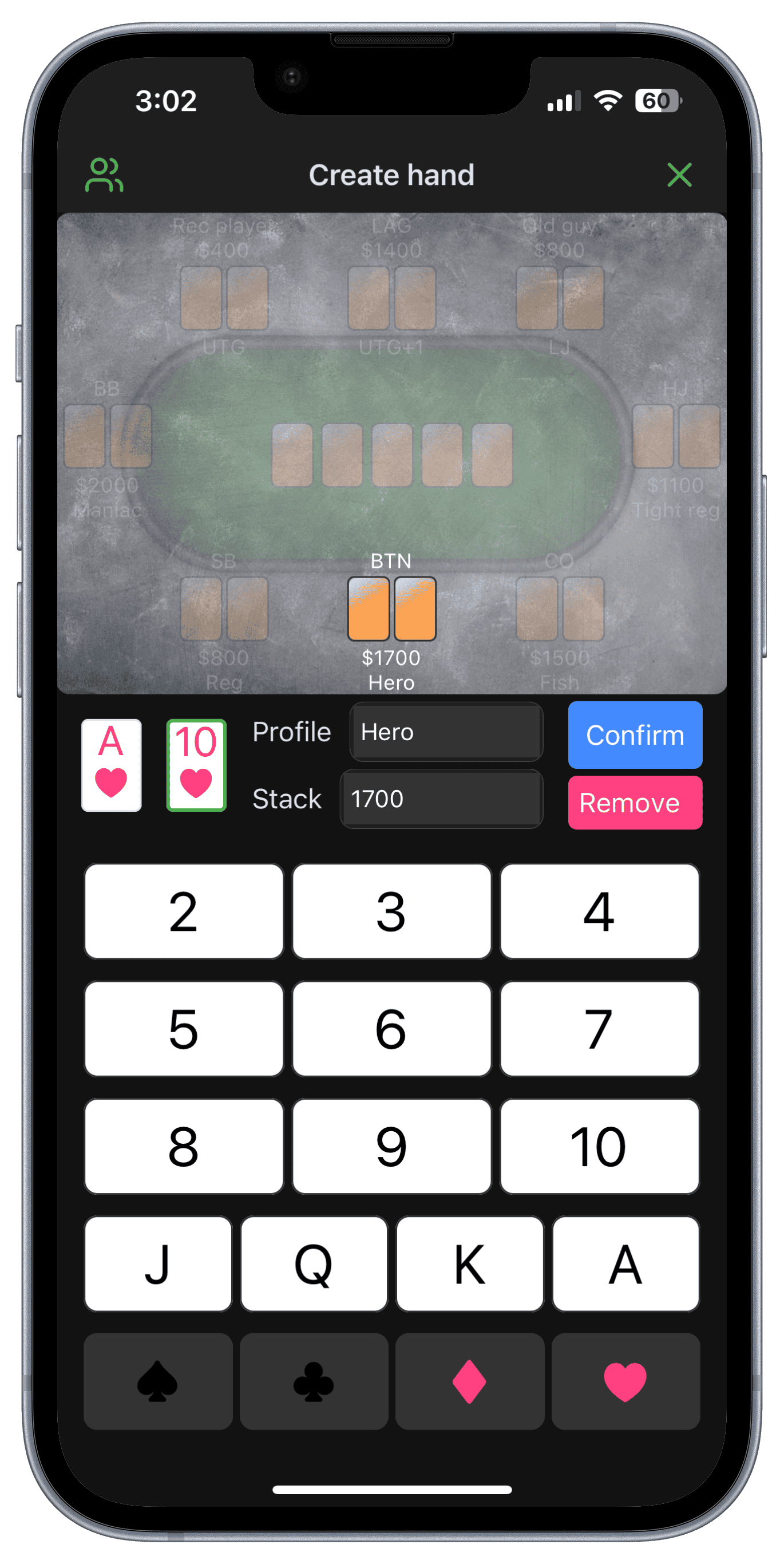
*This image shows a mobile app designed for poker hand analysis. It illustrates the key details you must capture for a meaningful review: your position, stack sizes, opponent types, and the action on every street.*

At a minimum, for each key hand, record:
*   Your hand and position.
*   Effective stack sizes.
*   Preflop action (limps, raises, callers, 3-bets, etc.).
*   The flop, and the action.
*   The turn, and the action.
*   The river, and the action.
*   Your best guess of opponent player types (e.g., "tight regular," "loose calling station").
- Write Down Your In-Hand Thoughts: For each tagged hand, add a quick note: What was I thinking? For example: "I called his turn bet because I thought he might be bluffing his missed flush draw" or "I value bet the river, but I was worried he'd only call if he beat me." This is crucial for the analysis step later.
- Mental Game Scorecard: Briefly assess your mental performance. Did you stick to your stop-loss? Did you use your breathing techniques? Did you notice any tilt triggers? Give yourself a grade (A-F) on your mental game for the session.
That's it. This entire process should take no more than 15 minutes. Now, you can put poker away, knowing you have everything you need for a productive study session later.
Step 2: Off-Table Analysis (The Deep Dive)
This is where you do the real work of improving. Schedule this for a different time, when you are rested and can think logically. Pick one or two of the hands you tagged and apply the following 5-step framework.
This framework is a direct application of the "Mental Hand History" we discussed last lesson, but we are expanding it to cover technical decisions as well.
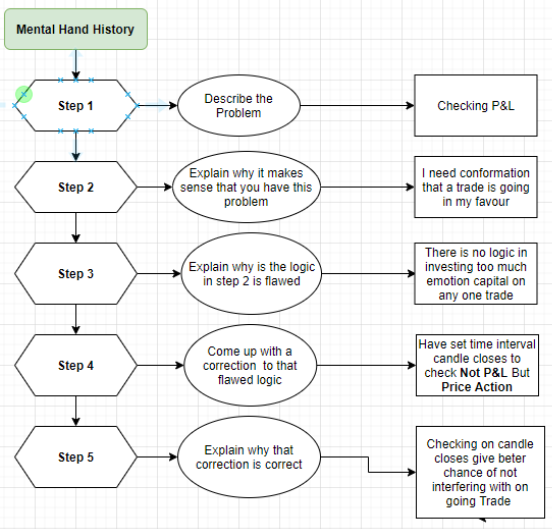
This flowchart shows a 5-step process for analyzing a decision. Though the example is from trading, the logic is identical for poker. It guides you from defining the problem to finding and correcting the flawed logic that led to it.
Here is the 5-Step Hand Analysis Framework:
- Describe the Problem/Decision Point: State the facts of the hand leading up to your key decision. (e.g., "I held A♠️K♦️. UTG opened, I 3-bet from the button, and the Big Blind cold-called. The flop was A♥️J♦️5♠️. The BB checked, and the decision was whether to c-bet and for how much.")
- Explain Your Logic at the Time: Use the notes you took right after the session. What was your rationale? (e.g., "My logic was that I had top pair, top kicker, and I should bet for value to get money from worse Aces and flush draws.")
- Find the Flaw in the Logic: This is the most important step. Be a detective. Question everything. Were you being results-oriented? Did you miss a key piece of information? Did you make an assumption that wasn't justified?
- Example Flaw: "My logic was flawed because I only considered my own hand. I didn't think about the Big Blind's range for cold-calling a 3-bet. His range is strong and hits this board well (AJ, AQ, 55, JJ). I was focused on 'I have TPTK' instead of 'How does my hand fare against his likely holdings?'"
- Define the Correct Approach: Based on your analysis of the flaw, what would a better decision have been? (e.g., "A better approach would be to check back on the flop. This controls the size of the pot, avoids getting check-raised by sets, and allows me to re-evaluate on the turn. It's a deceptive play that protects me against the stronger parts of his range.")
- Explain Why the Correction is Correct: Articulate the strategic principle behind your new approach. This solidifies the lesson. (e.g., "This correction is correct because in multi-way, 3-bet pots, pot control with one-pair hands is critical, especially when out of position or against a player whose range connects well with a wet board texture. Checking back is a higher long-term EV play than blindly betting.")
To see this in action, let's hear from a professional player on how he approaches this "digging" process.
Stop Wasting Time Reviewing Hands (Do This Instead)
In this video, 'Stop Wasting Time Reviewing Hands', pro player Tommy Angelo explains the importance of digging into the 'why' behind a mistake. His mindset perfectly aligns with Step 3 of our analysis framework.
Watch from 22:35 to 23:22. Listen to how he emphasizes not focusing on results, but on digging into your brain to find what you were thinking at the time and what was missing from your thought process.
By consistently applying this 5-step process, you turn frustrating losses and confusing spots into your most valuable learning opportunities.
Test your understanding!
You tagged a hand where you held 7♣️7♠️ on the Button. A loose player limped in middle position, you raised to isolate him, and he called. The flop came K♥️8♠️2♦️. He checked, you made a standard continuation bet, and he folded. You won the pot.
You review this hand later. At first glance, it seems fine. But when you get to Step 3 ("Find the Flaw"), how could you challenge your own logic? What might have been a flaw in your decision to c-bet, even though it worked?
Show answer
Even though the c-bet worked, a potential flaw in the logic could be: "My logic was automatic. I bet because that's what you're 'supposed' to do as the preflop raiser. I didn't stop to consider this specific opponent. He's a calling station who rarely folds any pair. This board is very dry. What hands am I trying to get value from? What bluffs am I trying to fold out? He's likely folding all his unpaired hands and calling with any King or any 8. Therefore, my bet only accomplishes getting called by better hands and folding out hands I was already beating. My logic was based on a general rule, not a specific plan against this opponent on this board texture."
The "Correct Approach" (Step 4) might have been to check back, take a free card, and re-evaluate on the turn, potentially bluffing on a later street if he shows weakness again.
Conclusion
You now have a complete, professional-grade protocol for session review. This system directly attacks results-oriented thinking by forcing you to evaluate your process. It creates a powerful feedback loop for improvement that is essential for any aspiring professional.
Key Takeaways:
- The Process Model (Preparation, Performance, Results, Evaluation, Analysis) provides a structure for your entire poker career.
- Your Session Review Protocol is a two-step process: an immediate post-session Evaluation to capture data, and a separate, in-depth Analysis session for deep learning.
- The 5-Step Hand Analysis Framework is your tool for the deep dive. It helps you diagnose flawed logic (both technical and mental) and replace it with a correct, process-oriented approach.
Your Action Plan:
- After your next two playing sessions, perform the 15-minute Post-Session Evaluation.
- Tag at least two key hands from each session and capture all the necessary details.
- Schedule a separate study block. Choose one hand from your notes and take it through the full 5-Step Hand Analysis Framework. Write it down. The act of writing is critical for clarifying your thoughts.
Preview of the Next Lesson:
As you use this review protocol, you'll start to notice patterns in your "Mental Game Scorecard." You might see that you get particularly frustrated after losing with pocket Aces, or that you get overconfident when you're winning. Our next lesson, "Recognize and label emotional states during play without acting on them," will give you the real-time skills to identify these feelings as they arise at the table, creating the first line of defense against tilt and impulsive action.