Hello. This module looks at how jurists develop legal interpretations from religious sources. The first question is not only what does a reported statement mean? but also how confident are we that it was transmitted accurately? Those are separate judgments, and disagreement about either can affect a ruling.
This lesson follows one concrete dispute through those judgments. It focuses on classical juristic reasoning, not on what any state currently enforces. Later lessons will examine other ways jurists reason when a text does not settle a case on its own.
A report can be clear without being reliable
A hadith is a report about the Prophet’s words, actions, or approvals. Its isnad is the chain of people through whom it was transmitted; its matn is the reported content. To use a hadith as evidence for a legal ruling, a jurist needs to consider at least two questions:
- Transmission: How well supported is this report as an account of what happened or was said?
- Interpretation: If the report is accepted, what does it mean in this case?
The second question cannot repair a failure in the first. Imagine a report whose wording, if genuine, plainly describes an action. A jurist might understand every word yet decline to base a ruling on it because the chain is unreliable. Conversely, jurists might accept a report’s transmission but disagree about whether its wording states a general rule or an exception.
Usul Al-Fiqh - Introduction & Evidence in Islam | Dr. Nasser Karimian
Watch the transmission-and-meaning distinction in “Usul Al-Fiqh - Introduction & Evidence in Islam” by Dr. Nasser Karimian. It supplies a useful framework for keeping these two judgments apart.
In the discussion of transmission and meaning, watch two questions: whether a text was reliably transmitted and whether its meaning is clear. Then watch a weak-report example. The lecturer explicitly invents that example; focus on why understandable wording does not make its transmission reliable.
Hadith critics investigated more than whether a chain named successive transmitters. They asked whether its links could be established and how accurately its transmitters passed on reports. In the Sunni criticism described in the following reading, assessments of a transmitter’s honesty and accuracy were related but distinct: someone might be sincere yet make frequent mistakes. Critics compared a person’s narrations with those of other students of the same teachers to detect such patterns.
Authenticating Hadith and the History of Hadith Criticism
Read the selected passages from “Authenticating Hadith and the History of Hadith Criticism” by Jonathan A. C. Brown for a closer look at how critics evaluated transmitters.
Under “Step two: Rating transmitters and establishing contiguous transmission,” begin with the two criteria and finish that paragraph. Farther down, find the paragraph beginning “How would a hadith critic such as Shuʿbah” and read the identification problem. Continue with the next paragraph, from “Second, the critic would collect all the reports” through the comparison method. Focus on why a named chain is a starting point for investigation, not an automatic guarantee.
What corroboration can—and cannot—show
A critic can seek other transmissions of a report. In the figure below, Transmitter A and Transmitter C both report through Successor A. Their parallel paths can help a critic check a transmission at that level. The path through Companion B offers a different kind of support for a similar report attributed to the Prophet. These are not interchangeable: two branches that share an earlier source are not independent at every point in the chain.
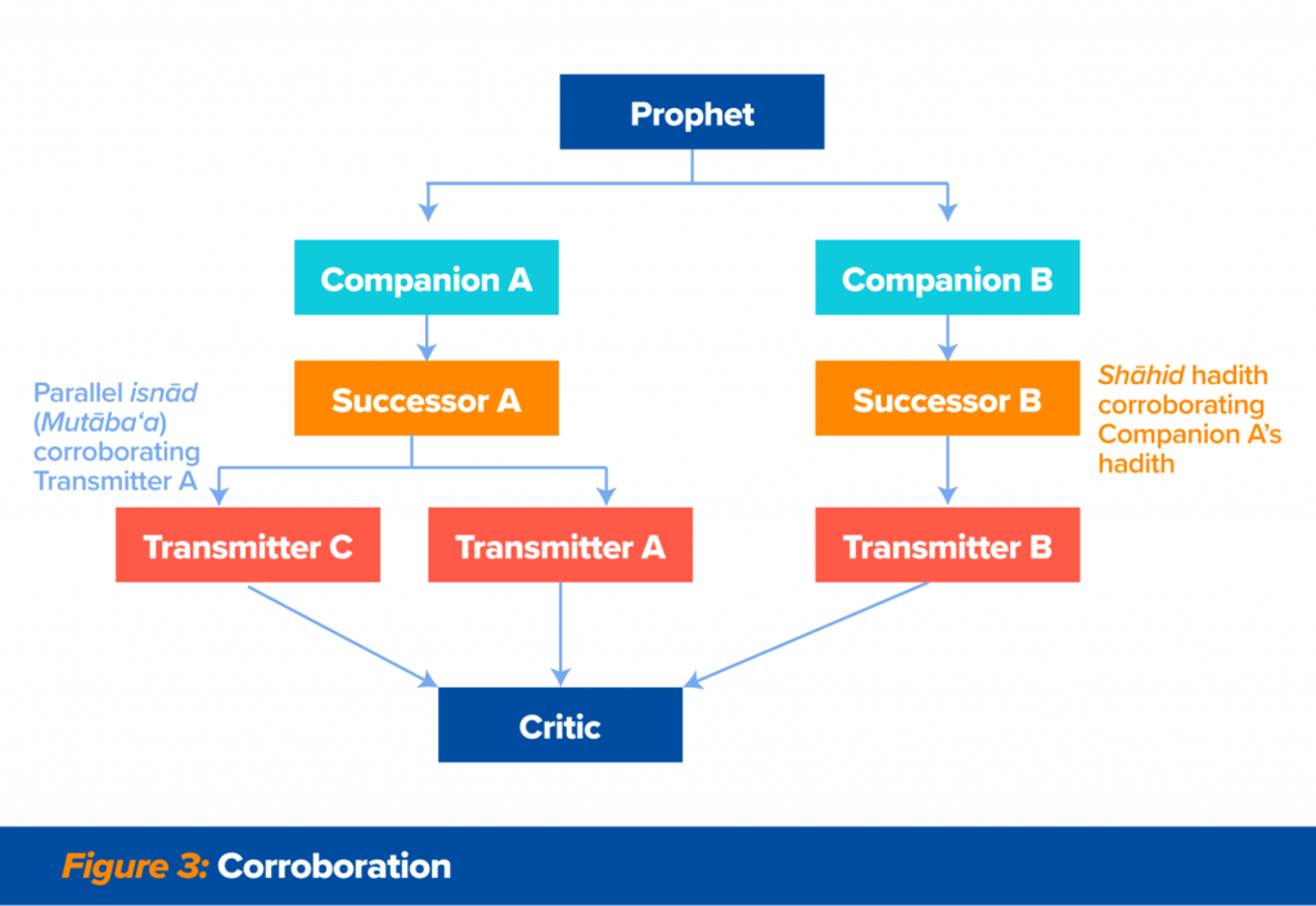
Corroboration matters because a report known only through an inaccurate transmitter is harder to use as proof than one supported through credible paths. But “no second chain found” is not a mechanical verdict of fabrication. A critic also considers the transmitter’s established accuracy, access to a teacher, and whether the report conflicts with better-attested material. Reliability is an assessment of the particular evidence, not simply a count of lines on a diagram.
Authenticating Hadith and the History of Hadith Criticism
Return to Brown’s article for the distinction between kinds of corroboration and the importance of context.
In “Step three: Finding corroboration for the hadith,” read the paragraph beginning “Corroboration took two general forms,” from two forms through its end. Then, below the extended quotation from Ibn Ḥibbān, find the paragraph beginning “Of course, this process of demanding corroboration took context into consideration.” Read the contextual qualification and finish the paragraph. Notice why the same lack of corroboration can carry different weight in different circumstances.
Why critics may reach different assessments
Critics did not always possess identical evidence or use identical thresholds. They could also judge a transmitter differently depending on which teacher that person was reporting from. Brown gives the case of Ibn Isḥāq, whose reliability was disputed among prominent critics. That disagreement illustrates a consequential point: if a report depends on a contested transmitter, later scholars may disagree about the report’s evidentiary strength without disagreeing about its words.
Authenticating Hadith and the History of Hadith Criticism
Read Brown’s example of disagreement among critics. Its purpose here is to show why a reliability assessment can itself require judgment.
Under “Reconciling disagreements among critics,” read the opening paragraph, from Ibn Isḥāq’s case. Continue through the next paragraph, from differing assessments. Focus on the reasons given for disagreement rather than trying to memorize the critics’ names.
The legal consequence depends on the report’s role among the other evidence. If it merely repeats an established rule, setting it aside may change little. If it supplies an exception to a general rule, accepting or rejecting it can change the answer for precisely the people covered by that exception.
Worked example: a disputed report and a disputed exception
The following example concerns classical rulings on apostasy. It involves severe historical punishments and is presented to explain a difference in juristic reasoning—not to endorse those punishments or describe present-day state law.
According to the assigned reading, classical jurists cited reports that they understood to support a punishment for apostasy. They then differed on a narrower question concerning women. The reading describes the Hanafi school as accepting a report that the Prophet prohibited killing women who left Islam; on that basis, its ruling was imprisonment rather than execution. It describes the majority of other jurists as judging that particular report unreliable and applying instead a general rule they understood to treat men and women alike in these punishments.
The Issue of Apostasy in Islam
Read the relevant passages in “The Issue of Apostasy in Islam” by Jonathan A. C. Brown. Treat them as an account of a classical juristic disagreement, while keeping the report, its reliability assessment, and each ruling distinct.
In “The Punishment for Apostasy in the Islamic Juristic Tradition,” start at the paragraph beginning “In all the classical schools of Sunni and Shiite Islam” and read the cited reports. Then move past the discussion of qualifications and outward expressions of belief to the paragraph beginning “Muslim scholars have disagreed on two other details of apostasy.” Read the disputed ruling, stopping before the paragraph on opportunities to repent. Focus especially on which report is disputed and what each side does when deciding whether to use it.
Here is the reasoning laid out without treating either conclusion as automatic:
| Point of decision | Hanafi position as described in the reading | Majority position as described in the reading |
|---|---|---|
| Disputed report | Accepts the report prohibiting killing women who left Islam as reliable evidence | Judges that report unreliable |
| How the evidence is used | Treats the accepted report as grounds for an exception concerning women | Does not use the disputed report to establish that exception; applies a general principle of equal treatment |
| Classical ruling described | Imprisonment rather than execution | Execution under the general ruling |
Notice the precise claim this example supports. Different reliability assessments help produce different legal conclusions because one side has evidence for a proposed exception that the other side does not accept. Reliability is not the whole story: jurists must still interpret the accepted report, determine its scope, and weigh it alongside other evidence. Likewise, rejecting one report does not, by itself, prove the majority ruling; that ruling also depends on the jurists’ treatment of the general evidence.
Finally, these are juristic rulings, not self-executing state statutes. A conclusion reached in fiqh and a rule recognized or enforced by a state are different things. Keeping that distinction in view prevents a discussion of historical jurisprudence from being mistaken for a statement about any country’s current law.
Conclusion
A hadith-based legal disagreement may begin before anyone interprets the report’s wording. Critics assess transmitters, chains, and corroboration; jurists decide whether a report is strong enough to use and then how it fits with other evidence. In the worked example, a disputed report mattered because it was used to support an exception to a broader ruling.
The next lesson considers a different route to a legal conclusion: analogical reasoning (qiyas), used when jurists identify a relevant shared cause between an established ruling and a new case.