Introduction
Welcome back. In our last lesson, we explored how to design interventions to prevent and mitigate change fatigue. We discussed the importance of acknowledging the sense of loss people feel, anchoring them in stability, and using a toolkit of practical activities to restore energy and clarity.
A critical theme emerged: for any of these interventions to work—whether it's a Feedback Wall or an open conversation about what's being lost—people must feel safe enough to speak up honestly. If they fear being judged, penalized, or sidelined for expressing their anxieties or admitting a mistake, your best efforts will be met with silence.
This brings us directly to today's topic, the very foundation of a resilient, change-capable organization. The learning outcome for this lesson is to develop strategies for creating psychological safety during organizational transformation. We will define what psychological safety truly means in a high-performance context, provide a structured framework for building it, and equip you with a toolkit of leadership behaviors and team-level practices.
1. What Psychological Safety Is (and Isn't)
The term "psychological safety" is often misunderstood. It is not about being "nice," lowering standards, or creating a conflict-free environment. It is about creating a climate where candor is expected and welcome.
Let's start with the foundational expert on this topic, Harvard Business School professor Amy Edmondson.
Building a psychologically safe workplace | Amy Edmondson | TEDxHGSE
In this renowned TEDx talk, Amy Edmondson uses powerful stories to illustrate why people instinctively stay silent at work and what psychological safety really is.
Please watch the first 7 minutes and 19 seconds (00:00 - 07:19). As you watch, reflect on your own experiences. Have you seen situations like the nurse, the pilot, or the executive she describes? Pay close attention to her definition of psychological safety and her research finding that 'better' teams appeared to report more errors.
Edmondson defines psychological safety as "a belief that it's absolutely okay, in fact it's expected, to speak up with concerns, with questions, with ideas, with mistakes."
During your transformation—especially the shift to microservices and AI—your team members will constantly be in situations where they risk looking:
- Ignorant: "How does this new API authentication work again?"
- Incompetent: "I've spent a day on this bug in the new service and I'm stuck."
- Intrusive: "Are we sure this is the right component to migrate next?"
- Negative: "This new AI-powered feature is promising, but I see a huge data privacy risk."
If people stay silent in these moments, your transformation will be crippled by hidden problems, slow learning, and missed opportunities.
The Performance Zone: Safety + Accountability
A common fear among leaders is that fostering psychological safety means sacrificing accountability and performance. This is a false dichotomy. True high performance exists where psychological safety and accountability are both high.
This 2x2 matrix, adapted from Amy Edmondson's work, illustrates that psychological safety is not about comfort. The goal is the 'Learning Zone' or 'High-Performance Zone', where high accountability is matched with high psychological safety, enabling teams to learn, innovate, and perform at their best, especially under the pressures of a transformation.
During your transformation, you are asking people to operate in a context of high uncertainty and interdependence. This is precisely when psychological safety moves from being a "nice-to-have" to a non-negotiable driver of performance.
2. A Strategic Roadmap: The 4 Stages of Psychological Safety
Thinking about "creating safety" can feel abstract. Dr. Timothy R. Clark provides a practical, phased framework that serves as a strategic roadmap. It breaks down the journey into four progressive stages, aligning with fundamental human needs.
The Fearless Organization in Practice: A Strategic Blueprint
This article, 'The Fearless Organization in Practice,' provides a detailed blueprint for cultural transformation. We will focus on the section that introduces Dr. Clark's 4 Stages model.
Please read 'Section 4: The Blueprint for Transformation'. This section outlines the 4 Stages of Psychological Safety™ framework. For each stage, focus on its definition and the key leadership actions required to foster it.
This model gives you a powerful diagnostic tool and a clear, sequential path for your transformation efforts.
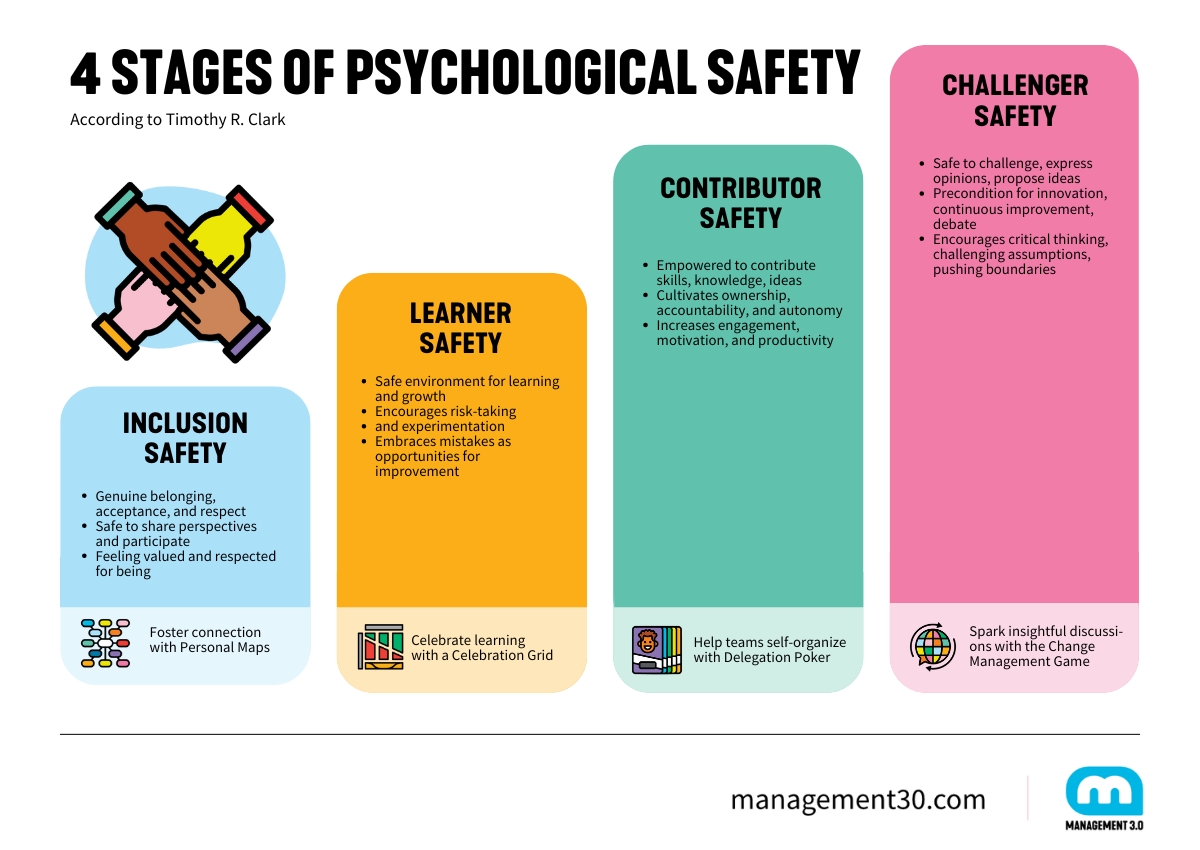
Here's how the four stages apply directly to your transformation context:
- Inclusion Safety (The Need to Belong): Before people will risk learning or contributing, they must feel accepted. During an organizational restructuring, this is the first stage to be threatened. Your first job is to ensure everyone, especially those in changed roles, feels they have a secure place on the new team.
- Learner Safety (The Need to Learn): This is the heart of your technical transformation. Your teams are learning new architectures (microservices) and new technologies (AI). They will make mistakes. Learner safety means they feel safe to ask "dumb" questions, experiment, and fail without fear of humiliation.
- Contributor Safety (The Need to Make a Difference): Once team members have learned, they need to feel safe to contribute. This means empowering an engineer to apply their new skills to build a service, or allowing a salesperson to help redesign the GTM messaging for the new modular product.
- Challenger Safety (The Need to Make Things Better): This is the ultimate goal. You need your teams to feel safe enough to challenge the transformation plan itself. You want the junior developer who spots a flaw in the migration strategy to speak up. You want the customer success manager who foresees a customer backlash to raise the alarm. Without challenger safety, you are flying blind.
3. The Leader's Toolkit: Actionable Strategies to Build Safety
Knowing the stages is one thing; activating them is another. As a leader, you are the primary architect of psychological safety. Your behaviors and the systems you design have an outsized impact.
Let's organize the practical strategies from the resources into three key areas.
Strategy 1: Model Vulnerability and Curiosity
Safety starts with you. Your team is constantly looking to you for cues on what is and isn't acceptable behavior.
Building a psychologically safe workplace | Amy Edmondson | TEDxHGSE
Let's return to Amy Edmondson's TEDx talk to hear her three essential, actionable steps for any leader.
Please watch the segment from 07:19 to 08:36. Note her three simple but powerful recommendations for leaders.
Her advice, supported by the other resources, forms the core of your personal leadership practice:
- Frame the Work as a Learning Problem: Constantly repeat that you are in uncharted territory. Use phrases like, "We've never built a product with this AI layer before, so we're going to have to learn our way to the solution. We'll need everyone's brains in the game." This makes mistakes an expected part of the process.
- Acknowledge Your Own Fallibility: Model vulnerability by admitting your own mistakes and knowledge gaps. Say things like, "I could be wrong about this timeline, I need you to poke holes in it," or "I don't fully understand the technical trade-off here, can you explain it to me?"
- Model Curiosity and Ask Powerful Questions: Shift from telling to asking. Actively invite input with open-ended questions like:
- "What are your thoughts on this?"
- "What are we missing?"
- "Who has a different perspective?"
Strategy 2: Re-engineer Team Interactions and Rituals
Embed safety into the team's daily operating rhythm by changing how you meet, give feedback, and handle failure.
The Fearless Organization in Practice: A Strategic Blueprint
This section of 'The Fearless Organization in Practice' provides a list of concrete exercises and meeting protocols you can implement immediately.
Please read 'Section 6: Activating Change at the Team Level'. Pay attention to the practical ideas like 'Team Charters,' 'User Manual of Me,' and 'Blameless Post-Mortems.'
Here are some high-impact practices to implement:
- Establish Team Charters: Run a workshop where the team collaboratively defines its own rules of engagement. How will you disagree respectfully? How will you share concerns? This creates shared ownership of the team's culture.
- Conduct Blameless Post-Mortems: This is vital for your engineering teams. When a deployment fails or a bug is discovered, the review process must focus 100% on "What can we learn from this to make the system more resilient?" rather than "Whose fault was it?"
- Structure Meetings for Inclusion:
- Start meetings with a brief, human check-in.
- Use structured dialogue, like a round-robin, to ensure everyone gets a chance to speak.
- Provide multiple channels for input (e.g., a shared document for pre-meeting thoughts) to include those who are less comfortable speaking up on the spot.
Strategy 3: Hardwire Safety into Organizational Systems
Your personal actions and team rituals can be undermined if the formal systems of the organization send a different message. Your background in Org Design and L&D makes you perfectly suited to champion these systemic changes.
- Performance Management: Shift reviews to focus on learning and growth, not just outcomes. Acknowledge the learning curve of a new technology; don't penalize an engineer whose initial velocity drops while they are mastering a new microservice pattern.
- Incentive Structures: Ensure that bonuses and recognition don't create zero-sum competition. Reward team-based collaboration on new initiatives and "assisting" activities that promote shared learning.
- Feedback and Reporting Channels: Create clear, reliable, and confidential channels for raising concerns about the transformation without fear of retaliation.
This image presents a useful cyclical model for this kind of continuous effort.

Practical Application Exercise
Let's apply this to a scenario within your transformation program.
Scenario: You are leading the transformation. One of the product teams is tasked with integrating a new AI-driven recommendation engine into a core product. It's a high-stakes project. In a steering committee meeting, the team lead reports that everything is "green" and on track. However, in a separate, informal conversation, a junior engineer from that team mentions to you that they are struggling with unexpected data quality issues and that the AI model's performance in their staging environment is far below what was promised. They quickly add, "But I'm sure we'll figure it out."
Your Task (10 minutes):
- Diagnose the Situation: Using the 4 Stages of Psychological Safety, at which stage(s) is this team most likely struggling? Explain your reasoning.
- Develop a Three-Part Strategy: Outline three specific, actionable steps you would take to address this situation. Your strategy should include:
- An immediate leadership action (modeling behavior).
- A team-level process change (re-engineering an interaction).
- A question to ask about the organizational system (to see if it's contributing to the problem).
Conclusion
In this lesson, we have moved from the abstract concept of psychological safety to a concrete set of strategies for building it. You've learned that it is not about being soft but about enabling high performance, especially in the face of uncertainty.
Key Takeaways:
- Psychological safety is the prerequisite for success in transformation. It allows teams to learn, make mistakes, and voice concerns openly—all of which are essential for navigating change.
- It is built systematically through four stages: Inclusion, Learner, Contributor, and Challenger Safety. This provides a clear developmental roadmap.
- Leadership is the catalyst. Creating safety starts with you modeling vulnerability, humility, and curiosity.
- It must be embedded in daily rituals and formal systems. Safety is created through consistent practice in meetings, feedback sessions, and performance reviews.
Preview of the Next Lesson
Creating psychological safety allows difficult truths and anxieties to surface. One of the most potent anxieties in your specific transformation will be the fear of job displacement due to AI. Having created the space for this fear to be voiced, you must be prepared to address it directly.
In our next lesson, we will tackle this head-on. We will focus on how to address job displacement fears arising from AI transformation with transparency and empathy, applying the principles of psychological safety to one of the most sensitive aspects of your program.