Introduction
Welcome back! In our previous lesson, we crafted the core story of your transformation, focusing on its fundamental "Why" and using narrative frameworks like the Hero's Journey to create a compelling, high-level vision. You now have the "story spine" that grounds the entire change initiative in a shared purpose.
However, a single story, no matter how powerful, rarely resonates equally with everyone in a diverse organization. A Head of Sales, a Customer Success Manager, and a CFO are all motivated by different priorities and speak different professional languages.
Today's lesson directly addresses this challenge. Our learning outcome is to translate technical shifts (microservices and AI) into value-based narratives for non-technical audiences. We will move from the general to the specific, learning how to adapt your core story into tailored messages that connect with the tangible, day-to-day concerns of various business departments.
Given your product management experience, you can think of this as moving from the overall product vision to creating specific value propositions for different user personas. The skill is the same: translating features into benefits that matter to a specific audience.
1. The Art of Translation: From Technical Jargon to Business Impact
Before diving into microservices and AI, let's establish the core principles of communicating complex topics to a non-technical audience. It’s a common pitfall for experts to overwhelm others with technical details, losing their interest and support before the key message is even delivered.
To start, let's watch a short, practical video on this skill.
Explaining Technical Information to Non-Technical People
This video, 'Explaining Technical Information to Non-Technical People,' offers straightforward advice on why simplifying your language is a crucial skill and how to begin doing it.
Please watch from the beginning to 01:15 and then from 02:53 to 04:06. Focus on: The core idea that simplicity demonstrates intelligence, not the use of jargon. The power of using analogies to make complex concepts relatable (e.g., the database as a book with bookmarks).
The video emphasizes a crucial point: your goal is not to "dumb down" the information but to make your audience feel included and understood. This is achieved by shifting the focus from how the technology works to what it achieves for them.
To build on this, let's explore a more strategic perspective on this type of communication.
How Can You Communicate Technical Concepts to Non ... - Medium
This article, 'How Can You Communicate Technical Concepts to Non-Technical Stakeholders,' provides excellent strategies for translating technical ideas into business value. It directly aligns with our goal for this lesson.
Please read the sections titled 'Know Your Audience,' 'Eliminate Jargon Ruthlessly,' 'Leverage the Power of Analogies,' and 'Connect Technical Choices to Business Outcomes.' Pay close attention to the examples provided, like the distinction between saying 'We need microservices' and framing it as a business strategy.
These resources give us a clear formula for our translation work:
- Know your audience: What are their goals, metrics, and pain points? (e.g., Sales cares about quota, CS cares about ticket volume, Finance cares about ROI).
- Eliminate jargon: Replace technical terms with their business outcomes.
- Use analogies: Connect abstract concepts to familiar, real-world experiences.
- Connect to business outcomes: Explicitly state how the technology helps achieve a specific business goal (e.g., increase revenue, reduce costs, improve customer satisfaction).
Now, let's apply this formula to the two major technical shifts in your transformation.
2. Translating Microservices into Business Value
The phrase "migrating from a monolith to a microservices architecture" is precise for an engineering audience but means very little to your sales, marketing, or finance teams. To them, it's abstract, risky, and doesn't immediately solve their problems. Your task is to reframe it.
The following article is purpose-built for this challenge, offering clear language to make the case for microservices to a business audience.
How to make the case for microservices - The Enterprisers Project
The article 'How to make the case for microservices' from The Enterprisers Project provides specific talking points for evangelizing this architectural shift.
Please read the subsections under 'Evangelizing microservices to a wide audience,' specifically: 'Describe benefits in terms of business value' 'Sell outcomes, not technologies' 'Tell a complete total cost of ownership (TCO) story' Focus on how the text reframes technical benefits like 'independent deployment' and 'scalability' into business outcomes like 'faster time to market' and 'optimized infrastructure spend.'
Let's synthesize this into a practical "translation table." On the left is the technical benefit of microservices; on the right is the value-based narrative for a specific department.
| Technical Benefit of Microservices | Value-Based Narrative for a Non-Technical Audience |
|---|---|
| Independent Team Deployment | For Sales: "Imagine being able to tell an enterprise client 'yes' when they ask for a key feature, knowing our team can deliver it in weeks without waiting for a massive, twice-a-year release. This is how we'll win more deals." |
| Increased System Resilience | For Customer Success: "This means fewer 'all hands on deck' emergencies. If one small part of the application has an issue, it won't bring down the entire platform. This leads to more stable service, happier customers, and lower ticket volume." |
| Targeted Scalability | For Finance/Leadership: "Instead of paying to scale our entire, expensive infrastructure during peak loads, we can scale only the specific services that need it. This allows us to manage our costs much more efficiently and invest that money back into innovation." |
| Technology Flexibility | For Product & Strategy: "This architecture allows us to experiment with new technologies, like a new AI feature, on a small and isolated part of our product. We can test new ideas faster, with less risk, and stay ahead of the competition." |
When you talk to these teams, you lead with the value narrative. The term "microservices" becomes secondary—it's simply the how behind the benefit you're delivering to them.
3. Translating AI into Business Value
Artificial Intelligence can be even more intimidating than microservices, often conjuring images of extreme complexity or job replacement. The key to creating a positive narrative is to demystify it and show how it augments human capability, making people better at their jobs.
Andrew Ng, a global leader in AI, is a master at this. Let's watch his TED talk to see how he does it.
How AI Could Empower Any Business | Andrew Ng | TED
In his talk, 'How AI Could Empower Any Business,' Andrew Ng explains how AI can be accessible and valuable beyond big tech companies. He provides brilliant, simple examples of its application.
Please watch from 02:03 to 05:19. Notice how Ng doesn't talk about algorithms or neural networks. Instead, he focuses on specific roles—a pizza shop owner, an accountant, a store manager, a quality inspector—and describes a concrete problem AI could solve for them.
Ng's approach is the blueprint for your own narrative. You need to connect AI capabilities to specific job functions within your B2B software company.
Let's create another translation table for AI:
| AI Capability | Value-Based Narrative for a Non-Technical Audience |
|---|---|
| Predictive Analytics | For Sales: "Our new AI tools will analyze historical deal data to create a 'likelihood to close' score for every lead in the pipeline. This helps you focus your energy on the most promising opportunities and provides data-backed insights for your forecasting." |
| Natural Language Processing (NLP) | For Customer Success: "Instead of manually reading and sorting every support ticket, our AI will automatically categorize them by topic and urgency. It can even suggest draft responses for common questions, freeing you up to provide high-touch support for our most complex customer issues." |
| Anomaly Detection | For Product Management: "The AI layer will monitor user behavior in real time, automatically flagging unusual patterns. This could be an early warning of a critical bug or, more excitingly, it could reveal a new and unexpected way customers are getting value from our product, sparking ideas for our next feature." |
| Personalization Engine | For Marketing: "We can use AI to deliver a unique experience for every user, highlighting the features and content most relevant to their job role and usage history. This will dramatically improve user engagement, adoption, and create more opportunities for upselling." |
These narratives transform AI from a vague, futuristic concept into a practical tool that helps people succeed in their roles today.
Practical Application Exercise
In the last lesson, you created the high-level "story spine" for the transformation. Now, let's practice tailoring that story for a specific audience.
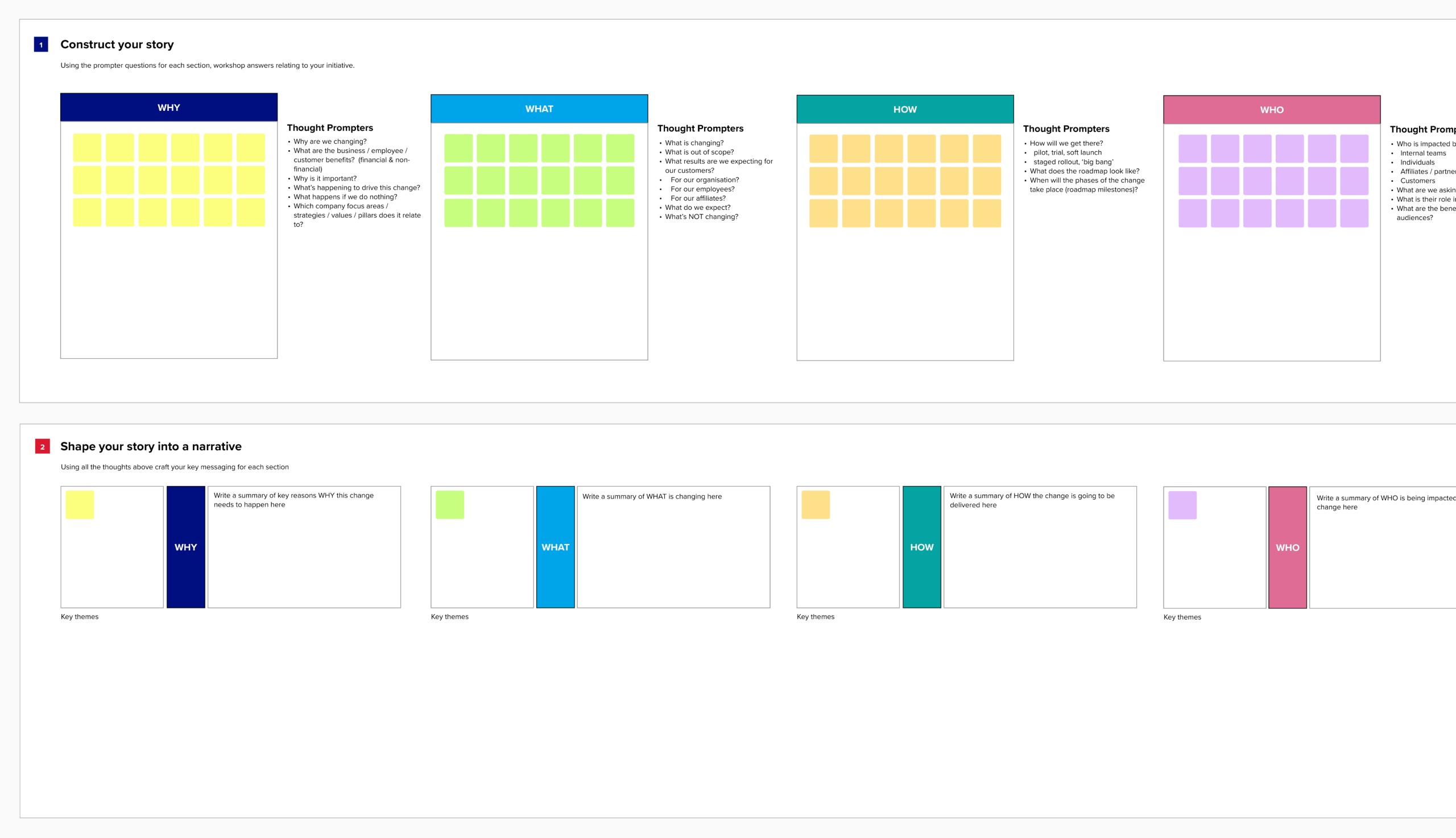
Your Task (15 minutes):
Choose one non-technical stakeholder group from your company (e.g., the Sales team, the Customer Success team, or the Finance department).
Using the "Why, What, How, Who" framework shown in the image above, draft a short, targeted narrative that explains the microservices and AI transformation specifically for them.
- WHY: Why are we doing this for you? (Connect to their goals).
- WHAT: What is changing for you? What will you be able to do that you couldn't before? (Focus on the value, not the tech).
- HOW: How will we support you through this? (Mention training, new tools, etc.).
- WHO: Who will benefit? (Emphasize the benefit to them, their customers, and the company).
Use the value propositions from the translation tables in this lesson to inform your points.
Example Answer for a Sales Team
- WHY: To help you win more deals and hit your targets by giving you a more flexible, powerful, and intelligent platform to sell.
- WHAT:
- You'll be able to confidently promise and deliver high-value features for key clients much faster.
- You'll have AI-powered insights to help you identify and focus on the leads most likely to close.
- You'll be selling a modular product, allowing you to create custom-fit solutions that perfectly match a customer's budget and needs.
- HOW: We will provide you with new demo environments, battle cards explaining the competitive advantages, and training on how to sell value based on this new modularity and intelligence.
- WHO: You will be able to close more complex deals and earn more. Your customers will get value faster. And the company will reclaim its position as the market's leading innovator.
Conclusion
In this lesson, you have acquired a critical skill for any transformation leader: the ability to translate complex technical change into compelling, role-specific business value. By moving beyond jargon and focusing on the "what's in it for me?" for each audience, you turn potential skeptics into informed advocates.
Key Takeaways:
- Translation is about empathy: Successful communication starts with understanding the priorities, language, and pain points of your audience.
- Focus on outcomes, not mechanics: Your non-technical colleagues don't need to know how microservices or AI work; they need to know what these technologies will do for them and their customers.
- Analogies and specific examples are your tools: Use the translation tables we developed as a model. For every technical feature, develop a clear, value-based narrative for each key stakeholder group.
- This is a core leadership skill: The ability to articulate a clear and compelling vision across all parts of the business is what separates a project manager from a true transformation leader.
Preview of the Next Lesson
You are now equipped to craft the right message for the right audience. The next step is to orchestrate how these messages are delivered over time to build and sustain momentum.
In our next lesson, we will focus on the learning outcome: "Design tailored messaging for different stakeholder groups including Sales, Customer Success, Finance, and Engineering." We will build directly on today's work to structure a full-fledged communication plan, deciding not just what to say, but when, where, and how to say it to create a powerful internal PR campaign for your transformation.