Introduction
Welcome back. In our last lesson, we established the strategic why behind a migration from a monolithic to a microservices architecture. We explored how this shift isn't just a technical upgrade but a strategic response to business challenges like slow time-to-market, inefficient scaling, and stifled innovation. Critically, we framed it as a way to manage team cognitive load, unlocking higher performance and agility.
Today, we move from the why to the what. This lesson addresses the learning outcome: Describe key architectural differences between monolithic and microservices-based products at a strategic level. Understanding these differences is crucial for you as a transformation leader. It will enable you to have credible, productive conversations with your engineering counterparts, grasp the true scope of the transformation, and anticipate the profound organizational impacts we will discuss in our next lesson.
We will not delve into code-level details but will focus on the fundamental structural, data, and communication differences that have significant strategic consequences.
1. The Core Difference: A Single Unit vs. a Constellation of Services
The most fundamental distinction lies in how the application is structured and deployed. A monolith is a single, indivisible unit. A microservices-based application is a collection of small, autonomous services that work together.
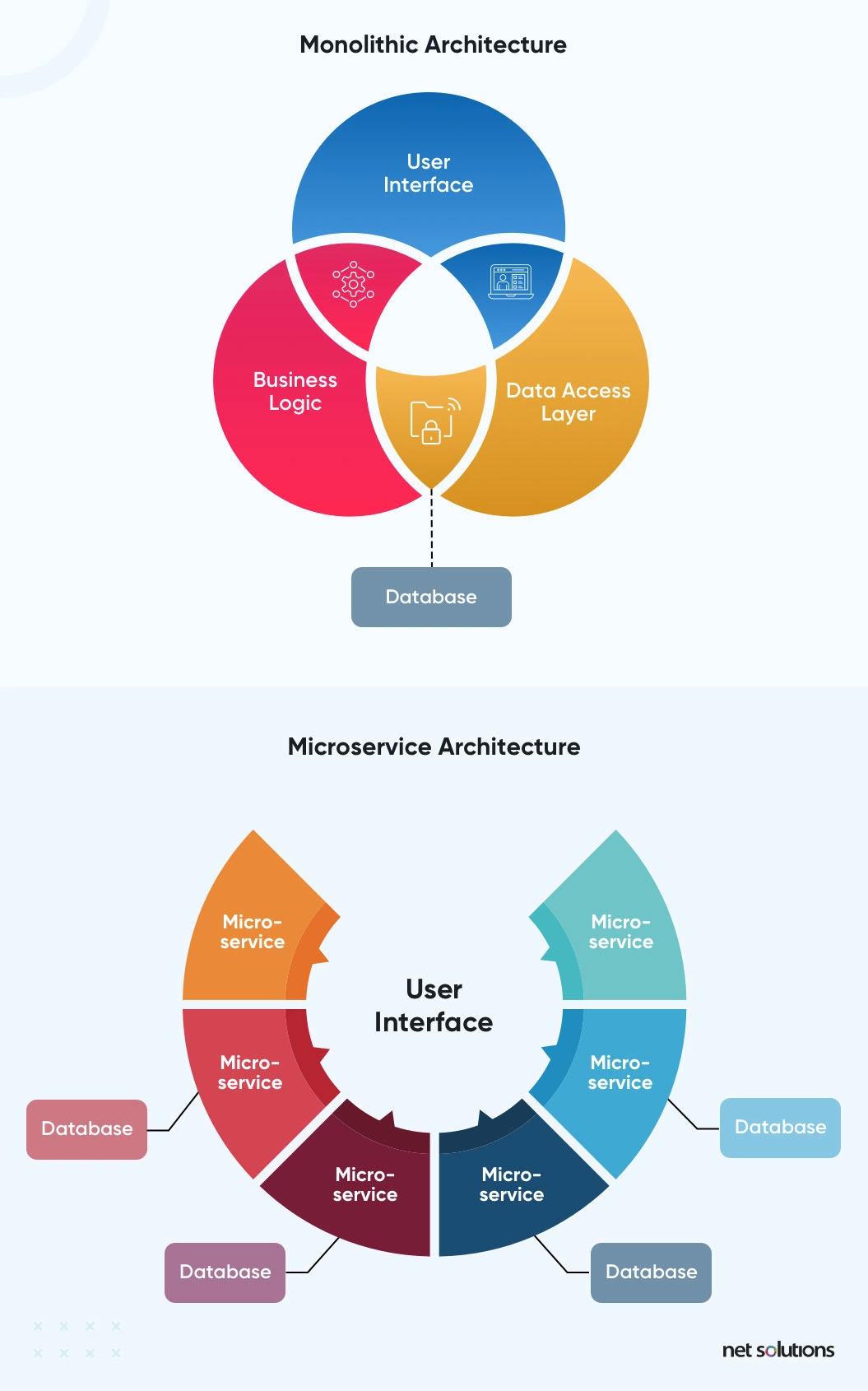
To solidify this foundational concept, let's start with a clear video explanation.
Monolithic vs Microservice Architecture: Which To Use and When?
The video 'Monolithic vs Microservice Architecture' by Alex Hyett provides a straightforward overview. We'll watch the segments that define each architecture.
Please watch the following two short segments: What is a monolith? (0:09 - 0:45) What are microservices? (3:25 - 4:14) As you watch, note how a monolith is described as 'one piece of code' and microservices are described as 'individual components' with 'single responsibility'.
The article "Microservices vs. Monolithic Architecture" provides a concise textual summary of these characteristics, which is useful for reference.
Microservices vs. Monolithic Architecture: A Decision Framework with Real-World Examples
This article from Full Scale offers a well-structured breakdown of the architectural fundamentals. It's a great resource to keep for reference.
Please read the section titled 'Architecture Fundamentals', focusing on the 'Key Characteristics' listed for both Monolithic and Microservices Architecture. This will reinforce the video's points.
At a strategic level, this difference between one and many has direct consequences:
- Deployment: A change to a monolith requires deploying the entire application. A change to a microservice requires deploying only that service.
- Technology Stack: A monolith is built on a single, unified technology stack. A microservices architecture allows for technology diversity; each service can use the language and tools best suited for its specific job.
- Fault Isolation: An error in a monolith can bring down the entire application. In a microservices architecture, the failure of one non-critical service may only degrade functionality, not cause a total outage.
2. Data Management: The Shared Database vs. "Database per Service"
One of the most significant and challenging architectural differences is how data is managed.
-
Monolithic Architecture: Typically uses a single, shared database for the entire application. All features and components read from and write to this central database. This is simple to manage initially and ensures strong data consistency. However, over time, this shared database becomes a major bottleneck. Any change to the database schema must be coordinated across all teams, and it becomes a single point of failure and contention.
-
Microservices Architecture: The guiding principle is for each service to own and manage its own data. This is often referred to as "database per service." The "Customer" service has its own customer database, and the "Orders" service has its order database. No other service is allowed to access another service's database directly.
This decoupling of data has profound strategic implications:
- Team Autonomy: Teams can manage and evolve their data model without coordinating with dozens of other teams.
- Optimized Technology: A service can choose the type of database that best fits its needs (e.g., a relational SQL database for transactional data, a NoSQL document store for product catalogs).
- Introduced Complexity: This autonomy comes at the cost of data consistency. Since data is distributed, ensuring consistency across services becomes a major architectural challenge, often requiring patterns like "eventual consistency" and complex event-driven communication.
As a transformation leader, you don't need to be an expert in these patterns, but you must understand that migrating data from a single database to dozens of smaller ones is one of the riskiest and most complex parts of the entire transformation.
3. Communication: Internal Function Calls vs. External Network Calls
The way components talk to each other is another core differentiator.
-
Monolithic Architecture: Communication between different parts of the application happens through simple, in-process function calls. This is extremely fast and reliable. When the "Payment" module needs to check a "User Profile," it just calls a function directly within the same running application.
-
Microservices Architecture: Since services are independent applications, they must communicate over a network using mechanisms like APIs (for synchronous, request-response interactions) or message brokers (for asynchronous, event-based communication).
This shift from internal to external communication is a critical trade-off.
Monolithic vs Microservice Architecture: Which To Use and When?
Let's return to the Alex Hyett video, which has an excellent segment explaining the three main ways microservices communicate.
Please watch the section from 4:06 to 5:24. Focus on understanding the difference between synchronous communication via API and asynchronous communication via a message broker. This distinction is key to managing complex workflows in a distributed system.
The strategic trade-offs are significant:
- Performance: Network calls are orders of magnitude slower than in-process function calls. This added latency must be managed.
- Reliability: The network is inherently unreliable. Microservices must be designed to handle failures in communication (e.g., using retries and circuit breakers).
- Complexity: Debugging a request that travels across multiple services is far more complex than tracing a single function call. This necessitates sophisticated distributed tracing and monitoring tools, increasing operational overhead.
4. Organizational Implications: Losing the "Anvil of Alignment"
Perhaps the most important difference for a leader with your background in organizational design is not technical but socio-technical. A monolith, for all its faults, performs a hidden organizational function.
The anvil of alignment: The value of monoliths over microservices
The article 'The anvil of alignment' from Test Double introduces a powerful concept for understanding the hidden value of a monolith. It argues that a monolith acts as a forcing function for organizational cohesion.
Please read the first four sections of the article, up to (but not including) 'Navigating the architectural divide as a leader'. Focus on understanding: The concept of the monolith as an 'anvil of alignment.' How moving to microservices removes this forcing function. The 'hidden costs' this creates, especially related to Conway's Law and operational complexity.
As the article explains, a monolith acts as an "anvil of alignment." Because everything must be built, tested, and deployed as a single unit, teams are forced to resolve their differences. If the "Sales" team and the "Support" team have different definitions of what a "Customer" is, they must agree on a single definition for the shared codebase to work. The architecture itself enforces organizational alignment.
Microservices remove this anvil. Each team can have its own definition of "Customer" within its own service. This grants autonomy but introduces the risk of organizational drift. Without the architectural forcing function, you must replace it with explicit governance, deliberate communication structures, and a strong, shared mission.
This connects directly to Conway's Law, which we've discussed before. If your organization has dysfunctional communication, a microservices migration won't fix it; it will simply codify that dysfunction into a set of poorly defined, misaligned services.
Practical Application: Comparing the Architectures
To synthesize what you've learned, create a simple comparison table. This will be a valuable artifact for you to use when explaining the trade-offs to other leaders.
Exercise (Approx. 10 minutes):
Create a table with the following rows and fill in the columns for "Monolithic Architecture" and "Microservices Architecture" based on the materials in this lesson.
| Dimension | Monolithic Architecture | Microservices Architecture |
|---|---|---|
| Deployment Unit | Single, large application | Multiple, independent services |
| Scaling | ||
| Technology Stack | ||
| Data Governance | ||
| Communication | ||
| Fault Isolation | ||
| Team Structure | ||
| Organizational Alignment |
Think about how you would describe each point to a non-technical executive.
Conclusion
In this lesson, we have dissected the key architectural differences between monolithic and microservices-based products. These are not just technical details; they are strategic choices with deep and lasting consequences for your organization's structure, processes, and culture.
Key Takeaways:
- Structural Differences: Monoliths are single, tightly-coupled units, while microservices are a collection of small, independent, and loosely-coupled services.
- Data Decoupling: Microservices trade the simplicity of a shared database for the autonomy of "database per service," introducing challenges in data consistency.
- Communication Overhead: Microservices replace fast, internal function calls with slower, more complex network communication (APIs, messaging).
- Organizational Impact: The shift to microservices removes the implicit "anvil of alignment" provided by a monolith, requiring explicit governance and communication strategies to prevent organizational drift.
The choice is not about which is "better," but about which set of trade-offs is right for your organization's scale, maturity, and strategic goals. As a leader, your role is to understand and guide the organization through managing these trade-offs.
Preview of the Next Lesson
We've now looked at the why and the what of the architectural shift. The logical next step is to analyze the human impact. In our next lesson, we will assess the organizational impact of a microservices migration on teams, roles, and workflows. We will explore how this architectural change necessitates a corresponding change in your operating model, team design, and the skills your people need to succeed.