Hello! Welcome back to the course.
In our last lesson, we focused on the crucial activities of backlog refinement and sprint planning. We learned how to collaborate with the team to clarify user stories, strengthen acceptance criteria, and ensure items are "ready" for development. This process creates a clean, well-understood backlog.
But having a backlog of "ready" items raises a new, critical question: what should the team work on next? In a world of limited time and resources, not all features are created equal. This is where prioritization comes in.
Today, you will learn how to prioritize product backlog items using frameworks based on business value and effort. As a Business Analyst, this is one of your most strategic functions. It’s how you help the business translate its goals into a sequence of work that delivers the most impact as quickly as possible. Mastering these frameworks is not only key to building successful products but also a common topic in BA job interviews.
1. Why Prioritize? The Core Principles
Before diving into specific frameworks, let's establish why and what we prioritize. An unprioritized backlog often leads to teams working on low-impact features while high-value opportunities are missed. Prioritization provides a logical structure for making decisions.
The key is to move beyond "gut feelings" or prioritizing based on the "loudest voice in the room." We need structured ways to evaluate items.
How To Prioritize A Product Backlog? | #6
The video 'How To Prioritize A Product Backlog?' provides an excellent foundation. It explains the core concepts and criteria that underpin all prioritization frameworks.
Please watch the following two segments: Why do we need to prioritize? (02:59 - 03:27): This section quickly explains the fundamental need for prioritization. Common criteria for prioritization (03:27 - 04:57): Pay close attention to the four variables discussed: business value, urgency, opportunity enablement/risk reduction, and development effort. These are the building blocks we'll use in the frameworks.
As the video highlights, prioritization is a balancing act. We want to maximize things like business value and urgency while being mindful of the development effort required. The frameworks we'll discuss provide different ways to weigh these factors.
It's also useful to distinguish between prioritizing and ordering.
- Prioritization is about assessing the relative importance or value of items.
- Ordering is the final sequence in the backlog, which considers not only priority but also dependencies (e.g., you must build the foundation of a house before the roof, even if the roof feels more valuable) and team logistics.
2. The Value vs. Effort Matrix: A Visual Approach
The most intuitive way to start prioritizing is by plotting items on a simple 2x2 grid. This framework helps you and your stakeholders visualize the trade-offs between the value an item delivers and the effort required to build it.
Value vs Effort method and Prioritization Matrix | Explanation + Example in Jira backlog
Let's watch 'Value vs Effort method and Prioritization Matrix' to see how this works in practice. This video clearly explains the four quadrants and how to use them to make decisions.
Watch the video from 00:27 to 02:07. Focus on: How 'Value' and 'Effort' are defined and assessed. The four quadrants of the matrix: Quick Wins, Big Projects, Fill-ins, and Time Sinks (or 'money sinks' as the video calls them).
Here is a visual representation of that matrix, often called an Impact/Effort Matrix:
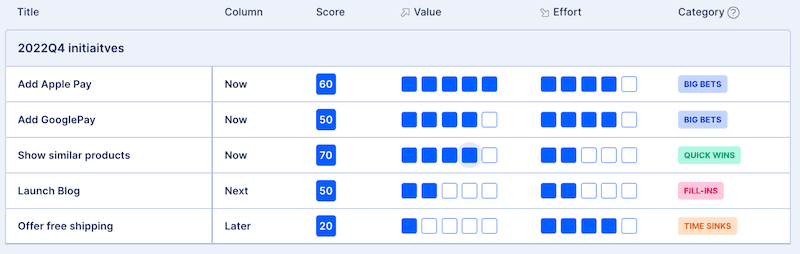
This visual approach is excellent for facilitating discussions with stakeholders. In a workshop, you can have the team collaboratively place user story cards on a physical or virtual whiteboard divided into these four quadrants.
3. MoSCoW: A Categorical Approach
Another popular and straightforward method is MoSCoW, which groups requirements into four categories. This is particularly useful for communicating with stakeholders to agree on the scope of a release or a Minimum Viable Product (MVP).
The categories are:
- M - Must Have: Non-negotiable features. The product or release is not viable without them. These are your core requirements.
- S - Should Have: Important features that add significant value, but the product would still function without them.
- C - Could Have: Desirable "nice-to-have" features that will be included only if time and resources permit.
- W - Won't Have: Features that are explicitly out of scope for the current release or timeframe. This is critical for managing expectations.
AdTech Example: Imagine you are building a new self-serve platform for advertisers.
- Must Have: The ability for an advertiser to create a campaign and upload their ad creative.
- Should Have: A dashboard showing the performance (clicks, impressions) of their live campaigns.
- Could Have: An A/B testing feature to compare two different ad creatives.
- Won't Have: Integration with third-party CRM systems (for this initial release).
Test your understanding!
Your team is developing a new mobile app for an e-commerce client. The stakeholders have provided a list of desired features for the first release:
- User login with email/password.
- Browse products by category.
- Add products to a shopping cart.
- Pay with a credit card.
- Pay with Apple Pay / Google Pay.
- A "dark mode" theme for the UI.
- A blog section with company news.
Using the MoSCoW method, how would you categorize these features?
Show answer
While there can be some debate (which is the point of the framework!), a likely categorization would be:
- Must Have:
- User login with email/password.
- Browse products by category.
- Add products to a shopping cart.
- Pay with a credit card. (The app is useless without a way to pay).
- Should Have:
- Pay with Apple Pay / Google Pay. (Important for convenience and conversion, but the core payment functionality exists with credit cards).
- Could Have:
- A "dark mode" theme for the UI. (A nice-to-have feature that improves user experience but isn't essential for the core function).
- Won't Have:
- A blog section with company news. (This likely doesn't contribute directly to the core goal of selling products and can be postponed).
4. Quantitative Frameworks: RICE and WSJF
While the previous methods are great for qualitative discussion, sometimes you need a more data-driven way to resolve disagreements or compare many different items. Quantitative frameworks use formulas to generate a priority score.
Agile Prioritization Techniques | Guide for Product Managers
The article 'Agile Prioritization Techniques' provides a great deep dive into several frameworks. We'll use it to understand RICE and MoSCoW in more detail, and later to compare all the techniques.
Please read the section titled 'Common Agile Prioritization Techniques Frameworks - Deep Dive'. Focus on the detailed explanations for: The RICE Scoring Model for Data-Driven Decisions MoSCoW Method: A Simple Approach to Stakeholder Alignment Kano Model: Prioritizing for Customer Delight (Note: The Kano model focuses on customer satisfaction rather than just value/effort, but it's an important related concept for a BA to know.)
RICE Scoring
As the article explained, the RICE score helps you systematically evaluate an initiative.
RICE Score = (Reach × Impact × Confidence) / Effort
- Reach: How many users will this feature affect? (e.g., 5,000 users per month)
- Impact: How much will this impact individual users? (Use a simple scale: 3 = massive, 2 = high, 1 = medium, 0.5 = low)
- Confidence: How confident are you in your estimates? (100% = high confidence, 80% = medium, 50% = low)
- Effort: How much time will it take from the team? (e.g., person-months or story points)
This method forces you to think critically about your assumptions and makes your prioritization rationale transparent and defensible.
Weighted Shortest Job First (WSJF)
WSJF is another powerful scoring method, popular in the Scaled Agile Framework (SAFe). It's designed to prioritize work that delivers the highest value in the shortest time.
WSJF = Cost of Delay / Job Size (Effort)
To understand this, let's turn back to our first video, which gives a great explanation of WSJF and the concept of relative estimation that underpins it.
How To Prioritize A Product Backlog? | #6
Let's revisit 'How To Prioritize A Product Backlog?' to understand WSJF. This segment also explains relative estimation, which is how teams often estimate 'Job Size'.
Please watch these two final clips: Relative Estimation (05:28 - 07:18): This explains how teams estimate effort without committing to precise timelines, using scales like T-shirt sizes or the Fibonacci sequence. Weighted Shortest Job First (WSJF) (09:08 - 11:10): This explains the formula and how to calculate a priority score using the four criteria we saw earlier.
The Cost of Delay is calculated by adding the scores for Business Value + Urgency + Opportunity/Risk Reduction. The Job Size is the estimated effort. By dividing the two, you find the items that give you the "most bang for your buck."
5. Choosing the Right Framework
You now have a toolkit with several frameworks. How do you know which one to use? The choice depends on your team, your project, and your goals.
| Framework | Best For... | Key Strength |
|---|---|---|
| Value vs. Effort | Quick, collaborative workshops; small backlogs. | Highly visual and fosters team discussion. |
| MoSCoW | Defining scope for a release/MVP; stakeholder alignment. | Simple to understand and provides clear boundaries. |
| RICE | Data-driven teams; large, complex backlogs. | Reduces bias with a quantitative score. |
| WSJF | Prioritizing for speed of value delivery; SAFe environments. | Maximizes economic value by focusing on time. |
This table is a simplified version of the one found in the "Agile Prioritization Techniques" article, which you can refer back to for more detail.
For a final perspective written specifically for Business Analysts, this next resource provides excellent real-world scenarios and tips.
The Art of Prioritizing Product Backlogs
The article 'The Art of Prioritizing Product Backlogs' synthesizes these concepts from a BA's point of view. It reinforces the frameworks and gives actionable tips on how to apply them.
Skim through these sections to connect the dots: Section 2: Beyond Gut Feel: Reinforces the RICE and WSJF formulas with BA-centric examples. Section 3: Stakeholder Harmony: Briefly read this to see how these frameworks are tools for managing conflict and aligning people. Section 5: Your Prioritization Power-Up: Read the 'Quick Wins for BAs' for ideas on how you can start applying this immediately.
Conclusion
Great job! Today you've learned a set of powerful tools for one of the most strategic parts of an Agile project. Moving items up or down the backlog directly impacts what gets built and when, shaping the future of the product.
Key Takeaways:
- Prioritization is a crucial discipline for focusing limited development resources on the work that delivers the most business value.
- Frameworks provide a structured, transparent way to make these decisions, moving beyond opinions to data-informed discussions.
- You have a range of tools at your disposal:
- Value vs. Effort Matrix for quick, visual collaboration.
- MoSCoW for clear scope definition and stakeholder alignment.
- RICE and WSJF for quantitative, data-driven prioritization.
- As a BA, your role is to facilitate these prioritization discussions, ensuring the chosen method is understood and the inputs (like value and effort) are debated and agreed upon by the team and stakeholders.
Preview of the Next Lesson:
In the last few lessons, we have been deeply immersed in the world of Agile artifacts like the product backlog, user stories, and story maps. But in many organizations, especially larger ones undergoing an Agile transformation, you will also encounter traditional requirements documents. In our next lesson, we will differentiate between traditional requirements documents (BRD) and Agile artifacts (backlog), preparing you to work effectively in any environment.