Hello! Welcome to your next lesson in the Stakeholder Engagement module.
In our previous lessons, we've focused on various ways to gather information from stakeholders and the environment—through interviews, workshops, document analysis, and most recently, job shadowing. These elicitation techniques build our understanding of the business needs and current processes.
Now, we shift our focus from gathering information to distributing it. Effective communication is a two-way street. A Business Analyst must not only be a great listener but also a proactive and strategic communicator. This lesson directly addresses the learning outcome: Develop a stakeholder communication plan for a project.
This plan is your roadmap for keeping everyone informed, engaged, and aligned. For someone with your background in project and account management, you'll recognize this as a critical tool for managing expectations and ensuring project success. We'll formalize this process from a BA perspective, creating an artifact that is essential for both job interviews and on-the-job effectiveness.
Why is a Communication Plan Your Project's Secret Weapon?
On any project, the number of potential communication channels can be surprisingly large. For a project with just 20 stakeholders, there are 190 possible communication pathways! Without a plan, it's easy for crucial information to be missed, leading to misunderstandings, misaligned expectations, and project delays.
Let's start with a short video that highlights the importance of planning your communication.
HOW TO CREATE A COMMUNICATION PLAN IN EXCEL & POWERPOINT | COMMUNICATION PLAN TEMPLATE
This clip from 'HOW TO CREATE A COMMUNICATION PLAN' by Alvin the PM explains why proactive communication planning is so critical to avoiding common project pitfalls.
Watch from 00:42 to 02:33. Notice the formula for calculating communication channels and think about projects you've managed. Have you ever experienced the consequences of someone being left out of a key discussion?
As the video emphasizes, a communication plan is more than just sending emails. It's a strategic document that ensures you are communicating the correct information to the correct people at the correct time.
The Core Components of a Communication Plan
A robust communication plan is designed to answer a few fundamental questions for every piece of information you share. A great way to remember these is by thinking through the "6 Ws" (with a slight twist on the last one):
- WHAT information needs to be communicated? (e.g., project status, risk updates, meeting minutes)
- WHY is this information important? (e.g., to secure budget approval, to inform of a schedule change)
- WHO is the audience receiving the information? (e.g., project sponsor, development team)
- HOW will the information be delivered? What is the medium? (e.g., email, formal report, live demo, Slack message)
- WHO (Owner) is responsible for sending the communication? (e.g., Project Manager, Business Analyst)
- WHEN will it be communicated and with what frequency? (e.g., daily, weekly, at project milestones)
By answering these questions for each key stakeholder group, you create a clear and actionable plan.
Step-by-Step Guide to Developing Your Plan
Creating a stakeholder communication plan involves three main steps. We'll use an excellent article from Resolution as our guide.
Step 1: Map Your Stakeholder Landscape (The "Who")
Before you can plan your communication, you must know your audience. This step relies on the stakeholder analysis you learned to perform in the first module. The key tool here is the Power/Interest Grid.
Build a Stakeholder Communication Plan That Works
The article 'Build a Stakeholder Communication Plan That Works' provides a great refresher on using the Power/Interest Grid to strategically categorize your stakeholders. This is the foundation of your plan.
Read the section 'How to Map Your Stakeholder Landscape.' Pay close attention to the descriptions of the four quadrants (High Power/High Interest, etc.) and the recommended actions for each. This tells you where to focus your communication efforts.
As a quick summary, the grid helps you decide on the communication strategy for each group:
- High Power / High Interest (Manage Closely): These are your key players. They require frequent, detailed, and often face-to-face communication.
- High Power / Low Interest (Keep Satisfied): These stakeholders (e.g., senior executives, a CFO) need concise, high-level summaries that respect their time. Focus on outcomes and risks.
- Low Power / High Interest (Keep Informed): This group (e.g., end-users) is passionate and affected by the project. Keep them informed through broader communications like newsletters, group demos, or status pages.
- Low Power / Low Interest (Monitor): Provide minimal, periodic updates. An FYI email or a general project update usually suffices.
Step 2: Craft Your Messages (The "What" and "Why")
A common mistake is sending the same update to everyone. Effective communication requires tailoring the message to the audience. Your executive sponsor cares about ROI and timeline risks, while the QA team cares about bug-fix rates and testing schedules.
Build a Stakeholder Communication Plan That Works
Now, let's continue with the same article to learn how to tailor your messages effectively.
Read the section 'Crafting Messages That Actually Get Results.' Focus on the concept of defining a clear objective for each communication and the practical steps for message customization.
The key is to frame the facts in a way that is most meaningful to your audience. Always ask yourself: “What do I need this group to know, feel, or do after receiving this message?”
Step 3: Define Channels, Cadence, and Ownership (The "How," "When," and "Owner")
This final step makes your plan tangible. You'll decide on the specific tools, frequency, and responsibilities for each communication type.
Build a Stakeholder Communication Plan That Works
Let's complete our reading with the final piece of the puzzle: setting the rhythm and assigning roles.
Read the section 'Finding Your Communication Rhythm and Channels.' The table at the end of this section provides a perfect template for documenting your plan. This is the format you will use in practice.
Predictability is your best friend. When stakeholders know when and how they'll hear from you, they are less likely to send ad-hoc requests for information, freeing you up to focus on your analysis work.
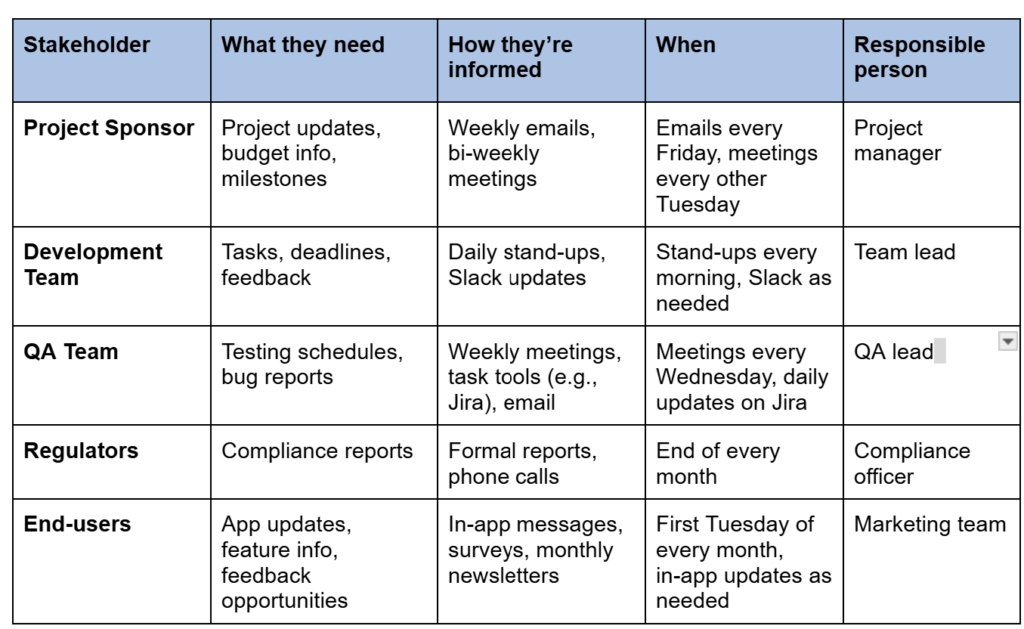
Bringing it All Together: The Communication Plan Matrix
The output of this process is typically a matrix or table that you can share with your project team. This matrix becomes a central reference point for managing all project communications.
Here are two excellent examples of what a completed communication plan can look like:

From Theory to Practice: Building the Plan
Now that we understand the components, let's watch a practical demonstration of how to build this matrix in a standard tool like Excel and prepare it for a presentation.
HOW TO CREATE A COMMUNICATION PLAN IN EXCEL & POWERPOINT | COMMUNICATION PLAN TEMPLATE
This video by Alvin the PM provides a clear, step-by-step guide to building the communication plan we've been discussing.
Watch from 04:09 to 08:21. The first part (until 07:37) demonstrates how to build the table in Excel, column by column. The second part shows how to copy this into a slide for a stakeholder presentation—a very common task for a BA.
Test your understanding!
Let's apply this to a scenario from your preferred AdTech domain.
You are a Business Analyst working on a project to launch a new "AI-Powered Budget Optimization" feature for your company's Demand-Side Platform (DSP). This feature will automatically reallocate an advertiser's budget to the best-performing ad campaigns in real-time.
One of your key stakeholder groups is the Sales Team. They are highly interested because this new feature is a major selling point, but they have low power over the technical development.
Task: Fill out one row of a communication plan matrix for the Sales Team. Define the following:
| Communication Type | Purpose | Audience | Method/Channel | Frequency | Owner |
|---|---|---|---|---|---|
| [Your Answer] | [Your Answer] | [Your Answer] | [Your Answer] | [Your Answer] | [Your Answer] |
Show answer
There are several good answers, but here is a strong example:
| Communication Type | Purpose | Audience | Method/Channel | Frequency | Owner |
|---|---|---|---|---|---|
| Feature Demo & Training | To educate the sales team on the new feature's benefits and how it works so they can confidently sell it to clients. | Sales Team, Sales Managers | Live Zoom session (recorded for new hires) followed by a Q&A. | Once before launch, with access to the recording thereafter. | Business Analyst / Product Manager |
Reasoning: The Sales Team (Low Power / High Interest) needs to be kept informed and excited. A live demo is much more engaging than an email. The purpose is not just to inform, but to enable them to do their job better. The frequency is tied to a key project milestone (pre-launch), which is appropriate. The ownership could be the BA or PM, as they are closest to the feature's development.
Conclusion
You now have a structured approach for creating one of the most important documents for managing stakeholder relationships. A well-crafted communication plan is not bureaucratic overhead; it's a strategic asset that builds trust, prevents misunderstandings, and keeps your project moving forward smoothly.
Key Takeaways:
- A stakeholder communication plan systematically defines how you will share information with all project stakeholders.
- The plan is built upon your initial stakeholder analysis, particularly the Power/Interest Grid, which determines the strategy for each group.
- For each communication, you must define the What, Why, Who, How, Owner, and When.
- Tailoring the message, channel, and frequency to each stakeholder group is critical for effective engagement.
- The final plan is often documented in a simple matrix that serves as a guide for the entire project team.
Preview of the Next Lesson:
A communication plan provides the structure for how you will talk to stakeholders. But what happens when their needs and priorities are in direct opposition? In our next lesson, we will tackle this challenge head-on by learning how to apply techniques to manage stakeholder expectations and negotiate conflicting requirements.