Hello! Welcome to your next lesson in our module on "Stakeholder Engagement and Requirements Elicitation."
In our last lesson, we did a deep dive into conducting one-on-one stakeholder interviews. You learned that these interviews are excellent for gathering detailed, individual perspectives and understanding specific user pain points. However, a Business Analyst's toolkit needs more than one tool. Sometimes, you need to bring people together to generate ideas, build consensus, or resolve conflicting viewpoints quickly.
Today's learning outcome is to facilitate workshops and brainstorming sessions to elicit collaborative requirements. This is a step up in complexity from one-on-one interviews, involving managing group dynamics and guiding multiple stakeholders toward a common goal. Your experience as a project and operational manager has undoubtedly given you exposure to leading group meetings, and this lesson will help you channel that experience into the specific, structured role of a BA facilitator—a crucial skill for both job performance and interview case studies.
To start, let's see where workshops fit into the larger landscape of elicitation techniques.

Why Workshops? The Power of Collaboration
Before we get into the "how," let's briefly cover the "why." While interviews are great for depth, workshops excel at:
- Efficiency: Gathering requirements from many stakeholders at once.
- Collaboration: Fostering a shared understanding and co-creation of ideas.
- Consensus-Building: Resolving differences and getting everyone aligned on priorities in real-time.
- Idea Generation: Sparking creativity that often doesn't happen in isolation.
We'll structure this lesson around the same three-phase model we used for interviews:
- Planning the Workshop
- Facilitating the Workshop
- Post-Workshop Actions
Phase 1: Planning the Workshop
Effective facilitation begins long before the workshop starts. For a group session, preparation is even more critical than for an interview. A well-planned workshop runs smoothly; a poorly planned one can descend into chaos.
To get a comprehensive overview of the entire workshop lifecycle, let's start with a foundational article.
How to Run Effective Requirement Gathering Workshops
The article 'How to Run Effective Requirement Gathering Workshops' provides a great, structured approach based on industry best practices like the BABOK® Guide. It breaks the process down into clear phases.
Please read the first major section, '1. Pre-Workshop Preparation: Laying the Groundwork'. Focus on the four key steps it outlines: defining objectives, identifying stakeholders, designing the agenda, and preparing pre-work materials.
As the article highlights, your planning should cover four key areas:
-
Define Clear Objectives: What is the single most important outcome you need from this session? Is it to define a problem, brainstorm solutions, or prioritize features for an MVP? A clear, stated goal keeps everyone focused. For example, in your AdTech domain, an objective could be: "Align on the key metrics and dimensions required for the new programmatic campaign performance dashboard."
-
Identify and Invite the Right People: A workshop's success depends on having the right mix of decision-makers, subject matter experts (SMEs), and end-users. Too many people can be unproductive, while missing a key stakeholder can force you to revisit decisions later.
-
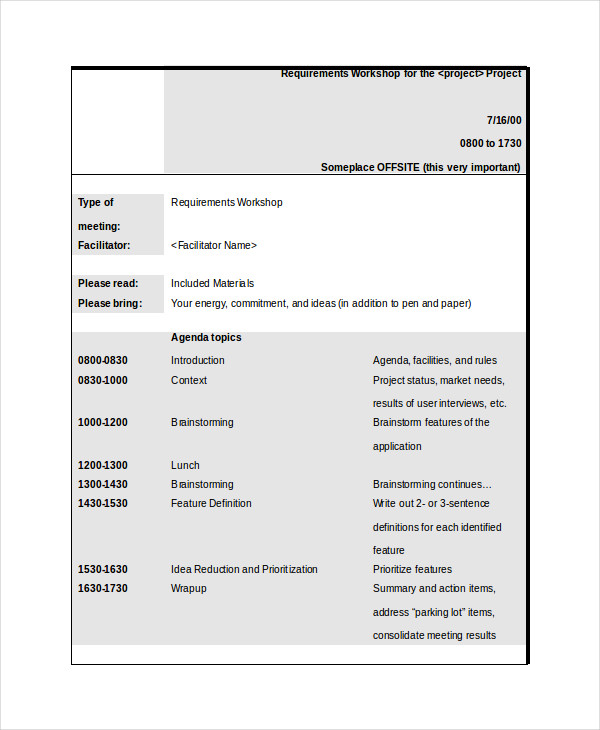
Design a Detailed Agenda: The agenda is your script for the workshop. It should be time-boxed and include a mix of activities to keep energy levels up. A good agenda turns a vague meeting into a productive working session.
Here is an excellent example of what a detailed workshop agenda looks like.
- Prepare Logistics and Materials: Will the workshop be in-person or virtual?
- In-person: Book a room with a large whiteboard, and bring sticky notes, markers, and dot stickers.
- Virtual: Set up a collaborative whiteboard tool like Miro or Mural. Ensure everyone has access and knows how to use the basic features. Also, check your tech!
This next video offers practical advice on preparation, especially the importance of doing your homework to build credibility with stakeholders.
How to Facilitate or Lead Workshops (Business Analyst version)
In 'How to Facilitate or Lead Workshops,' the presenter from Rich Millennial Mindset emphasizes the pre-workshop investigation phase. This resonates with your goal of immediate applicability, as being well-prepared is key to earning trust in a new role.
Watch from 00:48 to 09:10. Pay close attention to these points: Investigation (02:28): The idea of reviewing existing documents and data before the workshop to 'wow' your stakeholders. Visual Aids & Storytelling (05:01): How to prepare a presentation or demo to set the context. Technical Readiness (07:42): The simple but crucial step of making sure your projector or screen-share works, avoiding embarrassing delays.
Phase 2: Facilitating the Workshop
This is showtime. As a facilitator, your role is not to be the hero with all the answers. You are a neutral guide responsible for the process, creating an environment where the participants can produce the best content.
The video below is an excellent resource, framed as an answer to a BA interview question, making it perfect for your preparation. It covers the entire facilitation process, from managing pitfalls to specific techniques.
Part 1: How to run a Requirements Workshop - Business Analyst Training
Karaleise's 'How to run a Requirements Workshop' is a masterclass in practical facilitation. It's packed with tips you can use immediately and reference in interviews.
Watch from 02:38 to 09:51. This long clip is the core of this section. Focus on: Advantages of Workshops (02:38): A quick reminder of why you're doing this. Planning Considerations (03:56): A recap of tools and participant numbers. Things to Avoid (05:56): This is critical. Note the advice on managing a person who dominates the conversation and making people feel safe to share ideas. Owning the Session (08:51): The importance of establishing yourself as the leader of the process, whether in-person or virtually.
Elicitation Techniques in Action
A great workshop uses a variety of techniques to keep participants engaged and gather different kinds of information. Here are a few powerful methods you can use:
1. The 5 Whys (for Problem Definition)
In the last lesson, we mentioned asking 'why' to get to the root cause. In a workshop, you can do this collaboratively. You start with a high-level problem and, as a group, ask "Why?" five times to drill down to the core issue.
Let's see a concrete example related to your AdTech background.
Part 1: How to run a Requirements Workshop - Business Analyst Training
Let's return to Karaleise's video. She gives a brilliant, step-by-step demonstration of the '5 Whys' technique using a real-world business problem.
Watch from 09:51 to 14:42. Notice how the problem evolves from 'healthy accounts are churning' to the root cause: 'there was never any data used to show trends towards churn.' This technique is fantastic for ensuring you're solving the right problem.
2. "How Might We..." Statements (for Brainstorming Solutions)
Once you've defined the problem, you can reframe it as a series of "How Might We..." (HMW) questions to open up brainstorming. For the problem above, an HMW statement would be: "How might we use data to show trends towards churn?" This simple reframing encourages creative, optimistic solutions. This is often the focus of a separate "solutioning" or "ideation" workshop.
3. Gamified Techniques (for Engagement and Prioritization)
Workshops don't have to be dry. Using "innovation games" can make elicitation fun and incredibly insightful.
Part 1: How to run a Requirements Workshop - Business Analyst Training
This final clip from Karaleise's video introduces two popular and effective games you can facilitate.
Watch from 17:05 to 19:50. Pay close attention to: Speedboat: A great visual metaphor to identify 'anchors' (pain points) holding back a product or process. Buy a Feature: An excellent game for prioritizing features. By giving stakeholders a limited budget, you force them to make trade-offs and reveal what they truly value.
Test your understanding!
You are facilitating a workshop to gather requirements for a new internal reporting tool. During the brainstorming session, the most senior manager in the room consistently shuts down ideas from junior team members, saying "we tried that before" or "that's too complicated."
What are two different strategies you could use to manage this situation and ensure all voices are heard?
Show answer
Here are a few strategies based on the resources:
- Acknowledge and Redirect: "Thank you for that valuable context. That's a great point for our feasibility analysis later. For now, let's capture all ideas—no idea is a bad idea in a brainstorm. Sarah, you were about to say something?" (This validates the manager's input but parks it, then explicitly invites another person to speak).
- Switch to a 'Silent Writing' Technique: "This is great discussion. To make sure we capture everyone's thoughts, let's take five minutes for some silent brainstorming. Everyone write down as many ideas as you can on your own sticky notes. We'll group them together afterward." (This removes the dynamic of one person reacting to another in real-time and gives quieter participants a safe way to contribute).
- Use the Parking Lot: "That's an important constraint to remember. Let me add 're-evaluating previously attempted solutions' to our 'parking lot' so we can dedicate time to it later without losing our brainstorming momentum."
Phase 3: Post-Workshop Actions
The workshop's value is lost if the outputs aren't captured, validated, and communicated. Your work isn't done when everyone leaves the room.
How to Facilitate a Workshop: Guide (2025)
The article from Parallelhq, 'How to Facilitate a Workshop', has an excellent, concise section on what to do after the session ends.
Please read the section 'Closure and post-session follow-up'. Focus on the key actions: closing the workshop with a summary, gathering feedback, and documenting and distributing the outcomes promptly (within 24 hours is a good rule of thumb).
Key post-workshop steps include:
- Summarize and Confirm: End the workshop with a quick review of what was discussed, key decisions made, and action items assigned.
- Document and Distribute: Type up the notes, digitize the whiteboard photos or save the Miro board, and send a summary to all participants.
- Refine and Validate: The raw output of a workshop is not a final requirements document. You will need to process the notes, structure them, and often follow up with individuals to clarify details.
Conclusion
You've now learned the end-to-end process for facilitating a requirements workshop. This is a powerful technique that combines the deep elicitation of an interview with the speed and synergy of a group setting. By mastering the three phases of planning, facilitating, and following up, you can guide groups to produce high-quality, collaborative requirements.
Key Takeaways:
- Facilitation is a process, not a personality trait. It's a structured skill you can learn and practice.
- Preparation is paramount. A clear objective and a detailed, time-boxed agenda are your most important tools.
- Your role is a neutral guide. You are responsible for the process, enabling the participants to create the content.
- Use a variety of techniques. Mix discussion with visual aids, silent writing, and gamified exercises to keep energy high and get different types of input.
- Follow-up is crucial. The workshop's outcomes only become valuable once they are documented, distributed, and validated.
Preview of the Next Lesson:
So far, we have focused on eliciting requirements directly from people through interviews and workshops. But stakeholders don't always know or remember everything. In our next lesson, we will explore another crucial source of requirements: existing artifacts. We will cover how to analyze existing documentation and systems to identify implicit requirements.