Hello! Welcome to the first lesson of your Business Analysis course. We're starting with the absolute foundation: understanding what a Business Analyst actually is and does.
This lesson is designed to help you transition from your practical experience in management to the formal discipline of business analysis. By the end of our 60 minutes, you will be able to define the role, responsibilities, and core competencies of a Business Analyst. This will provide the framework for everything we cover in the course and will be crucial for articulating your skills in job interviews.
You've managed projects and teams, which means you've likely navigated business needs and project deliverables. Today, we'll put a formal structure and terminology to those activities, setting you on the path to becoming a dedicated Business Analyst.
What is a Business Analyst?
At its core, the role of a Business Analyst (BA) is to act as a crucial link between the business side of an organization and the teams that create solutions (often, but not always, IT teams). They are problem-solvers who ensure that the organization invests in and builds the right solutions to meet its goals.
A very effective and simple way to think about the role is to break it down into three key functions. Let's watch a short video that explains this.
Business Analysis Explained in Under 10 Minutes
This video, 'Business Analysis Explained in Under 10 Minutes' by David McLachlan, provides a concise, three-part definition of the BA role. It's a great starting point for understanding the BA's core purpose.
Please watch from 00:55 to 01:53. Pay close attention to the three-line definition and the three key knowledge areas the speaker highlights for a BA.
As the video explains, a Business Analyst:
- Elicits requirements from stakeholders.
- Ensures the solution matches those requirements.
- Verifies that the solution had the desired effect (i.e., delivered value).
The speaker also highlights that within a project, the BA's main focus is on stakeholders, scope, and quality. This contrasts with a Project Manager's broader focus which also includes time, cost, and resources. In your past roles, you were likely responsible for the entire project landscape; the BA has a specialized focus on ensuring the value and correctness of the outcome.
The Core Responsibilities of a Business Analyst
Now let's expand on that simple definition and look at the key responsibilities in more detail. The following infographic provides a great visual summary.
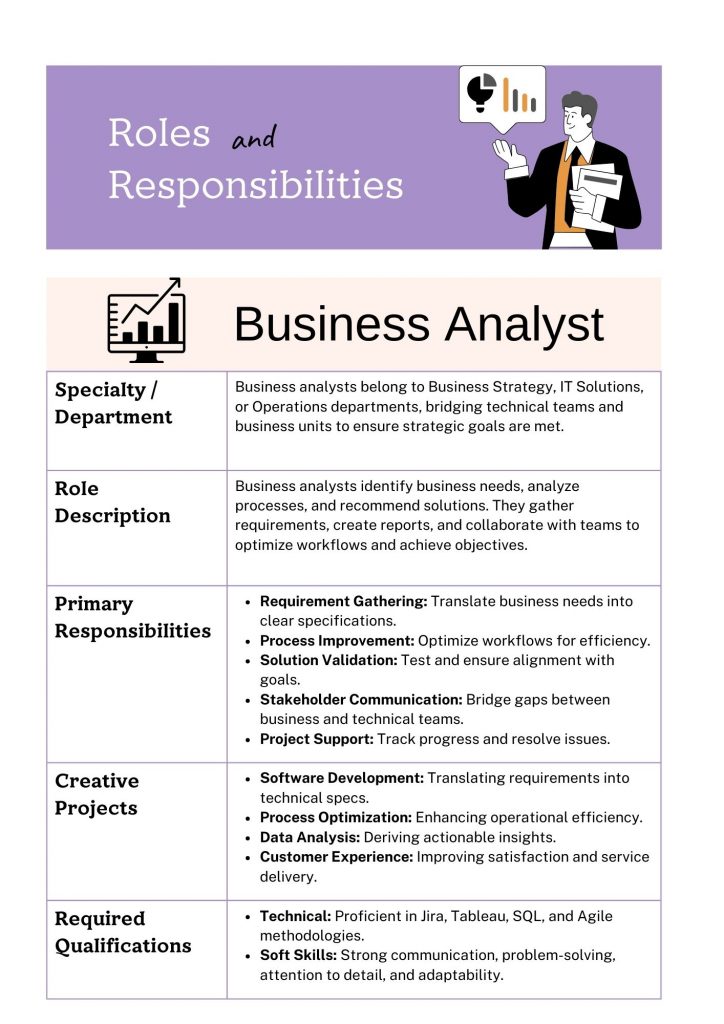
As you can see, the role is multifaceted. Building on the three-part definition, we can group the BA's responsibilities into a logical flow. The same video you just watched provides a great walkthrough of this process.
Business Analysis Explained in Under 10 Minutes
Let's return to the video 'Business Analysis Explained in Under 10 Minutes'. We'll now watch the segments that detail each of the three core responsibilities.
Please watch from 02:46 to 08:59. As you watch, notice the specific techniques and documents mentioned for each stage, such as stakeholder maps, process mapping, requirements traceability matrices, and acceptance criteria. We will be learning how to create these throughout the course.
Let's summarize those key responsibilities:
-
Understand the Business Need and Elicit Requirements:
- Identify and Analyze Stakeholders: Figuring out who has the information and who will be impacted by the solution.
- Facilitate Elicitation: Using techniques like interviews, workshops, and brainstorming to draw out the underlying needs, not just what people say they want.
- Visualize Requirements: Creating models like process maps, context diagrams, and wireframes to make abstract ideas visible and understandable for everyone.
-
Ensure the Solution Matches the Requirements:
- Analyze and Document Requirements: Translating the elicited needs into clear, unambiguous, and testable requirements that a development team can build.
- Manage Requirements: Using tools like a Requirements Traceability Matrix to link each requirement to a business objective and a specific solution component. This ensures nothing is missed.
- Define Acceptance Criteria: Specifying the exact conditions under which a piece of work can be considered "done" and accepted by the business.
-
Verify that the Solution Delivered Value:
- Support Testing: Working with Quality Assurance (QA) teams to ensure test cases accurately reflect the business requirements.
- Evaluate the Solution: After the solution is deployed, assessing whether it achieved the intended benefits (e.g., increased revenue, reduced costs, improved customer satisfaction) using metrics and user feedback.
Test your understanding!
Think back to a project you managed. Can you identify a specific moment where you were performing one of these BA responsibilities, even if you didn't use that terminology? For example, a time you had to clarify a confusing request from a client or map out a workflow to understand a bottleneck. How might having a formal BA process have changed how you handled it?
Show answer
There's no single right answer here, as it's based on your experience. For example, you might recall a time an advertiser (a stakeholder) wanted a new feature in a campaign reporting tool. As a project manager, you might have jumped straight to defining the project schedule and budget. A BA, however, would first use elicitation techniques to dig deeper: Why does the advertiser need this feature? What specific decision will it help them make? What is the business problem they are really trying to solve? This initial analysis prevents building a feature that doesn't actually solve the underlying problem.
The Core Competencies: A Framework for BA Skills
To carry out these responsibilities, a BA needs a specific set of skills, or competencies. The International Institute of Business Analysis (IIBA) provides an industry-standard framework for these.

This model can look a bit overwhelming, but let's break it down into three simple categories:
-
Underlying Competencies: These are the foundational personal skills. They include:
- Analytical Thinking and Problem Solving: The ability to break down complex problems and assess options critically.
- Communication Skills: Essential for listening, presenting, and writing clearly.
- Interaction Skills: Facilitation, negotiation, and leadership skills to guide stakeholders to a consensus.
- Business Knowledge: Understanding the industry, the organization, and its processes. Your background in AdTech will be a huge asset here.
-
Knowledge Areas: These represent the "work" of business analysis. Our course is structured around these areas, such as
Requirements Elicitation,Requirements Analysis, andSolution Evaluation. -
Techniques: These are the specific tools and methods a BA uses to perform the work, like
Process Modeling,Use Cases, andAgilemethodologies. We will be learning many of these.
The key takeaway is that a great BA combines strong analytical abilities with excellent people skills to navigate the complexities of an organization.
The BA Role in Your Target Industry: AdTech
Now, let's make this concrete by looking at how the BA role applies directly to your goal of working in the AdTech industry. A general job description can seem abstract, but in a specific domain, the responsibilities become much clearer.
First, let's look at a real-world job posting for a Technical Business Analyst in AdTech.
Technical Business Analyst (Adtech Domain Expert)
This job description for a 'Technical Business Analyst (Adtech Domain Expert)' shows exactly what employers are looking for. It connects the general responsibilities we've discussed to specific AdTech concepts.
Please read the 'Responsibilities' and 'Requirements/Skills' sections. Note how general tasks like 'collaborate with stakeholders' are specified as 'collaborate...to understand and document requirements for AdTech solutions, including...DMPs, DSPs'. Also, look at the tools mentioned, like JIRA and SQL.
This job description clearly shows the demand for BAs who not only have the core competencies but also specific domain knowledge. Your experience in media planning and account management gives you a head start in understanding the business needs of this ecosystem.
To further illustrate this, let's read about the experience of a BA Manager at an AdTech company.
Life in Adtech: Solving Complex Business Challenges
This article, 'Life in Adtech: Solving Complex Business Challenges,' features an interview with a Manager of Business Analysis at StackAdapt. It provides insight into the BA's role in driving strategy and process improvement within an AdTech firm.
Read the sections titled '2. What is the main focus of your role...' and '6. What advice do you have for people who aspire to work as business analysts?'. Notice how the role involves solving 'complex business challenges' and the advice emphasizes skills like data analysis and staying updated on technology.
These resources highlight that in a fast-paced industry like AdTech, the BA role is not just about documenting requirements but about understanding data, being aware of technology trends, and actively contributing to process optimization and business strategy.
Conclusion
In this lesson, we established the foundational definition of a Business Analyst. You've learned that a BA is a critical agent of change who bridges the gap between business needs and solution delivery.
Here are the key takeaways:
- The Role: A BA's primary function is to elicit requirements, ensure the solution aligns with them, and verify that the solution delivers its intended value.
- The Responsibilities: This involves a cycle of understanding the business context, engaging stakeholders, analyzing and documenting needs, supporting the development process, and evaluating outcomes.
- The Competencies: Success in the role depends on a blend of analytical thinking, strong communication and interpersonal skills, and solid business knowledge, all supported by a toolkit of formal techniques.
- The Context: In a specific industry like AdTech, these general responsibilities translate into concrete tasks related to that domain's platforms (DSPs, DMPs) and challenges.
Preview of the Next Lesson:
Now that you have a firm grasp of the BA's role, our next lesson will dive into the very first thing a BA produces: requirements. We will learn to distinguish between business, stakeholder, solution, and transition requirements. Understanding this classification is the first step in organizing and analyzing the needs you will elicit from stakeholders.