Hello! Welcome to the first lesson of Module 2.
In the previous module, we established a strong foundation in the "melody" of Mandarin by mastering the four tones and simple finals. You put this into practice by learning to pronounce the numbers 1 through 10. Now, we shift our focus from the melody to the "articulation"—the consonant sounds that begin a syllable, known as initials.
Today's lesson addresses a crucial and often misunderstood aspect of Mandarin pronunciation. Our goal is to produce the unaspirated vs. aspirated initial pairs: b/p, d/t, and g/k. Understanding this distinction is fundamental to achieving clear and accurate pronunciation.
What are Initials and What is Aspiration?
In Pinyin, most syllables are composed of an initial (a consonant) and a final (a vowel or vowel combination). For example, in bā (八, eight), b is the initial and a is the final.
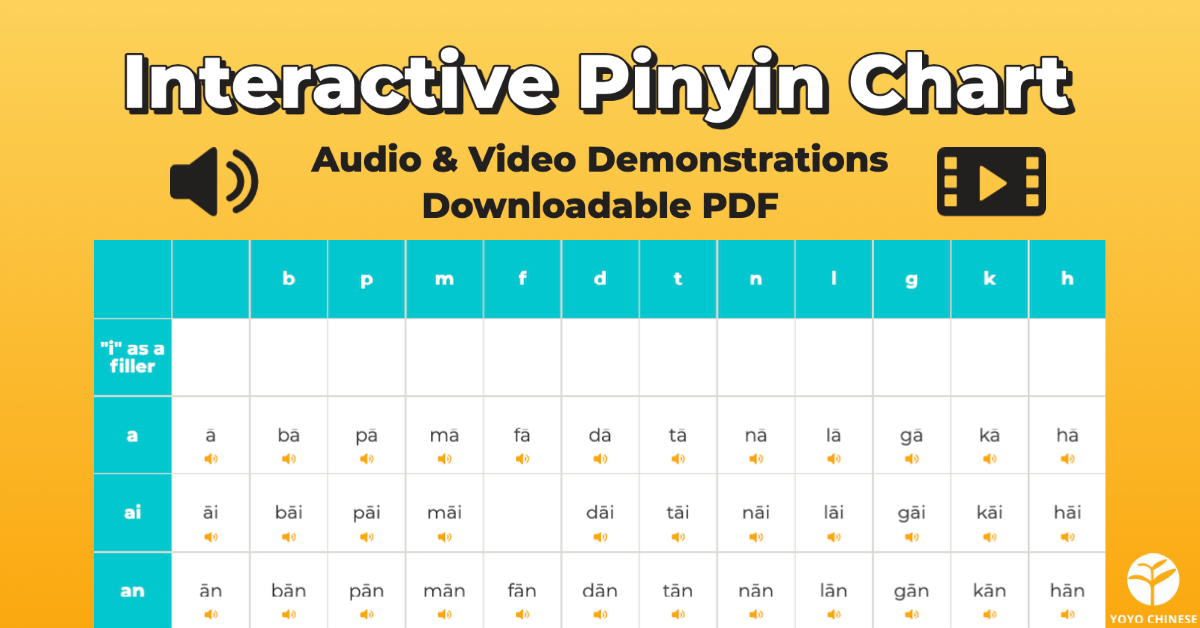
The challenge with pairs like b/p is that they don't map directly to their English counterparts. In English, the primary difference between "b" and "p" is voicing—whether or not your vocal cords vibrate. In Mandarin, the primary difference is aspiration—a strong puff of air that follows the consonant.
For an analytical breakdown of this concept, let's start with a short reading.
A guide to Pinyin traps and pitfalls: Learning Mandarin pronunciation
The article 'A guide to Pinyin traps and pitfalls' from Hacking Chinese clearly explains the concept of aspiration and why it's different from voicing. This will give you the theoretical framework for the sounds we're about to practice.
Please read section 4, titled 'Aspirated and non-aspirated consonants'. Pay close attention to the key idea: Mandarin 'b', 'd', and 'g' are NOT voiced. The difference between b/p, d/t, and g/k is the presence or absence of a 'puff of air'. The article includes audio links to compare sounds like 'dan' and 'dang' which will be useful for a later lesson, but you can listen to them now to start training your ear.
To summarize the key point from the reading:
- Unaspirated initials (b, d, g): No puff of air. Your vocal cords do not vibrate.
- Aspirated initials (p, t, k): A strong puff of air is released. Your vocal cords do not vibrate.
This is fundamentally different from English, where b, d, and g are typically voiced.
The Aspiration Test: Feeling the Difference
Now let's see—and feel—this in action. A simple physical test can make the concept of aspiration tangible.
Mandarin Pronunciation: Everything You Need to Know in Under 1 Hour
This video from Mandarin Blueprint provides excellent analogies and a physical test to help you distinguish these sounds. The presenter contrasts the English voiced sounds with the Mandarin unaspirated/aspirated sounds.
Watch the segment from 00:12:35 to 00:14:25. As the speaker demonstrates, place your hand in front of your mouth to feel the puff of air for the aspirated sounds (p, t, k) and the lack of air for the unaspirated ones (b, d, g).
Another common method is to hold a single sheet of paper in front of your mouth. When you correctly pronounce an aspirated sound like p, the paper should move significantly. For an unaspirated sound like b, it should barely move.
Producing the Initial Pairs
Let's break down each pair, focusing on the correct mouth position and airflow. The following video gives a very detailed look at the b/p and d/t pairs, using the paper test.
Chinese Initials - b,p,m,f,d,t,n,l | Mandarin Pronunciation Training 03 | In Chinese
The 'In Chinese' channel offers a detailed guide to producing these initials. We'll watch specific clips for each pair.
You will watch several short clips from this video. For each pair, focus on the speaker's mouth and the paper test demonstration.
1. The b / p pair (Bilabial sounds)
These are made by bringing your lips together.
- b (unaspirated): Start with your lips closed. Push air forward to part your lips, but release no puff of air. It sounds like the "p" in the English word "spy".
- p (aspirated): Same starting position, but release a strong, explosive puff of air. It's like the "p" in "pie", but much stronger.
Chinese Initials - b,p,m,f,d,t,n,l | Mandarin Pronunciation Training 03 | In Chinese
First, watch the demonstration for the 'b' sound.
Watch from 00:02:00 to 00:03:14. Notice how the paper does not move.
Chinese Initials - b,p,m,f,d,t,n,l | Mandarin Pronunciation Training 03 | In Chinese
Next, watch the demonstration for the 'p' sound.
Watch from 00:03:14 to 00:03:59. See how the paper flutters violently.
2. The d / t pair (Alveolar sounds)
These are made with the tip of your tongue touching the ridge just behind your upper teeth (the alveolar ridge).
- d (unaspirated): Place your tongue tip there. Push air forward to release the tongue, but with no subsequent puff. It sounds like the "t" in "sty".
- t (aspirated): Same starting position, but release a strong puff of air as your tongue moves away.
Chinese Initials - b,p,m,f,d,t,n,l | Mandarin Pronunciation Training 03 | In Chinese
Now, let's watch the demonstration for the 'd' and 't' sounds.
Watch from 00:04:58 to 00:06:34. Again, observe the difference in airflow using the paper test.
3. The g / k pair (Velar sounds)
These are made with the back of your tongue pressed against the soft palate at the back of your mouth.
- g (unaspirated): Raise the back of your tongue to the soft palate. Release the air without a puff. It sounds like the "k" in "sky".
- k (aspirated): Same starting position, but release a strong puff of air.
Listening and Practice
Theory and demonstration are important, but mastery comes from practice. The following resource provides an excellent interactive table where you can hear a native speaker pronounce each initial.
Pinyin Rules: Initials Finals and Tones - YellowBridge
This reference table from YellowBridge will be our practice tool. It includes audio for example words, allowing you to connect the pinyin letter to its correct sound.
Scroll down to the 'Initials' table. Find the rows for b, p, d, t, g, and k. Click on the blue pinyin examples (bù, péng, duì, tiān, gè, kè) repeatedly. As you listen, try to mimic the sounds. Use your hand or a piece of paper to check your own aspiration.
To solidify your production, practice saying these minimal pairs aloud. They use the simple finals a and e that you are already familiar with from Module 1.
| Unaspirated | Aspirated | Notes |
|---|---|---|
| bā (八, eight) | pā (趴, to lie down) | You already know bā! |
| dā (搭, to build) | tā (他, he/him) | You'll learn the character 他 soon. |
| gē (哥, older brother) | kē (科, department) | Focus on the sharp puff of air for kē. |
Try to make the distinction between the pairs as clear as possible. Record yourself if you can, and listen back to see if you can hear the difference.
Conclusion
Excellent work today. You've tackled one of the most significant hurdles in Mandarin pronunciation for English speakers. By focusing on the concept of aspiration rather than voicing, you are building a much more authentic and accurate pronunciation.
Here are your key takeaways:
- The Mandarin initial pairs b/p, d/t, and g/k are distinguished by aspiration (a puff of air), not voicing.
- The initials b, d, g are unaspirated, meaning they are produced with no puff of air. They are analogous to the sounds p, t, and k in the English words spy, sty, and sky.
- The initials p, t, k are aspirated, produced with a strong puff of air.
- You can use a hand or a piece of paper in front of your mouth to get physical feedback on your aspiration.
In our next lesson, we will continue building your inventory of initials by learning to produce the remaining non-sibilant sounds: m, f, n, l, and h. These are generally more straightforward as they have closer equivalents in English.