Hello! Welcome to the next stage of your Chinese language journey.
In the first two modules, you built a complete foundation in Pinyin, mastering the sounds and spelling rules of Mandarin. As we concluded our last lesson, we noted that this was the key to the sound of the language. Now, we transition to the sight and structure of the language: the writing system.
This lesson marks your first step into the world of Chinese characters (汉字, Hànzì). In line with your preference for an analytical approach, we won't be memorizing shapes. Instead, we'll start by deconstructing characters into their most fundamental components. Today's learning outcome is to identify and write the basic strokes of Chinese characters (e.g., héng, shù, piě, nà, diǎn). Think of this as learning the alphabet before you learn to spell words.
1. The Building Blocks of Chinese Characters
Every Chinese character, no matter how complex it may seem, is composed of a small set of simple, repeated lines called strokes (笔画, bǐhuà). Understanding these strokes is the key to demystifying the writing system.
To begin, let's watch a short introductory video that uses a helpful analogy.
Learn All the Basics of Chinese Writing Part 1 - Strokes | How to Write Chinese Characters (Hanzi)
This clip from Janus Academy explains why strokes are the essential 'building blocks' of all Chinese characters, much like Lego bricks.
Please watch the introduction from 00:00 to 01:30. Pay attention to the core idea: if you know the individual pieces and how to put them together, complex structures become manageable.
This "building block" concept is central to our method. By mastering these basic strokes, you will be able to recognize patterns, learn new characters faster, and write them with accuracy and confidence.
The following reading reinforces this idea and sets the stage for learning the strokes themselves.
Basic Strokes of Chinese Characters: A Complete Guide
This article, 'Basic Strokes of Chinese Characters: A Complete Guide' from Hanzistroke, elaborates on why this foundational knowledge is so powerful.
Please read the section titled 'Why Basic Strokes Matter'. It clearly outlines the benefits of this analytical approach.
2. The Five Most Fundamental Strokes
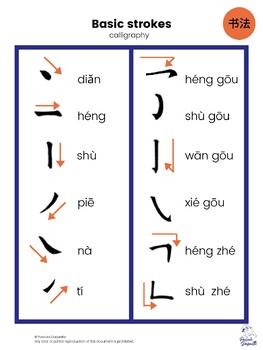
While there are several types of strokes, we will begin with the five most common ones. For each stroke, we will learn its name, its direction of writing, and see it in action.
As you go through these, I highly recommend having a pen and paper ready to try writing them yourself.
Héng (横) — The Horizontal Stroke
This is a simple horizontal line written from left to right.
- Pinyin:
héng - Character: 横
- Symbol: 一
Learn How to Write Chinese Characters for Beginners Easy Fast & Fun | Chinese Strokes Writing - 1
The video from ChineseFor.Us provides a clear demonstration of how to write the héng stroke and shows it within simple characters.
Watch from 01:11 to 02:31. Notice the correct left-to-right direction and the examples of characters like 一 (one), 二 (two), and 三 (three).
Shù (竖) — The Vertical Stroke
This is a vertical line written from top to bottom.
- Pinyin:
shù - Character: 竖
- Symbol: 丨
Learn How to Write Chinese Characters for Beginners Easy Fast & Fun | Chinese Strokes Writing - 1
Now let's see the shù stroke from the same video.
Watch from 02:31 to 03:54. Observe the top-to-bottom direction and see how it combines with héng to form the character 十 (ten).
Piě (撇) — The Left-Falling Stroke
This is a sweeping stroke that falls from top-right to bottom-left.
- Pinyin:
piě - Character: 撇
- Symbol: 丿
Nà (捺) — The Right-Falling Stroke
This is a pressing stroke that falls from top-left to bottom-right, often forming a pair with piě.
- Pinyin:
nà - Character: 捺
- Symbol: ㇏
Piě and nà are often seen together, creating a balanced, symmetrical shape, as in the character for "person" (人, rén).
Learn All the Basics of Chinese Writing Part 1 - Strokes | How to Write Chinese Characters (Hanzi)
This clip from Janus Academy demonstrates both the piě and nà strokes.
Please watch from 04:31 to 05:19. Notice the direction and shape of both the left-falling (piě) and right-falling (nà) strokes.
Diǎn (点) — The Dot Stroke
This is a small dot or dash, typically written from top to bottom.
- Pinyin:
diǎn - Character: 点
- Symbol: 丶
Learn All the Basics of Chinese Writing Part 1 - Strokes | How to Write Chinese Characters (Hanzi)
Finally, let's look at the diǎn stroke.
Watch from 02:41 to 03:32. Observe that this 'dot' is more like a small, quick press of the pen.
3. A Classic Framework: The Eight Principles of Yong
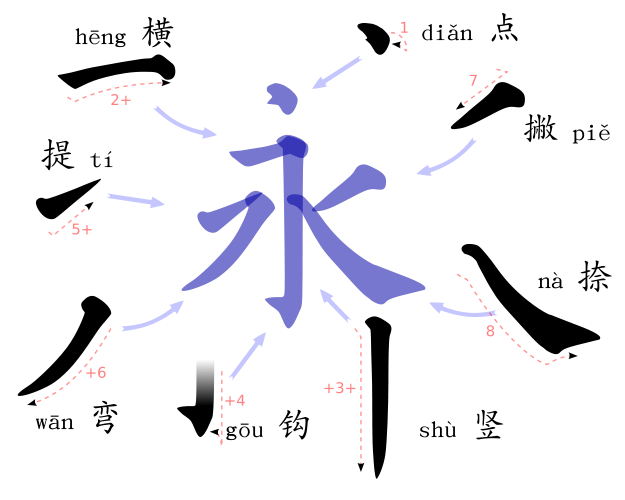
Historically, Chinese calligraphers developed a mnemonic tool for teaching the most important strokes. They observed that the single character 永 (yǒng), meaning "eternity," contains eight of the most essential stroke types. This is known as the Eight Principles of Yong (永字八法, Yǒngzì Bāfǎ).
This framework provides a systematic way to understand how different strokes are related and combined.
Chinese Stroke Order: 6 Essential Rules
The article 'Chinese Stroke Order: 6 Essential Rules' introduces this concept and provides a clear table of the eight basic strokes.
Please read the section 'How many total possible strokes are there in Chinese?'. Focus on the table that lists the eight strokes found in the character 永.
The table introduced you to a few new strokes in addition to the five we've already covered:
- 提 (tí): A rising stroke.
- 折 (zhé): A turning stroke (e.g., horizontal then vertical in one motion).
- 钩 (gōu): A hook added to the end of another stroke.
This image provides a perfect visual breakdown of the character 永, showing how each of the eight principles manifests within it.
4. Practice and Identification
Now it's time to put this knowledge into practice. The goal is to develop muscle memory for the direction and feel of each stroke.
Your Task:
- Using a notebook (grid or graph paper is ideal), practice writing each of the eight basic strokes from the
永character at least 10-20 times.- 点 (diǎn) - dot
- 横 (héng) - horizontal
- 竖 (shù) - vertical
- 钩 (gōu) - hook
- 提 (tí) - rising
- 撇 (piě) - left-falling
- 捺 (nà) - right-falling
- 折 (zhé) - turning
- As you write, say the name of the stroke (e.g., "héng," "shù"). This helps connect the physical action to the concept.
- Focus on executing each stroke as a single, continuous motion in the correct direction.
To see how just a few of these strokes can already form simple characters, you can watch this final short clip.
Learn How to Write Chinese Characters for Beginners Easy Fast & Fun | Chinese Strokes Writing - 1
This segment from ChineseFor.Us shows how the first three strokes you learned (héng, shù, diǎn) combine to write the characters for 'up' (上, shàng) and 'down' (下, xià).
Watch from 05:16 to 06:42. You don't need to master these characters yet, but observe how the strokes are assembled. This provides a glimpse into our next topic: stroke order.
Conclusion
Excellent work. You have taken a crucial and analytical first step into the Chinese writing system. Instead of being intimidated by complex characters, you now have the tools to see them as logical constructions of simple parts.
Key Takeaways:
- All Chinese characters are built from a finite set of basic strokes (笔画, bǐhuà).
- The five most fundamental strokes are héng (横), shù (竖), piě (撇), nà (捺), and diǎn (点).
- The character 永 (yǒng) provides a classic framework for learning the eight most essential stroke types, known as the Eight Principles of Yong.
- Writing strokes correctly involves a single, continuous motion in a specific direction.
In our next lesson, we will build directly on this foundation. Now that you can identify the strokes, we will learn the fundamental rules that govern the sequence in which they are written—the standard stroke order. This will be the key to assembling these building blocks into well-formed characters.