Hello! Welcome back to our lesson.
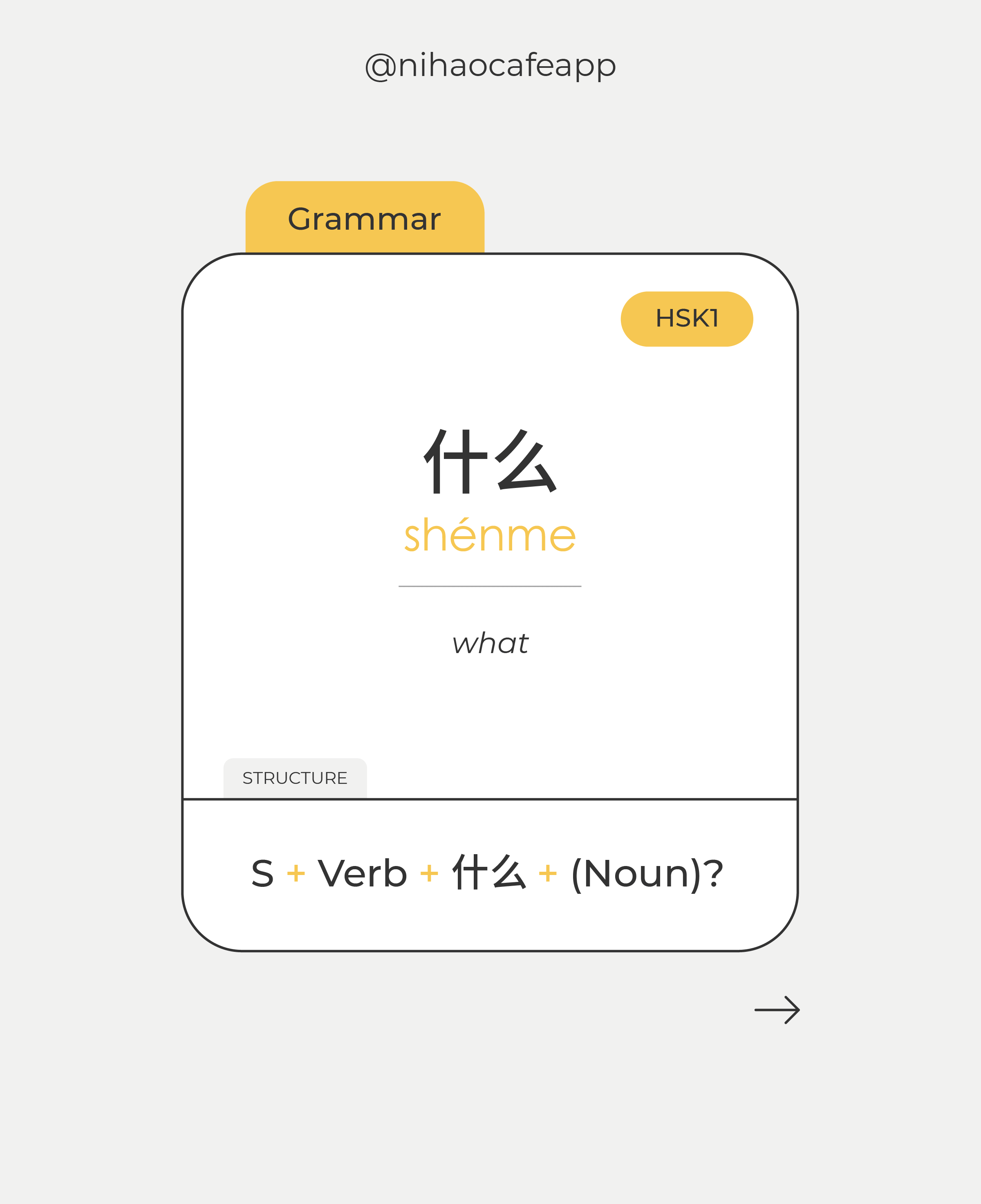
In our last session, we established the fundamental principle for asking "what" questions in Chinese. You learned that 什么 (shénme) acts as a placeholder for the unknown information, and the sentence structure remains the same as a statement. This gave us the core pattern: Subject + Verb + 什么?, as in 这是什么? (Zhè shì shénme? - What is this?).
Today, we're going to make our questions more specific. Instead of just asking "what," you will learn how to ask "what kind of..." or "which..." by combining 什么 with a noun. This lesson will enable you to ask more nuanced questions and is a natural extension of the grammar you've just learned.
1. The 什么 + Noun Structure
The grammatical logic you learned in the previous lesson continues to apply. The key difference is that instead of 什么 replacing the entire object, it now acts as a modifier for a noun that follows it.
This structure allows you to ask about a specific item within a known category.
Let's look at an example. You know the question:
- 这是什么? (Zhè shì shénme?) - What is this?
Now, let's imagine you know the object is a book, but you don't know which book it is. You would use the 什么 + Noun pattern. For this, we'll need a new character:
- 书 (shū): book
The question becomes:
- 这是什么书? (Zhè shì shénme shū?) - What book is this? (Literally: This is what book?)
Here, 什么 specifies the unknown aspect of the known category 书.
To see this pattern used with a different verb, we'll introduce another very common word:
- 喜欢 (xǐhuān): to like
Mastering “什么” (shénme) – The Essential Chinese Question Word
Let's revisit the article from Chinestudy.com. It provides a perfect example of this structure.
Please read the section titled '💡 Examples' and focus on example #4: '你喜欢什么书?' (nǐ xǐhuan shénme shū?). This demonstrates the 'Subject + Verb + 什么 + Noun?' pattern perfectly.
As you can see, the structure is consistent:
你 喜欢 什么 书? (Nǐ xǐhuān shénme shū?)
Subject + Verb + "What" + Noun?
2. Practice: Building Your Own Question
Let's practice forming a question with characters you already know. Using the pattern Subject + Verb + 什么 + Noun?, how would you ask:
"What kind of person is he?"
Think about the characters for "he" (他), "to be" (是), and "person" (人).
...
The correct structure would be "He is what person?":
他是什么人? (Tā shì shénme rén?)
This is a common question that can be used to ask about someone's character, profession, or identity.
3. A More Specific Form: 什么样的 (shénme yàng de)
While 什么 + Noun is perfectly correct, if you explicitly want to ask "what kind of..." or "what type of...", there is a more precise phrase you can use. This involves adding the character 样 (yàng), which means "type" or "appearance," and the particle 的 (de).
The structure is: 什么样的 (shénme yàng de) + Noun
Let's explore this with an excellent resource that includes native audio pronunciation, which I know you value.
How to Say “What” in Chinese? 什么Shenme & 怎么Zenme
This article from How to Say in Chinese introduces the phrases '什么样的' and '什么类型' to ask about types and kinds. It provides several clear examples with audio.
Please read the section titled 'What Type / Kind / Sort – 什么样 Shénme Yàng/ 什么类型 Shénme Lèixíng'. Read the example sentences and click the play button on the audio players to hear the correct pronunciation. For now, you can focus on '什么样的 (shénme yàng de)'.
So, to ask "What kind of person do you like?", you could say:
你喜欢什么样的人? (Nǐ xǐhuān shénmeyàng de rén?)
This structure is extremely useful when asking about preferences, which is a common topic in conversation.
4. How to Answer These Questions
Now that you can ask these specific questions, how do you answer them? The "quote and replace" method you've seen before is the key. You simply replace the 什么 (+ Noun) part of the question with your specific information.
Let's watch a video that reviews this answering technique.
Learn Chinese:What, Who, Where,Which, When, Why, Whose, What time in Mandarin WH Questions
The speaker from Andy and Sarah Mandarin explains a simple trick for answering WH-questions in Chinese. This will help you formulate responses to the questions we are learning today.
Please watch from 11:34 to 12:39. Pay close attention to the 'quote and replace' method, especially with the example '你喜欢什么颜色?' (What color do you like?). The logic is the same for a question like '你喜欢什么书?'.
Applying this method:
- Question: 你喜欢什么书? (Nǐ xǐhuān shénme shū?) - What books do you like?
- Answer: 我喜欢中国书。 (Wǒ xǐhuān Zhōngguó shū.) - I like Chinese books.
You simply replace 什么 with 中国 (Zhōngguó), keeping the rest of the sentence structure intact.
Conclusion
Excellent work. You've now expanded your questioning ability from general "what" questions to specific "what kind of" questions. This is a powerful tool for gathering more detailed information.
Key Takeaways:
- The
什么 + NounPattern: To ask "what [noun]...?", you use the structure: Subject + Verb + 什么 + Noun? (e.g.,这是什么书?). - "What Kind Of...": For more explicit questions about type or category, you can use the structure 什么样的 + Noun (e.g.,
你喜欢什么样的人?). - Answering Strategy: To answer these questions, you use the "quote and replace" method, swapping the
什么placeholder with the specific information.
Preview of the Next Lesson:
In our next lesson, we will put everything from the last few lessons together. The goal will be to answer simple yes/no and 'what' questions using the vocabulary you have learned so far. This will be a great opportunity to consolidate your knowledge and practice your conversational skills.