Welcome back to our Chinese course.
In the previous lesson, we established a core principle of Chinese grammar: how to form yes/no questions by adding the particle 吗 (ma) to the end of a statement. You learned that this simple addition requires no change to the sentence's word order, a key feature of the language.
Today, we will equip ourselves to ask a different, more open-ended type of question. To do this, we must first learn the essential building blocks. Our goal for this lesson is to recognize and write the characters for 什 (shén) and 么 (me). These two characters combine to form one of the most useful words in the entire language: 什么 (shénme), meaning "what."
1. The First Component: 什 (shén)
Let's begin by analyzing the character 什. Your preference for understanding character structure will be very useful here, as 什 is a logical combination of components you have already encountered.
Character Analysis: 什
- Pinyin: shén
- Tone: 2nd tone (rising)
- Meaning: In combination, it means "what." It can also mean "miscellaneous."
- Structure: Left-right
The character 什 is composed of two parts:
- Left side: 亻. This is the 'standing person' radical, which you will recognize from characters like 你 (nǐ) and 他 (tā). It is derived from the character 人 (rén, person).
- Right side: 十. This is the character for the number ten, 十 (shí), which you have also learned.
So, you can think of 什 as person (亻) + ten (十). While its original meaning related to a group of ten soldiers, this is no longer relevant to its modern use in forming the word "what." The key takeaway is recognizing its constituent parts.
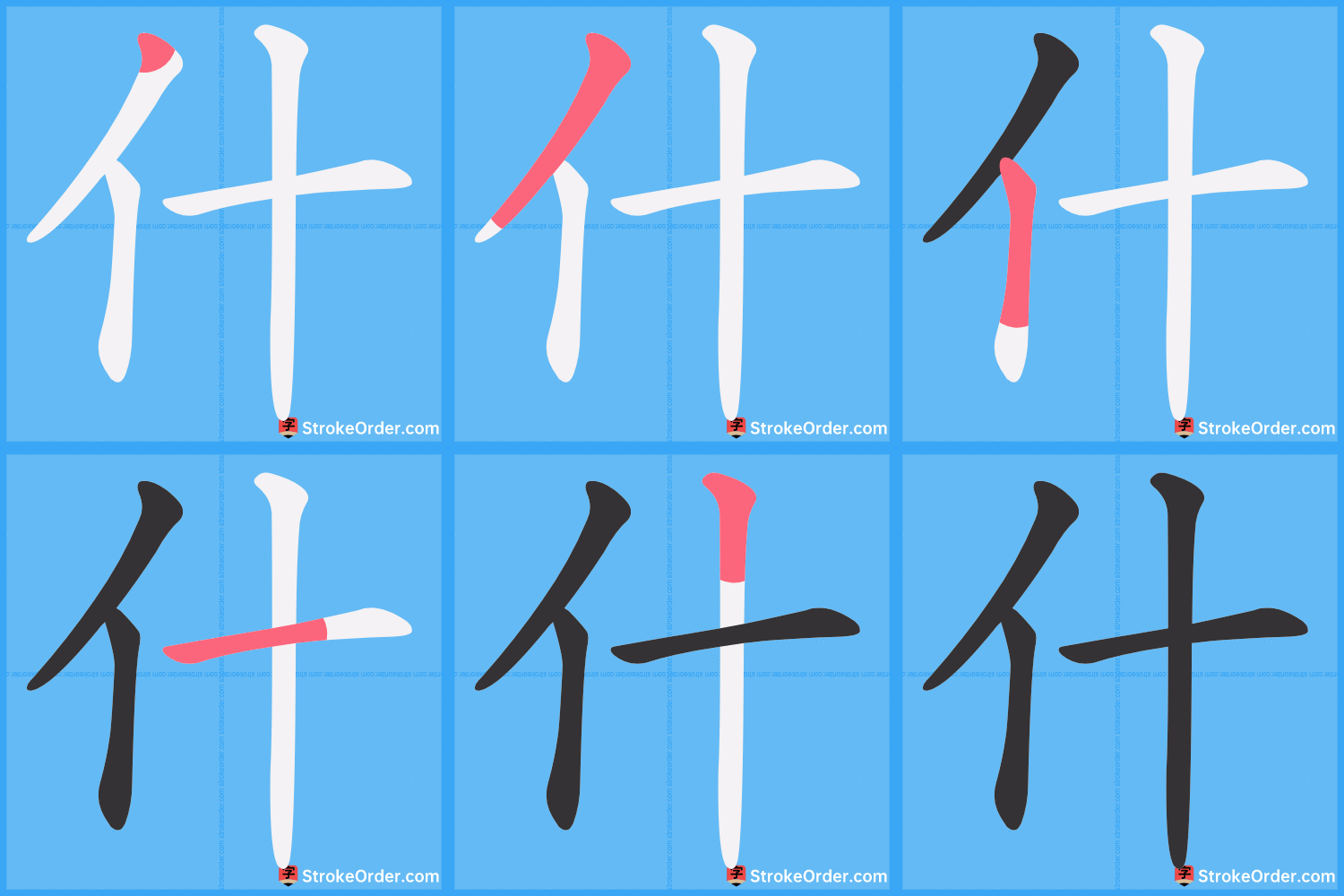
Writing Practice: 什 (shén)
什 has a total of 4 strokes. The writing process follows the fundamental rule of left-to-right.
- First, write the left radical, 亻 (piě, shù).
- Then, write the right component, 十 (héng, shù).
This animation provides a clear visual guide:
Now, let's use a resource to explore this character in more detail and practice writing it.
什 shén - English Meaning | Mandarin Temple
The Mandarin Temple page for 什 (shén) provides a comprehensive breakdown. We will use it to review the components and practice writing the character.
Please review the following sections on the page: Under '什 shén Meaning': Note the two pinyin pronunciations, but focus on shén for our current purpose. Under 'About 什 shén': Observe the number of strokes (4) and the radical (亻). Under 'Etymology of 什 shén': See the positional decomposition ⿰亻十 which confirms the left-right structure we just discussed. Under 'Write it!': Use the interactive tool to practice writing the character. Press 'Show Strokes' to see the order, then try writing it yourself in the box. Finally, look at the '什 shén Decomposition' section at the bottom to see a final summary of its parts.
2. The Second Component: 么 (me)
Now let's turn to the second character, 么. This character is much simpler in form but is almost always used in conjunction with other characters, rather than on its own.
Character Analysis: 么
- Pinyin: me
- Tone: Neutral tone (light and unstressed)
- Meaning: It functions as a suffix or particle, most famously in the word 什么 (shénme).
- Structure: Top-bottom
The character 么 is composed of two simple strokes/components:
- Top part: 丿 (piě), a left-falling stroke you know well.
- Bottom part: 厶 (sī), which is not a common character on its own but is a component in other characters.
This character is very simple, consisting of only 3 strokes.
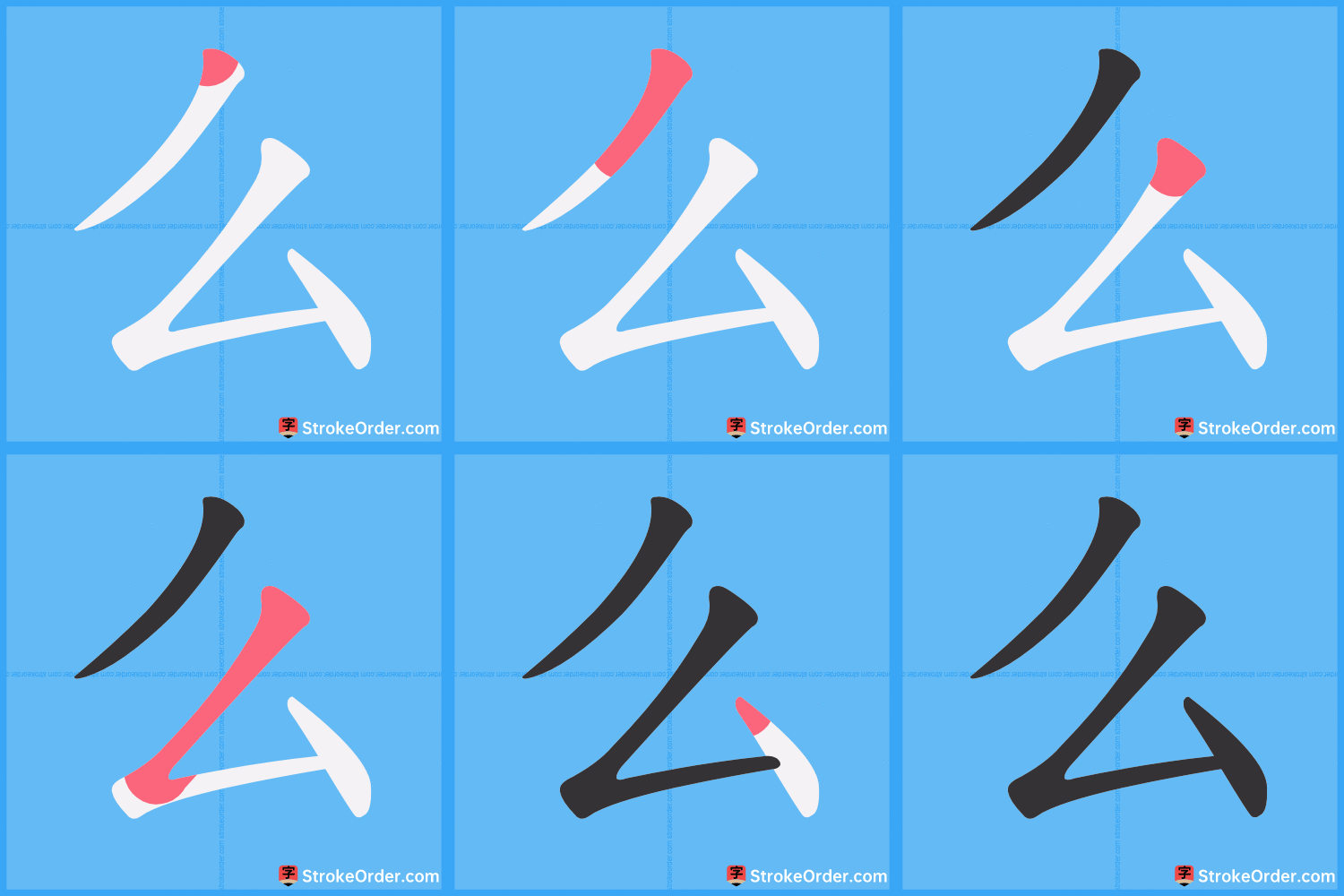
Writing Practice: 么 (me)
The writing order for 么 follows the top-to-bottom rule.
- First, write the top stroke, 丿 (piě).
- Then, write the bottom component, 厶, which itself consists of a piě and a diǎn.
Here is the animated stroke order for 么:
Let's use another resource to solidify your understanding and practice writing it.
么 me - English Meaning | Mandarin Temple
The Mandarin Temple page for 么 (me) will help us confirm its structure and practice writing.
On this page, please focus on the following: Under '么 me Meaning': Find the pinyin me (with the neutral tone me5) and its meaning as a 'suffix, used to form interrogative 甚麼/什么'. Under 'About 么 me': Note the number of strokes (3). Under 'Etymology of 么 me': See the positional decomposition ⿱丿厶, confirming its top-bottom structure. Under 'Write it!': Use the interactive tool to practice the 3-stroke order. Press 'Show Strokes' first, then practice drawing it.
3. Combining the Characters: 什么 (shénme)
You have now learned to recognize, analyze, and write the two characters that form the word for "what."
什 (shén) + 么 (me) → 什么 (shénme)
This combination is a fundamental question word in Mandarin. In the resources you just studied, you may have seen example sentences using 什么. For instance:
- 这是什么? (Zhè shì shénme?) — What is this?
Notice the pronunciation: a rising tone on shén followed by a light, unstressed neutral tone on me.
We will dedicate our entire next lesson to learning the grammar of how to place 什么 in a sentence to ask questions. For today, the focus remains on mastering the individual characters 什 and 么.
Conclusion
Excellent work today. You've broken down two more essential characters, reinforcing your understanding of radicals and stroke order rules. This analytical approach is crucial for building a solid foundation.
Key Takeaways:
- 什 (shén): A 4-stroke, left-right character composed of the 'person' radical (亻) and the 'ten' character (十).
- 么 (me): A 3-stroke, top-bottom character composed of a piě (丿) stroke and the component 厶. It is typically pronounced with a neutral tone.
- Together, they form the word 什么 (shénme), which means "what."
Preview of the Next Lesson:
Now that you can recognize and write 什 and 么, you're ready to use them. In the next lesson, we will learn how to form "what" questions using 什么 (shénme), such as asking about objects and people. We will also learn how to use it with a noun to ask "what kind of...".