Hello! Welcome to our next lesson.
In our last session, we learned how to form the words for "mom" (妈妈, māmā) and "dad" (爸爸, bàba). We analyzed the character 妈 (mā) as a phono-semantic compound, combining the meaning component 女 (nǚ) with the sound component 马 (mǎ).
Today, we will dissect another character that uses 马 (mǎ) for its sound: the question particle 吗 (ma). This single character is the key to unlocking a fundamental type of communication: asking yes-or-no questions. In keeping with your preference for an analytical approach, this lesson will focus exclusively on recognizing and writing 吗 (ma) by understanding its structure. We'll put it into grammatical action in our next lesson.
Your learning outcome for today is to recognize and write the question particle 吗 (ma).
1. Analyzing the Character 吗 (ma)
The character 吗 is arguably one of the most useful in Mandarin. It functions as a "modal particle" (语气词, yǔqì cí), which means it's a word that sets the tone of a sentence. In this case, it turns a statement into a question.
Pronunciation:
The pinyin for this character is ma, and it's pronounced with a neutral tone. This means it is light, short, and has no specific pitch contour. You may see some resources incorrectly associate it with the third tone (mǎ) because of its phonetic component, but when used as a question particle, it is always neutral.
Structure:
Like 妈 (mā), the character 吗 (ma) is a phono-semantic compound with a left-right structure. This should feel familiar.
- Semantic Component (Radical): The left side is 口 (kǒu). This is the "mouth" radical. You've seen this radical before, and its presence here logically indicates that the character's meaning is related to speech, sound, or asking.
- Phonetic Component: The right side is 马 (mǎ), the character for "horse." Just as in 妈 (mā), its role here is to provide the character's sound,
ma.
So, the logic is: mouth (口) + horse-sound (马) = question particle (吗).
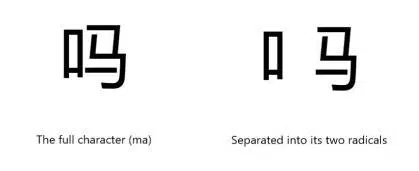
To deepen your understanding of how these components create meaning, let's turn to a short reading.
The Anatomy of Chinese Characters
The article 'The Anatomy of Chinese Characters' from StudyCLI provides an excellent narrative for remembering 吗 (ma). It explains the concept of using stories to learn characters, which complements our analytical approach.
Please read the section that begins 'Another method—one that is quite popular with Western students...'. Focus on the example given for the character 吗 (ma). The text explains how the 'mouth' (口) and 'horse' (马) radicals combine and offers a short story to link them to the meaning of 'question'.
This story-based explanation, combined with the structural analysis, provides a robust way to commit the character's form and function to memory.
2. Writing the Character 吗 (ma)
Now that you understand its components, let's focus on writing the character. The stroke order follows the fundamental rule of left-to-right. You will first complete the 口 radical before moving on to write the 马 component.
The character 吗 has a total of 6 strokes: 3 for 口 and 3 for 马.
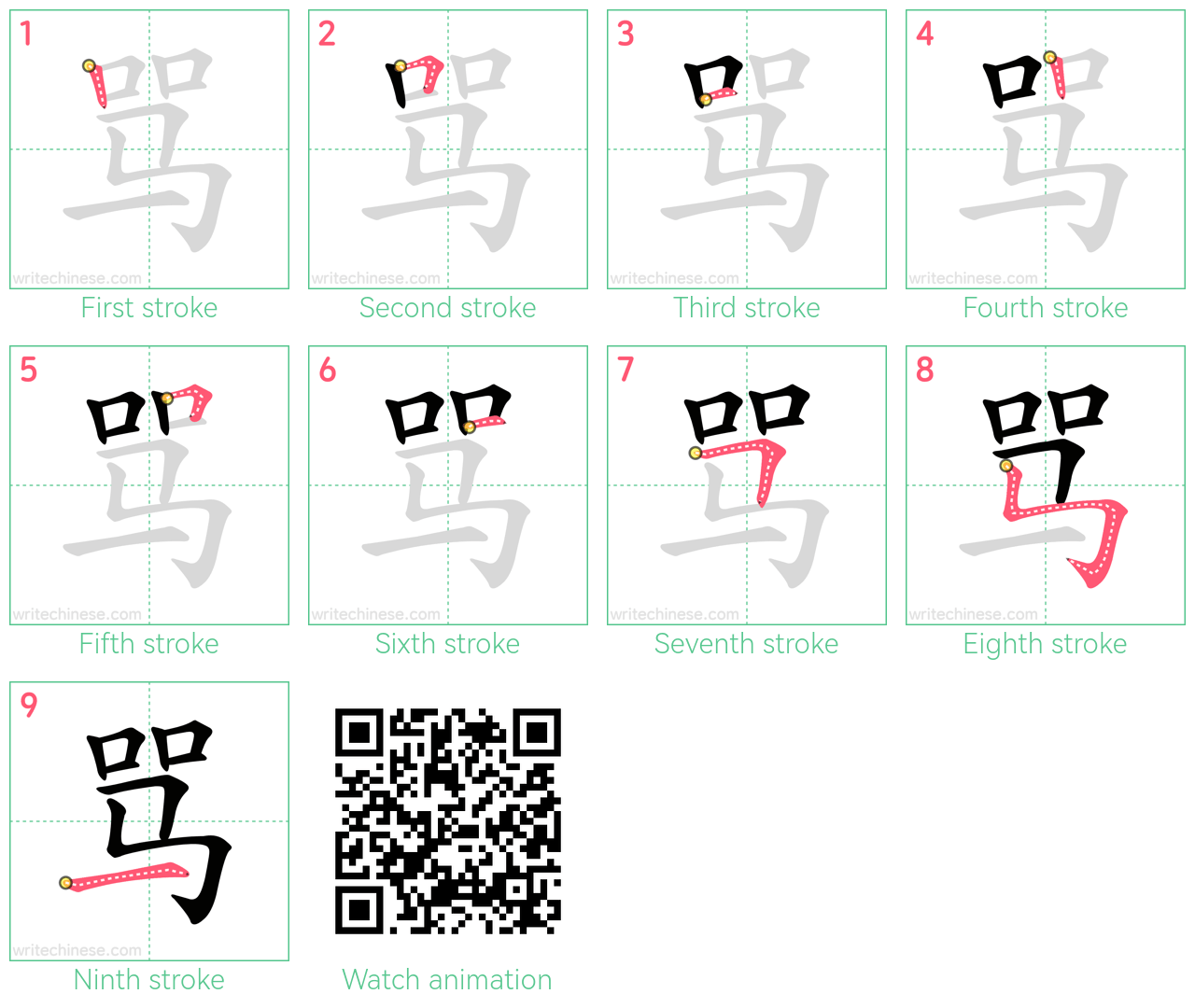
For a more detailed breakdown and an opportunity to practice, please use the following resource.
吗 ma - English Meaning | HSK 1
The Mandarin Temple dictionary entry for 吗 (ma) provides technical details and an interactive writing tool. We'll use it to solidify your understanding of the character's structure and practice writing it.
First, find the heading 'About 吗 mǎ'. Note the number of strokes (6) and the radical (口 kǒu). Next, under 'Etymology', confirm that it is a 'pictophonetic' (phono-semantic) character with 口 as the semantic part and 马 as the phonetic part. Finally, scroll down to the 'Write it!' section. Use the 'Show Strokes' button to review the stroke order, then practice drawing the character yourself.
Note: As mentioned earlier, this resource lists the pinyin as mǎ in the title, likely referencing the phonetic component. Remember that the correct pronunciation for the question particle is the neutral tone, ma.
Conclusion
Excellent work today. You have successfully dissected and learned to write a crucial functional character. By breaking 吗 (ma) down into its semantic and phonetic parts, you are continuing to build a strong, logical foundation for character recognition that will serve you well throughout your studies.
Key Takeaways:
- The character 吗 (ma) is a question particle used to form yes/no questions.
- Its pronunciation is a light, neutral tone:
ma. - It is a phono-semantic compound with a left-right structure:
- Radical (Meaning): 口 (kǒu) - mouth/speech.
- Phonetic (Sound): 马 (mǎ) - horse.
- The stroke order is left-to-right, completing the 口 radical first, then the 马 component, for a total of 6 strokes.
Preview of the Next Lesson:
Now that you can recognize and write 吗, the next logical step is to use it. In our next lesson, we will focus entirely on its grammatical function. You will learn how to add 吗 to the end of the declarative sentences you already know, transforming them into questions. For example, you'll be able to turn "He is a student" (他是学生) into "Is he a student?" (他是学生吗?).