Hello! Welcome to the third module of our course. In the previous module, we developed a deep understanding of vector spaces and linear transformations, culminating in how to represent the same transformation in different bases. As we previewed, our focus now shifts to adding geometric structure to these abstract spaces.
In this lesson, we will introduce the inner product, a powerful concept that generalizes the familiar dot product from your high school physics and math classes. We'll explore how this generalization allows us to define notions of length, distance, and angle in any vector space—even spaces of functions or complex vectors. This is a foundational step that opens the door to critical concepts in both deep learning (like projections and optimization) and quantum mechanics (the entire state-vector formalism).
Our goal is to define both real inner products (like the dot product) and complex inner products (often called Hermitian products), and learn how to verify that a given operation satisfies the required properties.
1. From Dot Product to Real Inner Product
You're already familiar with the dot product for vectors in . For two vectors and , their dot product is .
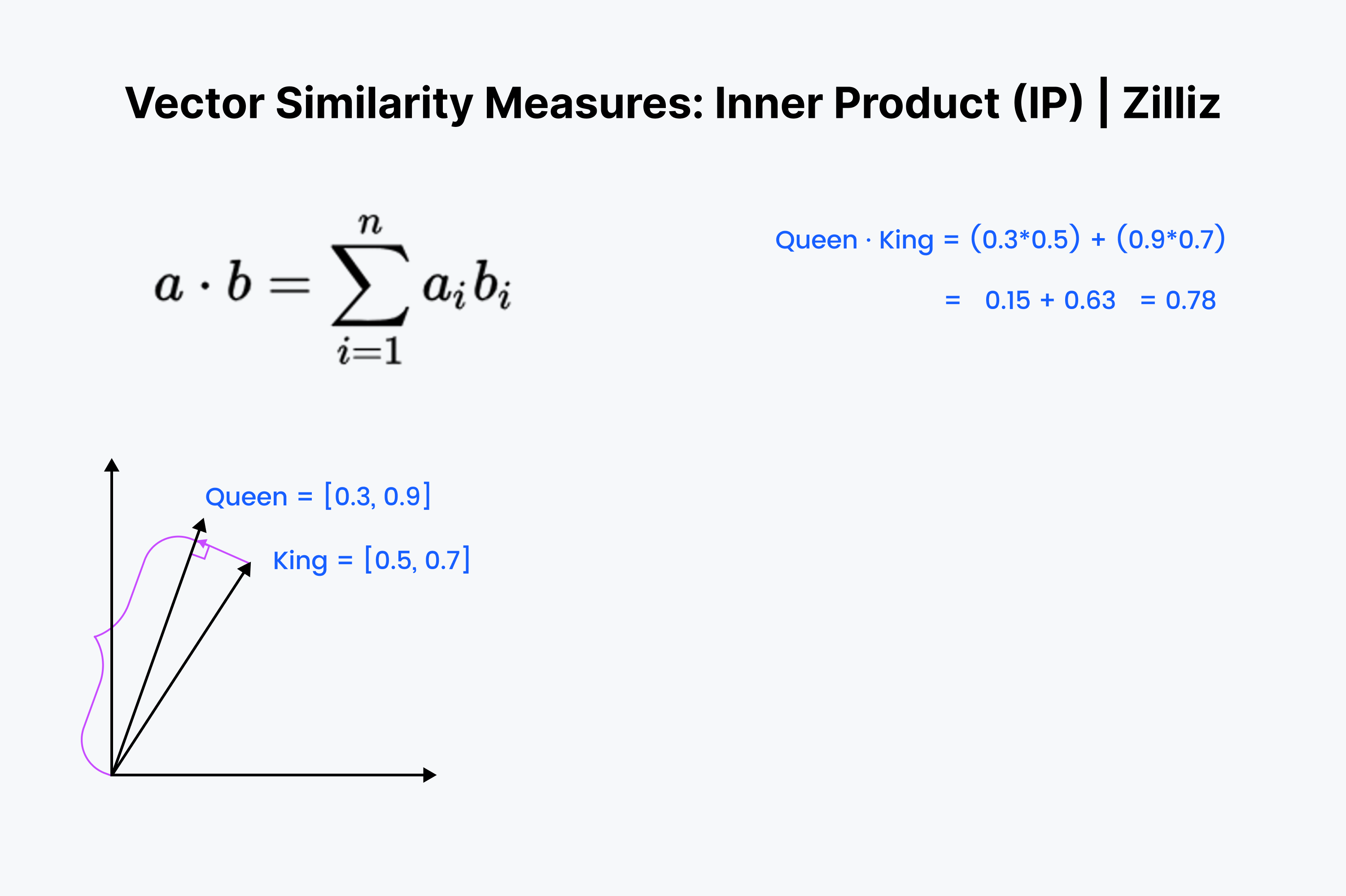
Beyond just a computational formula, the dot product provides geometry. It allows us to define:
- Length (or Norm): The length of a vector is .
- Angle: The angle between two vectors and is given by .
- Orthogonality: Two non-zero vectors are perpendicular if their dot product is zero.
The video below gives a great recap of why these geometric properties are so useful, setting the stage for why we want to abstract them.
Ch 4: What is an inner product? | Maths of Quantum Mechanics
The channel Quantum Sense provides an excellent motivation for why we need to generalize the dot product. This segment focuses on what the dot product gives us geometrically.
Watch from the beginning to 01:57. The main idea is that concepts like length and orthogonality are too useful to be confined only to arrow-like vectors in Rⁿ.
Defining the Real Inner Product
An inner product on a real vector space is a function that takes two vectors and returns a real number, denoted , that satisfies the following three axioms:
-
Linearity in each argument (this property is called bilinearity):
- for any scalars .
- .
-
Symmetry:
- .
-
Positive-Definiteness:
- for all vectors .
- if and only if is the zero vector, .
A real vector space equipped with an inner product is called a real inner product space.
The following video walks through these formal definitions and shows how the standard dot product in is a perfect example of a function that satisfies all these rules.
Oxford Linear Algebra: Inner Product Space
The 'Oxford Linear Algebra' series provides a clear, formal introduction to inner products. This part will define the properties and verify them for the dot product.
Watch from the beginning to 12:10. The video first defines a 'bilinear form' (our linearity property) and then adds symmetry and positive-definiteness to define an inner product. Follow the step-by-step check to see how the dot product satisfies these axioms.
An Example Beyond : Inner Products on Function Spaces
Inner products are not limited to column vectors. We can define them for more abstract vector spaces, like the space of continuous functions you've worked with in calculus.
Consider the vector space of all continuous real-valued functions on the interval . We can define an inner product for two functions and as:
This might seem unusual, but this definition fulfills all the inner product axioms and is fundamental in fields like Fourier analysis and quantum mechanics (where wavefunctions are treated as vectors in a function space).
The Oxford Linear Algebra video you just watched continues with an example of this type.
Oxford Linear Algebra: Inner Product Space
Let's continue with the same video to see how an integral can act as an inner product for a space of polynomials.
Watch from 13:52 to 19:03. Notice how the properties of integrals (like \int (f+g) = \int f + \int g) map directly to the linearity axiom of inner products.
Test your understanding!
Let and be vectors in . Consider the function defined by . Is this a valid inner product? Check the three axioms.
Show answer
Yes, this is a valid inner product. It's a "weighted" dot product.
- Linearity: It is linear. For example, . The logic extends for vector sums.
- Symmetry: It is symmetric. .
- Positive-Definiteness: It is positive-definite. . Since and , the sum is always . The sum can only be 0 if both and , which means .
2. The Complex (Hermitian) Inner Product
For quantum mechanics, we must work with vector spaces where the scalars are complex numbers. This requires a small but crucial modification to the inner product definition.
Why the Real Definition Fails
Let's see what goes wrong if we use the real inner product axioms for a complex vector space. The positive-definiteness axiom requires , ensuring the "length squared" of any vector is a non-negative real number.
Consider a vector in (i.e., just a complex number). Let . If we tried to define an inner product as (analogous to the dot product), we would get:
A length-squared of -1 is problematic! This violates positive-definiteness. The fix involves complex conjugation.
Ch 4: What is an inner product? | Maths of Quantum Mechanics
The Quantum Sense video provides a perfectly intuitive explanation for why we need to change the rules for complex spaces and how to fix it.
Watch from 01:57 to 05:16. Pay close attention to the example with the vector iψ. This shows exactly why symmetry must be replaced with conjugate symmetry to keep vector lengths real and positive.
Defining the Complex Inner Product
As the video showed, the solution is to replace the symmetry axiom. An inner product on a complex vector space (also called a Hermitian inner product) is a function that maps two vectors to a complex number and satisfies:
-
Linearity in the second argument:
- .
-
Conjugate Symmetry:
- . (The bar denotes complex conjugation).
-
Positive-Definiteness:
- and is a real number.
- if and only if .
A complex vector space with such an inner product is a complex inner product space (or a unitary space).
A Note on Conventions: Sesquilinearity
What about linearity in the first argument? Let's derive it from the axioms:
So, . Pulling a scalar out of the first argument requires conjugating it. This property is called conjugate linearity or anti-linearity. An operator that is linear in one argument and anti-linear in the other is called sesquilinear (from Latin for "one and a half times linear").
Important Convention Note: Physicists (especially in quantum mechanics) almost universally define the inner product to be linear in the second argument and anti-linear in the first, as we have done. Many mathematicians, however, use the opposite convention. Both are valid, but you must be consistent. We will stick to the physics convention as it aligns with your goal of studying quantum mechanics.
Standard Inner Product on
The standard inner product on for vectors and is defined as:
Using matrix notation, if and are column vectors, this is written as , where (read "u-dagger") is the conjugate transpose (or Hermitian conjugate) of —you transpose the vector and take the complex conjugate of each element.
For , .
Let's check the positive-definiteness for this definition:
Since is the squared modulus of a complex number, it is always a non-negative real number. The sum is therefore also a non-negative real number, and it can only be zero if all are zero, which means . This is exactly what we need!
The following resources provide a clear definition and verification of the complex inner product.
Intermediate Quantum Mechanics Lecture 2 Notes
These lecture notes from a Rutgers quantum mechanics course give a concise explanation for why the complex inner product is defined with a conjugate, and then state the definition using the bra-ket notation common in QM.
Read the section titled 'Inner product' on page 3. It shows how the definition ⟨a|b⟩ = a₁b₁ + a₂b₂ ensures that ⟨a|a⟩ is real and positive. The notation ⟨a| is the equivalent of our u-dagger.
Oxford Linear Algebra: Inner Product Space
Finally, the 'Oxford Linear Algebra' video also covers the transition to complex spaces.
Watch from 27:37 to 33:26. This segment introduces 'sesquilinear forms' and 'conjugate symmetry', reinforcing the concepts we've just discussed, and verifies the properties for the standard complex inner product.
Conclusion
In this lesson, we have generalized the dot product to the more abstract and powerful concept of an inner product. This allows us to import geometric intuition into all kinds of vector spaces, which will be immensely valuable.
Key Takeaways:
- An inner product is a function that takes two vectors and produces a scalar, satisfying axioms of linearity, symmetry (for real spaces) or conjugate symmetry (for complex spaces), and positive-definiteness.
- The real inner product uses symmetry: . The standard dot product is an example.
- The complex (Hermitian) inner product uses conjugate symmetry: . This is necessary to ensure that the inner product of a vector with itself, , is a non-negative real number.
- The standard inner product on is .
- A vector space equipped with an inner product is called an inner product space.
Preview of the Next Lesson:
Now that we have formally defined the inner product, we can immediately put it to use. In the next lesson, we will use the positive-definiteness property to formally define the norm (or length) of a vector as . From there, we will define distances and explore their properties.