Hello! Welcome back to our journey through eigenvalues and eigenvectors.
In our last lesson, we defined the algebraic multiplicity (AM) and geometric multiplicity (GM) of an eigenvalue. We established the crucial relationship and saw that an eigenvalue is "defective" when its geometric multiplicity is smaller than its algebraic multiplicity.
Today, we'll see exactly why this distinction matters so much. Our goal is to determine the conditions under which a matrix is diagonalizable. This concept is the bridge between the theory of eigenvalues and powerful applications, such as computing the evolution of quantum systems or understanding the behavior of neural networks. We'll finally answer the question: when does a matrix have "enough" eigenvectors?
1. What is Diagonalization?
First, let's define the term. A square matrix is diagonalizable if it can be written as a product of three matrices in the form:
where:
- is a diagonal matrix.
- is an invertible matrix.
This decomposition is incredibly useful. For instance, calculating high powers of becomes simple. Instead of performing hundreds of matrix multiplications for , you can use the decomposition:
Calculating is trivial—you just raise each diagonal entry to the 100th power. Given your computer science background, you can appreciate how this turns a computationally expensive problem into an efficient one.
To get a feel for this, let's watch a short video that introduces the concept and its motivation.
The 4 Ways to Tell if a Matrix is Diagonalizable [Passing Linear Algebra]
This video from STEM Support quickly explains what a diagonalizable matrix is and why we care about it, focusing on the efficiency of calculating matrix powers.
Watch from the beginning to 3:14. The video introduces the A = CDC⁻¹ formula (they use C instead of P, which is a common notational difference) and explains the roles of the matrices C and D.
2. The Core Condition: A Full Set of Eigenvectors
As the video highlighted, the matrices and are not just any matrices; they are built directly from the eigenvalues and eigenvectors of .
- The diagonal entries of are the eigenvalues of .
- The columns of are the corresponding eigenvectors of .
This reveals the central requirement for diagonalizability. For the matrix to be invertible, its columns must be linearly independent. Since the columns of are the eigenvectors of , this leads us to the single most important theorem on this topic.
The Diagonalization Theorem
An matrix is diagonalizable if and only if it has linearly independent eigenvectors.
This is the fundamental condition. If we can find a set of linearly independent eigenvectors for an matrix, we can use them to form a basis for the vector space (or ). This special basis is called an eigenbasis.
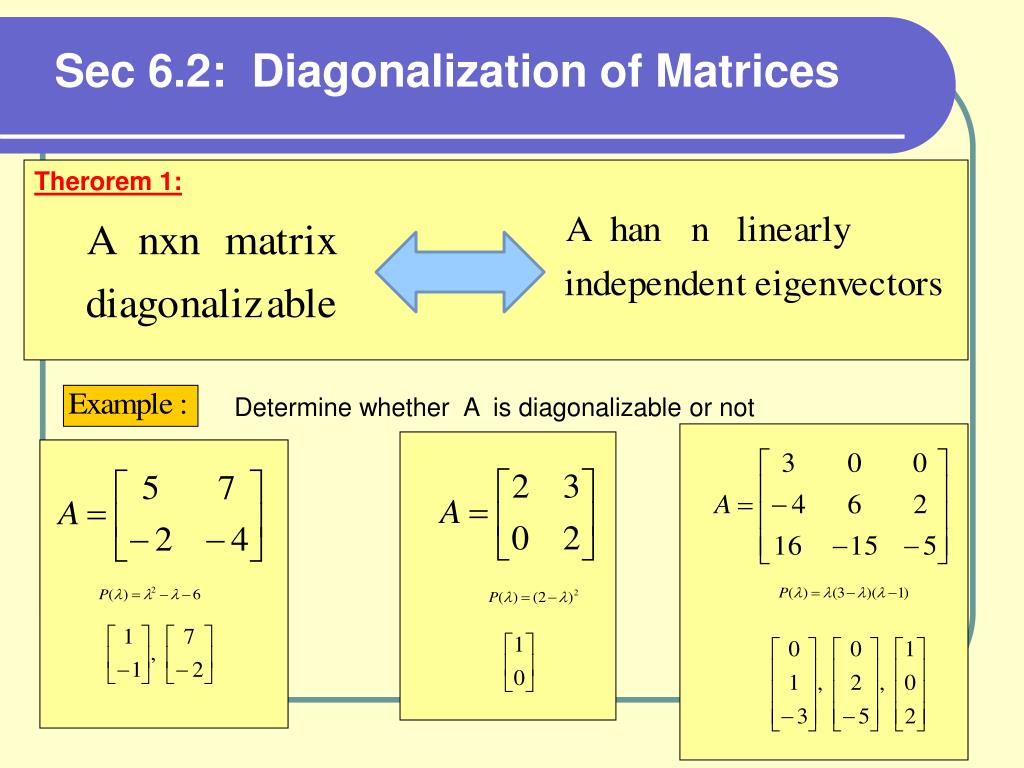
To further solidify this central idea, please read the first part of the following resource.
The following textbook section from Georgia Tech provides a formal statement of the Diagonalization Theorem and its proof.
Read the subsection 'Diagonalizability', starting from the definition and ending just before the 'Example (A shear is not diagonalizable)'. Focus on the 'Diagonalization Theorem' and its implications.
An important clarification mentioned in the text is that diagonalizability has nothing to do with invertibility. A matrix can be invertible but not diagonalizable, and it can be diagonalizable but not invertible (if it has an eigenvalue of 0).
3. The Practical Test: Connecting to Multiplicities
The Diagonalization Theorem is great, but how do we check for n linearly independent eigenvectors in practice? This is where our work from the last lesson pays off.
The number of linearly independent eigenvectors an eigenvalue provides is its geometric multiplicity, . To find the total number of linearly independent eigenvectors for a matrix , we simply sum the geometric multiplicities of all its distinct eigenvalues:
For an matrix to be diagonalizable, this sum must equal .
Now, let's bring in the algebraic multiplicity. We know two facts:
- (The degree of the characteristic polynomial is )
For to equal , all the "less than or equal to" signs in the chain must become equalities. This happens if and only if two things are true:
- The sum of the algebraic multiplicities is . (This means the characteristic polynomial factors completely, with no non-real complex roots if we are working in ).
- For every eigenvalue , .
This gives us our ultimate practical test. A matrix is diagonalizable if and only if none of its eigenvalues are defective.
The following video does an excellent job of summarizing these equivalent conditions.
The 4 Ways to Tell if a Matrix is Diagonalizable [Passing Linear Algebra]
Let's return to the STEM Support video, which lists the four equivalent ways to determine if a matrix is diagonalizable, connecting everything we've discussed.
Watch from 6:03 to 8:13. This section neatly summarizes the four conditions. Pay attention to how condition #4 (GM=AM for each eigenvalue) implies condition #3 (sum of GMs is n).
4. Summary of Conditions and a Non-Diagonalizable Example
Let's consolidate. For an matrix , the following statements are equivalent:
- A is diagonalizable.
- A has linearly independent eigenvectors.
- The sum of the geometric multiplicities of its eigenvalues equals .
- The algebraic multiplicity of every eigenvalue equals its geometric multiplicity.
A very common and useful shortcut:
- If an matrix has distinct eigenvalues, it is guaranteed to be diagonalizable. This is because each eigenvalue must have GM . With distinct eigenvalues, the sum of GMs must be at least , and since it can't exceed , it must be exactly .
Example: A Non-Diagonalizable Matrix
Let's see what happens when a matrix fails the test. Consider the matrix:
-
Find Eigenvalues: Since this is an upper-triangular matrix, the eigenvalues are on the diagonal. We have with an algebraic multiplicity of 2.
-
Find Eigenvectors (and Geometric Multiplicity): We need to find the null space of .
The equation becomes:
The variable is free, while is a pivot variable. Since there is only one free variable, the dimension of the eigenspace is 1. Thus, the geometric multiplicity is 1.
-
Conclusion: We have but . Since , the eigenvalue is defective. The matrix only has one linearly independent eigenvector (any multiple of ), which is not enough to span . Therefore, is not diagonalizable.
Test your understanding!
A 5x5 matrix has the characteristic polynomial .
Further analysis reveals that the dimension of the eigenspace for is 3, and the dimension of the eigenspace for is 1.
Is the matrix diagonalizable? Why or why not?
Show answer
No, the matrix is not diagonalizable.
Here's the reasoning:
- For : The algebraic multiplicity is 3 (from the exponent in the polynomial). The geometric multiplicity is given as 3 (the dimension of the eigenspace). Here, AM = GM, which is good.
- For : The algebraic multiplicity is 2. The geometric multiplicity is given as 1. Here, GM (1) < AM (2).
- Conclusion: Because there is at least one eigenvalue () for which the geometric multiplicity is less than the algebraic multiplicity, the matrix is defective and therefore not diagonalizable. We cannot find 5 linearly independent eigenvectors. We can only find 3 + 1 = 4.
Conclusion
Today we've connected all the dots between eigenvalues, eigenvectors, and the powerful concept of diagonalization. This is a major milestone in your linear algebra journey.
Key Takeaways:
- A matrix is diagonalizable if it can be written as , where is a diagonal matrix of eigenvalues and is an invertible matrix of eigenvectors.
- The fundamental condition for an matrix to be diagonalizable is that it must have linearly independent eigenvectors.
- The most practical way to test for this is to check if, for every eigenvalue , its geometric multiplicity equals its algebraic multiplicity ().
- Certain matrices, like those with all distinct eigenvalues or symmetric matrices (which we will study later), are always diagonalizable.
Preview of the Next Lesson:
We now know when we can diagonalize a matrix. The next logical step is to learn how. In the next lesson, we will walk through the full computational recipe: "Given a diagonalizable matrix , construct the matrices and ".