Hello! Welcome to the eighth module of our course.
In the previous module, we explored powerful applications of linear algebra in data analysis, culminating in understanding Principal Component Analysis through the lens of Singular Value Decomposition. We saw how SVD provides a robust method for uncovering the directions of maximum variance in a dataset.
Now, we pivot from data applications to the foundational structures required for your future studies in quantum mechanics. This module, "Tensor Products for Composite Systems," introduces a new way to combine vector spaces. While direct sums allow us to "add" spaces, tensor products provide a way to "multiply" them. This concept is the mathematical language used to describe systems composed of multiple parts, such as a collection of particles or the multi-qubit systems central to quantum computing.
In this first lesson, we will tackle the fundamental definition of a tensor product. Our goal is to define the tensor product of two vector spaces and learn how to compute the dimension of the resulting space.
1. Combining Systems: More Than Just Stacking Vectors
Imagine you have two separate systems. System A could be a quantum coin with two states (Heads, Tails), described by a 2D vector space . System B could be a quantum die with six states (1 to 6), described by a 6D vector space . How do we describe the combined system, where we can observe both the coin and the die simultaneously?
A single outcome of the combined system is a pair of outcomes, like (Heads, 3) or (Tails, 5). We need a new, larger vector space that can account for all possible combinations of states.
You're already familiar with one way to combine vector spaces: the direct sum, . In a direct sum, we essentially stack the vectors. If and , the new vector is . The dimensions add up: . For our coin and die example, this would be a dimensional space. This isn't quite right, because there are possible combined outcomes.
The tensor product provides the correct framework. It creates a new space, , where the dimensions multiply: .
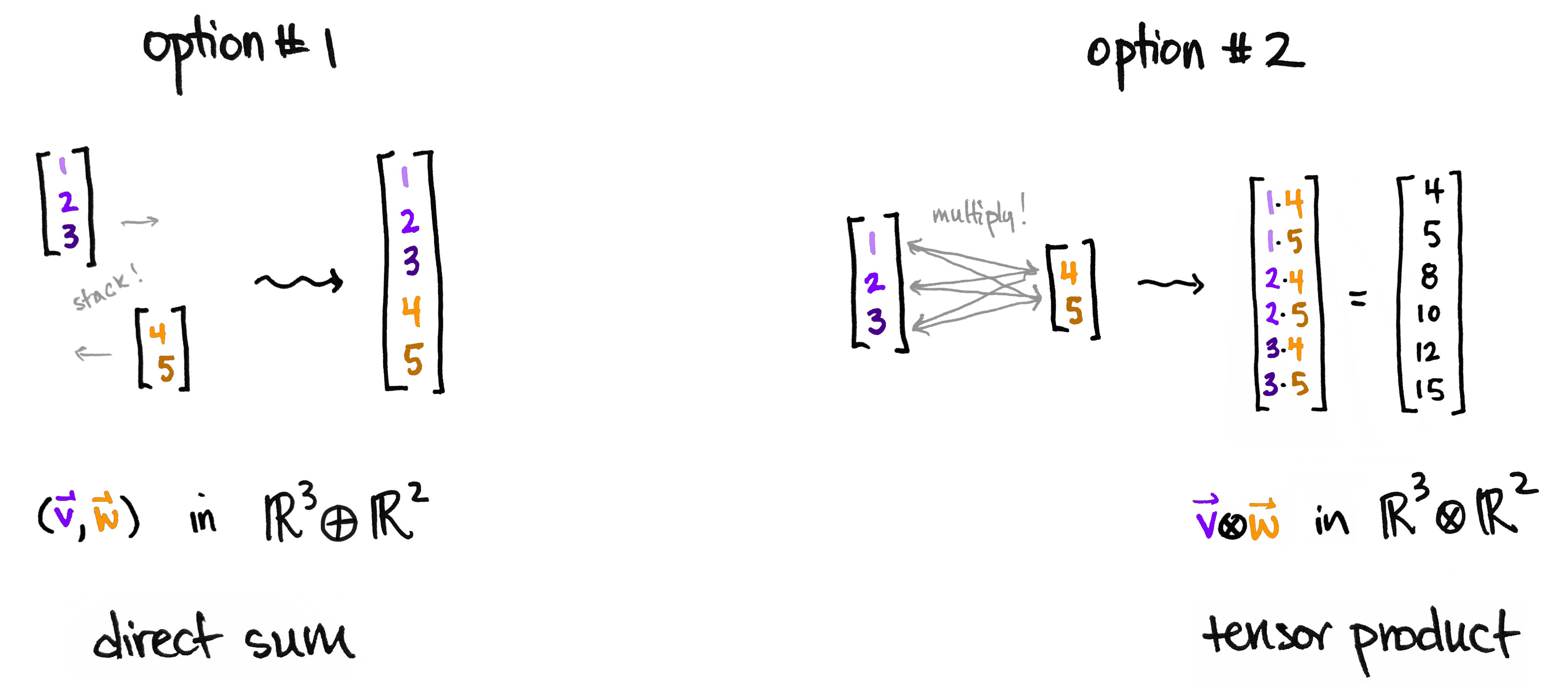
To build some more intuition, let's start with a brief, accessible article that introduces the core idea.
The Tensor Product, Demystified
The article 'The Tensor Product, Demystified' by Tai-Danae Bradley provides a great high-level introduction. It contrasts the direct sum and tensor product and explains why the tensor product involves dimensions multiplying.
Please read the first section, 'Making new vectors from old'. It will reinforce the key distinction we've just discussed.
This idea of combining systems by taking all possible pairings is the conceptual heart of the tensor product.
2. The Formal Construction: Sculpting the Right Space
Now, how do we formally define this new vector space, ? It's a bit more abstract than just saying "multiply the components," because we need a definition that works for general vector spaces, not just .
The standard approach is a clever, multi-step process that you can think of as "sculpting":
- Start with a massive, unrefined vector space that includes all possible "formal products" of vectors from and .
- "Chip away" at this space by enforcing the algebraic rules we want our product to have (like the distributive property). This is done formally by taking a quotient space.
The following video provides an excellent and clear explanation of this construction. It first builds the motivation for why this process is necessary.
What is a tensor anyway?? (from a mathematician)
Let's watch a video by Michael Penn titled 'What is a tensor anyway??'. He does a great job of motivating the quotient space construction by first defining a 'formal product' space that is 'too big' and then showing how to refine it.
Please watch from 1:48 to 14:15. (1:48 - 4:45) Introduces the 'formal product' V * W, a huge vector space with no relations between its elements. (4:45 - 10:39) Shows examples of elements in this space that 'feel' like they should be related but are not, highlighting the need for more structure. (10:39 - 14:15) Explains how to impose the desired relations (like distributivity and scalar multiplication rules) by defining a special subspace I and taking the quotient (V * W) / I. This final object is the tensor product space V ⊗ W.
Let's summarize the key steps from the video:
-
The Formal Product (): We start with a vector space whose basis is the set of all symbols for every and . This space is enormous and lacks the properties we'd expect from a "product." For example, is a completely separate basis vector from .
-
The Subspace of Relations (): We identify all the relationships we want to be true. These are the bilinearity properties:
- for any scalar .
We form a subspace, , by taking the span of all vectors of the form(left side) - (right side)from these desired identities (e.g., ).
-
The Quotient Space: The tensor product space is formally defined as the quotient space . This construction effectively sets every element in the subspace to zero, thereby enforcing the desired bilinearity relations in the final space. An element in this new space is written as .
This construction ensures that the tensor product behaves like a proper, well-behaved multiplication operation between vectors.
3. Basis and Dimension of the Tensor Product Space
Now that we have defined the space , we can answer the second part of our learning goal: what is its dimension?
The key insight is that if we have a basis for and a basis for , we can construct a basis for by taking all possible tensor products of their basis vectors.
Let's watch a segment from another excellent video that clearly explains this.
A Concrete Introduction to Tensor Products
The video 'A Concrete Introduction to Tensor Products' by Mu Prime Math provides a very clear derivation of the basis and dimension of a tensor product space.
Please watch from 23:46 to 28:43. The video shows how any vector in the tensor product space can be expanded into a linear combination of e_i ⊗ f_j, where {e_i} and {f_j} are bases for the original spaces. This directly leads to the dimension formula.
As the video explains, if is a basis for and is a basis for , then the set of all pairwise tensor products:
forms a basis for .
You can visualize this as creating a grid:
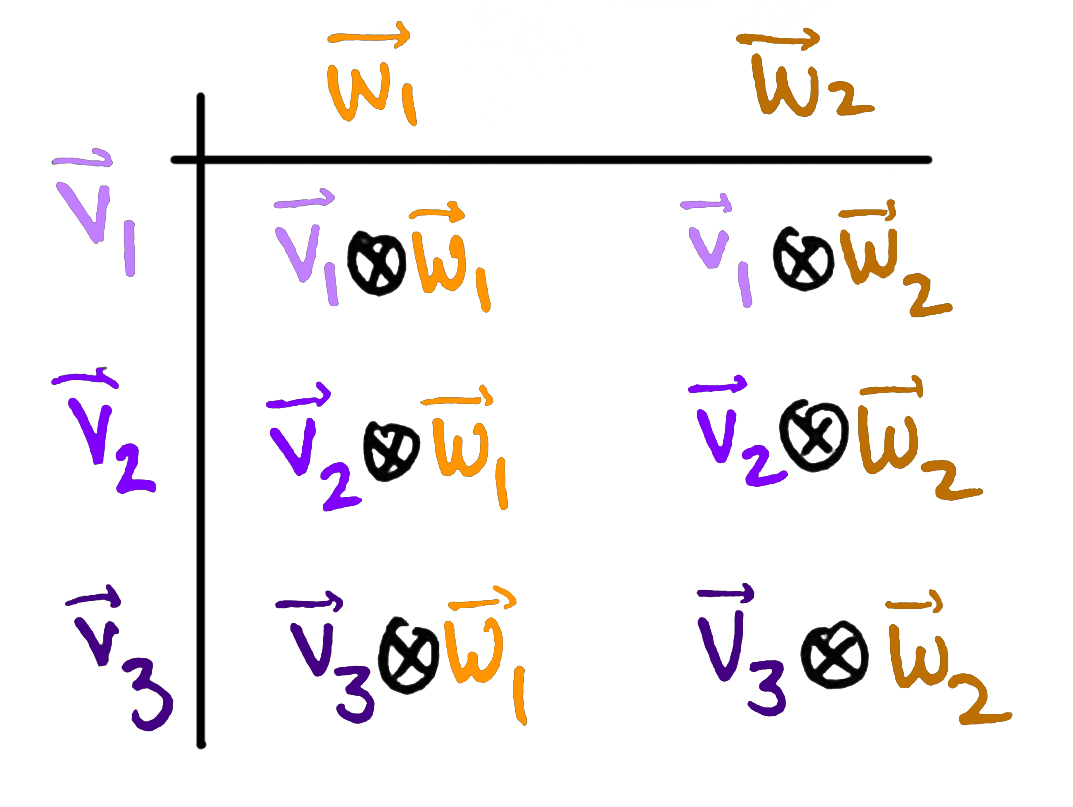
Since there are choices for the first vector and choices for the second, there are a total of basis vectors in this new set. This gives us our fundamental result:
The dimension of the tensor product of two vector spaces is the product of their individual dimensions.
Test your understanding!
Let be the vector space of all real matrices, and let be a 4-dimensional complex vector space (over the field of complex numbers).
What is the dimension of the tensor product space ?
Show answer
First, we find the dimensions of the individual spaces.
- The space of matrices, , has dimension .
- The space has dimension 4.
The dimension of the tensor product is the product of the individual dimensions:
The resulting space is 24-dimensional.
Conclusion
In this lesson, we introduced the tensor product as a new way to combine vector spaces, a method that is essential for describing composite physical systems.
Key Takeaways:
- The tensor product is a new vector space constructed from vector spaces and . It models composite systems where the number of possible states is the product of the states in the individual systems.
- Formally, is defined as a quotient space. This construction ensures that the tensor product operation is bilinear, meaning it distributes over vector addition and behaves correctly with scalar multiplication.
- If is a basis for and is a basis for , then the set of all products forms a basis for .
- The dimension of the tensor product space is the product of the dimensions of the constituent spaces: .
Preview of the Next Lesson:
We've defined the space and found its dimension. In the next lesson, we will get more concrete and learn how to compute the tensor product of two specific vectors. This will introduce the Kronecker product, which is the matrix representation of the tensor product for column vectors. We will then see how this extends to defining tensor products of linear operators, a crucial step for describing operations on multi-qubit systems in quantum computing.