Welcome back! In our last lesson, we established the fundamentals of function pointers: how to declare them, assign function addresses to them, and invoke functions through them. We concluded by noting that while powerful, the syntax, especially for complex function signatures, can quickly become unwieldy and a source of errors.
Today, we'll tackle that problem head-on. This lesson is dedicated to a standard C practice that dramatically improves the clarity of your code: using the typedef keyword to create aliases for function pointer types. For an engineer working with complex systems like AUTOSAR, where callbacks and event handlers are ubiquitous, mastering this technique is essential for writing clean, maintainable, and less error-prone code.
By the end of this lesson, you will be able to use typedef to simplify function pointer declarations and improve code readability, a skill that is highly valued in professional C development.
The Problem: When Syntax Obscures Intent
Complex declarations are a common pain point in C, and function pointers are a prime offender. Consider the standard C library function signal(). Its declaration is notoriously difficult to parse at a glance.
A resource on Stack Overflow provides a perfect illustration of this problem.
Understanding typedefs for function pointers in C - Stack Overflow
This Stack Overflow discussion, "Understanding typedefs for function pointers in C," opens with a classic example of complex C syntax. We'll focus on the initial problem statement.
Read the first part of the top answer, starting from "Consider the signal() function..." down to where the typedef version is introduced. Focus on the raw declaration of signal() and try to parse it yourself before seeing the simplified version.
The declaration is:extern void (*signal(int, void(*)(int)))(int);
As the author notes, it is "perfectly obscurely obvious." This function takes two arguments (an int and a pointer to a function) and also returns a pointer to a function. In an interview, being asked to decipher this under pressure is a real possibility. This is the exact problem typedef is designed to solve.
The Solution: Creating an Alias with typedef
typedef allows you to create a new, more descriptive name for an existing data type. It doesn't create a new type; it simply provides an alias. When applied to function pointers, it lets you hide the complex syntax behind a clean, intuitive name.
The general syntax is:typedef return_type (*AliasName)(parameter_type1, ...);
Now, let's see how this cleans up the signal() declaration, as shown in the same Stack Overflow answer you just read.
-
Define the alias: We create an alias named
SignalHandlerfor the function pointer typevoid (*)(int). This represents any function that takes anintand returnsvoid.typedef void (*SignalHandler)(int signum); -
Use the alias: Now, we can redeclare
signal()using this much clearer alias.extern SignalHandler signal(int signum, SignalHandler handler);
The result is a declaration that is immediately understandable: signal() is a function that takes an int and a SignalHandler as arguments, and it returns a SignalHandler. The complexity is abstracted away, making the code's intent clear.
Here is a simple visual summary of the concept.
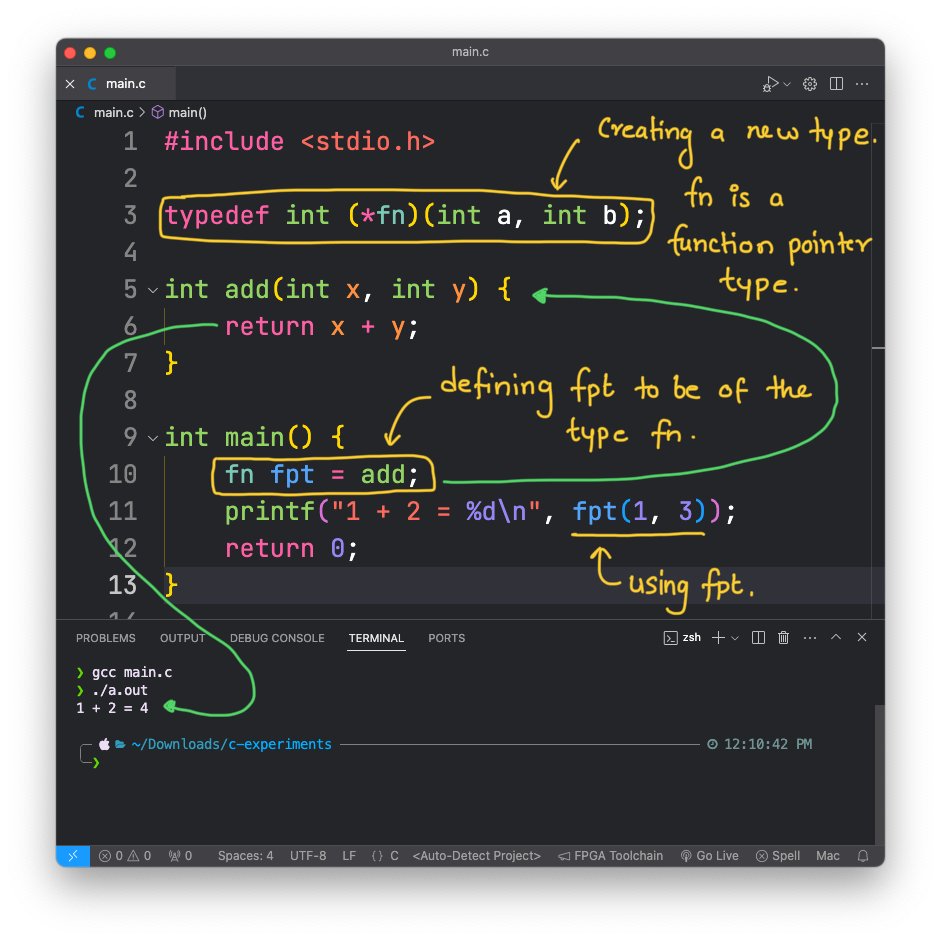
Key Benefits of Using typedef for Function Pointers
Using typedef isn't just a matter of style; it has tangible benefits that are critical in professional software engineering, especially in embedded systems where code clarity and maintainability are paramount.
[PDF] The Use and Benefits of typedef in Embedded C
This document, "The Use and Benefits of typedef in Embedded C," provides an excellent summary of why this practice is so important in your field.
Please read the section titled "Benefits of Using typedef". These four points are excellent talking points for an interview when asked about code quality.
To summarize for your interview preparation, the key advantages are:
- Readability: It transforms complex, error-prone syntax into simple, self-documenting type names.
- Portability: You can abstract away platform-specific details. For instance, if a function signature changes on a new hardware platform, you might only need to update a single
typedef. - Maintainability: When function signatures are used in many places (e.g., as parameters to multiple functions, in arrays of function pointers), a
typedefprovides a single point of truth. If the signature needs to change, you only have to edit thetypedef, and the compiler will flag all the places that now have a type mismatch. - Ease of Use: It's simply easier and less error-prone to write
SignalHandler my_handler;thanvoid (*my_handler)(int);every time.
A Practical Embedded Example: Timer Callbacks
Let's ground this in a scenario you're likely familiar with from your work in driver development: a timer with a callback function. This is a classic use case where typedef makes the design much cleaner.
[PDF] The Use and Benefits of typedef in Embedded C
The same PDF provides a concrete example of using typedef to manage callbacks for a hardware timer.
Read the section "typedef for Function Pointers: Callback Management". Pay close attention to how the TimerCallback alias is defined and then used as a member within the HardwareTimer structure. This is a very common and powerful pattern.
Let's break down the code from that example:
// 1. Define the alias for the callback function pointer type.
// It's a pointer to a function that takes no arguments and returns void.
typedef void (*TimerCallback)(void);

// 2. Use the alias within a structure that defines a hardware timer.
// This makes the struct declaration clean and its purpose obvious.
typedef struct {
    uint32_t period;
    TimerCallback callback; // The function to call when the timer elapses
} HardwareTimer;

// Define two different callback functions that match the signature
void onTimerElapsed(void) {
    printf("Timer 1 has elapsed!\n");
}

void onAnotherTimerEvent(void) {
    printf("Timer 2 event occurred!\n");
}

// In your main application logic...
int main() {
    // 3. Initialize timer structures with their respective callbacks.
    HardwareTimer timer1 = { .period = 1000, .callback = onTimerElapsed };
    HardwareTimer timer2 = { .period = 500,  .callback = onAnotherTimerEvent };

    // 4. In a real system, an interrupt would trigger this.
    // Here, we simulate the timer elapsing and invoke the callback.
    if (timer1.callback != NULL) {
        timer1.callback(); // Invokes onTimerElapsed
    }

    if (timer2.callback != NULL) {
        timer2.callback(); // Invokes onAnotherTimerEvent
    }

    return 0;
}
Without typedef, the HardwareTimer struct would have been declared as:typedef struct { uint32_t period; void (*callback)(void); } HardwareTimer;
While manageable here, imagine if the callback took several arguments. The typedef approach scales much better and keeps the struct definition focused on its members rather than on complex syntax. This pattern is fundamental to many driver architectures, state machines, and the notification systems you've worked with in AUTOSAR.
Conclusion
In this lesson, we've seen how a simple C keyword, typedef, can be used to manage complexity and significantly improve code quality. For function pointers, it is not just a convenience but a crucial tool for writing readable, maintainable, and robust software.
Key Takeaways for Your Interview:
- The "Before and After": Be ready to show an example of a complex function pointer declaration (like
signal()) and then demonstrate howtypedefsimplifies it. This clearly illustrates your understanding of the problem and the solution. - Articulate the Benefits: Memorize and be able to explain the key advantages: improved readability, maintainability, portability, and ease of use.
- The
structPattern: Explain howtypedefis invaluable when embedding function pointers instructsto create configurable objects or implement callbacks, a pattern central to embedded systems and driver development. - It's an Alias, Not a New Type: Be precise.
typedefcreates a synonym for a type, not a fundamentally new one.
You now have a solid grasp of how to declare and manage function pointers cleanly. In our next lesson, we will build directly on this by implementing a complete callback mechanism, where we pass function pointers as arguments to other functions to create a flexible, event-driven design.