Hello! Welcome to the final lesson in our module on function pointers.
In our last few lessons, we built up from the basics of function pointers to implementing callbacks and efficient dispatch tables. You learned how to replace a cumbersome switch statement with an array of function pointers, creating a clean, scalable, and high-performance command processor.
Today, we'll synthesize these concepts to analyze their most significant application in your field: the notification and callback patterns that form the backbone of AUTOSAR and similar embedded architectures. We'll explore how these patterns enable the strict decoupling between software components and layers, a fundamental principle of AUTOSAR. Understanding this isn't just about C syntax; it's about architectural thinking, a key differentiator in senior engineering interviews.
By the end of this lesson, you will be able to analyze the use of function pointers for notification and callback patterns in an AUTOSAR-style architecture.
The "Don't Call Us, We'll Call You" Principle
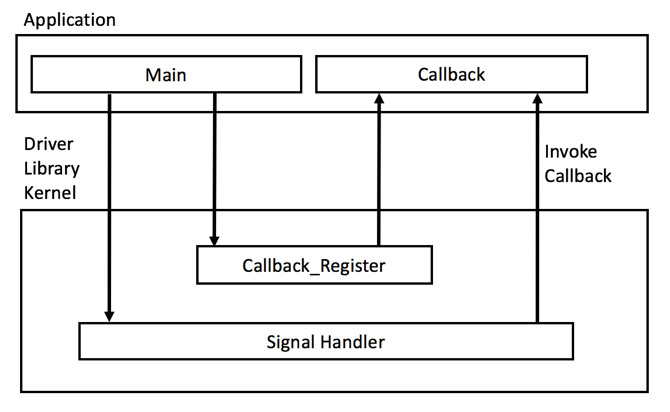
The core design philosophy behind these patterns is Inversion of Control (IoC). In traditional programming, a high-level function calls low-level functions to get work done. With IoC, this is flipped: the low-level framework or service calls back into the high-level application code when a specific event occurs.
The high-level code says, "Here's a function pointer to my onDataReceived function. Call it whenever new data arrives." The low-level module doesn't know or care what onDataReceived does; it just knows it has a valid function to call. This creates a powerful decoupling mechanism.
Let's see this in action in a classic embedded scenario: handling interrupts.
Using Callbacks with Interrupts
The article "Using Callbacks with Interrupts" from Beningo Embedded Group provides an excellent, practical walkthrough of this exact problem. It shows how to transform a rigid, application-specific Interrupt Service Routine (ISR) into a flexible, reusable driver component.
Please read through the article, from the introduction to the conclusion. Pay close attention to how a static, hard-coded interrupt handler is refactored to use a function pointer. Notice the API for registering the callback and the choice between dynamic (runtime) and static (compile-time) assignment.
The approach detailed in the article is fundamental to creating a Hardware Abstraction Layer (HAL). Let's break down the key elements of this pattern:
- The Problem: An ISR directly contains application-specific logic (e.g.,
RingBuffer_Insert(&MyBuffer, Uart_Read())). This makes the UART driver non-reusable because it's tightly coupled toMyBufferand the application's specific data handling. - The Abstraction: The driver's ISR is generalized. Instead of containing application logic, it simply checks if a function pointer is non-NULL and, if so, calls it.
// Inside the driver's ISR if (RxCallback != NULL) { RxCallback(); } - The Registration: The driver exposes a public API function, like
Uart_RegisterRxCallback(void (*callback)(void)), allowing the application layer to "register" its specific handler function during initialization. - The Control: The application defines its handler (e.g.,
MyUartRxHandler) and passes its address to the driver. The application maintains control over the what, while the driver handles the when.
Callback Patterns in AUTOSAR
Your experience with AUTOSAR is a large-scale application of this exact principle. The entire architecture, from the Microcontroller Abstraction Layer (MCAL) to the Application Layer (ASW), is built on callbacks and notifications managed by the Runtime Environment (RTE).
Let's consider a concrete example you've likely worked with: receiving a CAN message in the COM module.
- A CAN frame arrives. The
CanIf(CAN Interface) module's ISR is triggered. CanIfvalidates the frame and passes the Protocol Data Unit (PDU) up to the PDU Router (PduR).PduRdetermines which module should receive this PDU. For a COM message, it callsCom_RxIndication(). This is the first key callback: the lower layer (PduR) is notifying the service layer (Com) of an event.- The
Commodule receives the PDU, unpacks the signals within it, and performs its configured processing (e.g., filtering, timeout monitoring). - For each signal that has a "notification" configured,
Cominvokes a callback function. This function is generated by the RTE and ultimately leads to the application's code (e.g., a runnable in a Software Component).
This flow is precisely what enables the strict separation of concerns in AUTOSAR.

Analyzing the "Why": Architectural Benefits
In an interview, explaining why this architecture is used is as important as explaining how it works.
- Modularity and Reusability: The
Commodule can be configured and used in any project. It has no hard-coded dependencies on the application logic that consumes the signals. An application SWC that reads a temperature signal doesn't care if that signal comes from CAN, Ethernet, or FlexRay. The RTE and COM abstract this away. - Configuration over Code: You don't manually write the function pointer assignments. The AUTOSAR toolchain reads the configuration (from ARXML files) and generates the glue code, including the notification function calls and the tables that link signal IDs to their respective callback functions. This is a large-scale, automated implementation of the dispatch tables we studied in the last lesson.
- Event-Driven Efficiency: The application code is not polling a status flag (
if (Com_IsDataNew()) ...). It is executed only when data changes, which is far more efficient and leads to more predictable system behavior. This is crucial for real-time systems. - Safety and Predictability: As the Beningo article touched upon, these function pointers are often assigned statically at compile time through generated configuration tables. This is a
static constdispatch table on a massive scale. It means the call graph is fixed and can be statically analyzed, which is a critical requirement for safety standards like ISO 26262. Runtime changes to callbacks are often disallowed to prevent unpredictable behavior.
Function Pointer in C – Complete Guide with Examples
To reinforce these architectural benefits, let's briefly review a summary of why function pointers are so valuable in this context.
Please read section 10, "Function Pointer as a Callback Function," and the summary in "Advantages of Function Pointers in C." The example uses a Windows driver, but the principle is identical to an AUTOSAR BSW module. The advantages listed directly map to the benefits we see in the AUTOSAR architecture.
Conclusion
You have now completed the module on function pointers, moving from basic syntax to a deep architectural analysis of their use in the automotive domain. You can now articulate not just how to use function pointers, but why they are essential for building the modular, configurable, and robust systems required by standards like AUTOSAR.
Key Takeaways for Your Interview:
- Start with the Principle: Frame your answer around Inversion of Control and decoupling. Explain that callbacks allow lower layers (drivers, services) to notify higher layers (applications) without having any knowledge of the application's logic.
- Use a Simple Analogy: Start with the UART driver/ISR example. It’s a clear, concise way to demonstrate the core concept of registering a callback to make a driver reusable.
- Connect to AUTOSAR: Bridge the concept to the AUTOSAR stack. Confidently describe the notification chain, for example:
CanIf -> PduR -> Com -> RTE -> Application SWC. Mentioning specific function names likeCom_RxIndicationshows deep familiarity. - Explain the Architectural "Why": Discuss the benefits of modularity, reusability, and event-driven efficiency. Crucially, emphasize how AUTOSAR tools generate these callback mechanisms from configuration files (ARXML), creating large, statically defined dispatch tables that are safe and predictable. This demonstrates a senior-level understanding of the entire development ecosystem, not just the C language.
This concludes our deep dive into pointers. In the next module, we will shift our focus to how data itself is organized in memory, starting with a topic that is a frequent source of tricky interview questions: structure padding and memory alignment.