Hello! Let's continue our deep dive into low-level C concepts for your interviews.
In our last session, we introduced bit-fields as a powerful tool for modeling hardware registers, offering improved readability over manual bitwise operations. We also touched upon their main weakness: a lack of portability due to implementation-defined behaviors.
This lesson directly addresses that weakness. Our goal is to explain the portability and implementation-defined aspects of bit-fields, such as bit ordering and padding. A deep understanding of these issues is what separates a good C programmer from a great one, especially in interview scenarios where you need to articulate trade-offs. We'll explore exactly what the C standard leaves unspecified and how different compilers and architectures handle these details.
1. The Source of Non-Portability: "Implementation-Defined"
The core issue with bit-fields is that the C standard deliberately leaves several key aspects of their layout undefined. Instead, it delegates these decisions to the "implementation"—meaning the compiler, the target architecture, and the conventions they follow, which are formally specified in a document called the Application Binary Interface (ABI).
To understand this foundational concept, let's start with an article that digs into the standards.
Bit-fields | An Attempt to Organize Information
The article "Bit-fields | An Attempt to Organize Information" by mocelik.com provides an excellent overview of the portability concerns. It explains that the C/C++ standards leave bit-field allocation and alignment as implementation-defined and traces this down to the platform-specific ABIs.
Please read the initial sections, starting from the introduction and focusing on the "Portability Concerns" section. Notice how it references the C++ standard (which reflects the C standard's ambiguity) and points to ABIs like System V for specific platforms (x86-64, ARM) as the documents that actually define the behavior.
As the article states, key behaviors like whether bit-fields are assigned left-to-right or right-to-left are not guaranteed by the language itself. This is why code that perfectly maps a register on an ARM processor might produce garbage data when recompiled for an x86 target. For your work in automotive systems, where you might deal with different microcontrollers (e.g., Infineon TriCore, NXP S32K, etc.), this is a critical consideration.
2. Key Portability Issues: A Deeper Look
Let's examine the three most common implementation-defined behaviors you'll be asked about.
a) Bit Ordering: Big-Endian vs. Little-Endian Bits
Just as processors have an endianness for bytes within a word, compilers have an effective "bit endianness" for laying out bit-fields within a memory unit (like a uint16_t or uint32_t).
- LSB-first (Little-Endian): The first bit-field in the
structis placed at the least significant bit (LSB) of the memory unit. This is common on x86 and ARM architectures. - MSB-first (Big-Endian): The first bit-field is placed at the most significant bit (MSB).
This has a direct, and sometimes counter-intuitive, impact on how you map a register from a datasheet.
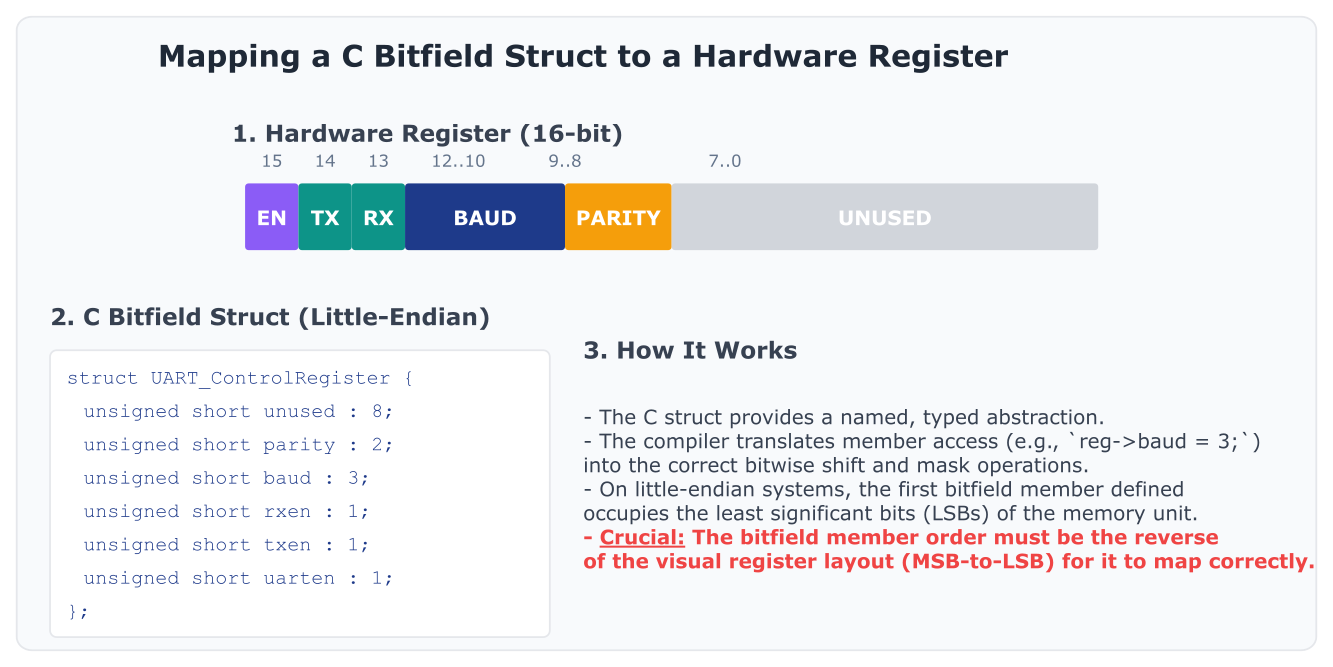
Look closely at the image. The datasheet shows the EN (enable) bit at bit 15 (the MSB). However, in the C struct for a little-endian system, EN is the last member. This is because the compiler starts filling from the LSB (bit 0).
BAUD(4 bits) is declared first, so it occupies bits 0-3.PARITY(2 bits) is next, occupying bits 4-5.- ...and so on, until
ENis placed in the final available bit, bit 15.
In an interview, explaining this reversal for LSB-first packing demonstrates a practical understanding of how datasheets translate to code.
b) Straddling and Padding within Bit-Fields
Another implementation-defined behavior is whether a bit-field can "straddle" (span across) the boundary of its underlying memory unit. This can lead to inefficient memory usage.
The case studies in the article you just read provide excellent examples of this.
Bit-fields | An Attempt to Organize Information
Let's return to the article "Bit-fields | An Attempt to Organize Information" to examine specific cases of memory layout.
Read the sections "Case 1: Straddling – Spanning multiple units" and "Case 2: Avoiding Straddling". Pay attention to how the choice of underlying type (uint8_t vs. uint16_t) affects the total size of the struct.
Let's summarize the key insight from these cases:
- The Problem (Straddling): The
NonPortableBitfieldexample has three members (:7,:7,:2) totaling 16 bits. One might expectsizeofto be 2 bytes. However, since the base type isuint8_t, the compiler might not allow thesecondfield to straddle the first and second bytes. It may place eachuint8_tmember in a new byte, resulting in a total size of 3 bytes—worse than not using bit-fields at all! - A Portable Solution: The
PortableBitfieldexample solves this by changing the base type touint16_t. Now, all 16 bits of data fit comfortably within a single 16-bit memory unit. The C standard guarantees that if bit-fields fit within the same unit, they will be packed adjacently. This makes the size predictable (2 bytes).
This highlights a crucial rule for writing more portable bit-field code: choose an underlying type large enough to hold all the bits you intend to pack together.
c) The Impact of the Underlying Type (int vs. unsigned int)
The type you choose for a bit-field matters. Your experience with MISRA C is very relevant here.
A Rationale-Based Classification of MISRA C Guidelines
The paper "A Rationale-Based Classification of MISRA C Guidelines" discusses the rule for bit-field types, which directly relates to portability.
Read the paragraph describing "Rule 6.1: Bit-fields shall only be declared with an appropriate type." Focus on the three issues it highlights.
As the paper points out, MISRA Rule 6.1 addresses these critical issues:
- Portability of
int: Declaring a bit-field asint : 4;is not portable. On some compilers, plainintissigned, while on others it might beunsigned. This can lead to completely different behavior when a value is interpreted. - Undefined Behavior (C90): Older standards like C90 only strictly defined behavior for
unsigned intandsigned int. - Influence on Layout: Newer standards allow other types like
_Booloruint8_t, but as we saw with the straddling example, the chosen type directly influences the implementation-defined layout and padding.
The key takeaway, enforced by standards like MISRA, is to always be explicit about signedness. Using unsigned int is the safest and most common practice for bit-fields representing hardware flags or magnitudes.
3. Forcing the Layout: Packing and Its Costs
What if you absolutely need to control the layout to match a hardware specification, even if it means violating alignment rules? Compilers provide non-standard extensions for this, like #pragma pack or __attribute__((packed)).
This is a trade-off between memory size and performance. Let's see the impact.
Bit-fields | An Attempt to Organize Information
The article on bit-fields also explores what happens when you use compiler-specific packing attributes.
First, briefly review the section "Overview: Size and Runtime Access Cost" to see the assembly instructions generated to access a simple bit-field. Then, read "Case 3: Packed Bit-fields" to see how using a packed attribute can generate even more assembly instructions for unaligned access.
The assembly examples are very telling. Accessing a bit-field already requires extra shift and mask instructions compared to a normal variable. When you add packed, you might force an unaligned memory access. On some architectures, this is forbidden and must be handled by the compiler generating multiple byte-sized accesses, which is even slower. On architectures that allow unaligned access, it may still incur a performance penalty at the hardware level (e.g., causing extra cache line fetches).
In an interview, you can summarize this as: "Packing gives you precise control over memory layout, which is sometimes necessary to match a network protocol or hardware interface, but it's non-standard and can degrade performance due to the CPU overhead of handling unaligned memory accesses."
Conclusion
We've now thoroughly dissected the challenges of using bit-fields in C. While they offer syntactic convenience, they come at the cost of portability and potential performance overhead.
Key Takeaways:
- Implementation-Defined Nature: Bit-field layout is not fully specified by the C standard but by the platform's ABI, leading to variations in bit ordering, padding, and straddling behavior across compilers and architectures.
- Bit Ordering: Be aware of the LSB-first vs. MSB-first packing on your target system and order struct members accordingly to match hardware datasheets.
- Padding and Straddling: A bit-field may not be packed efficiently if it needs to cross the boundary of its underlying type. Choosing a larger base type (e.g.,
uint32_t) can create a more portable and predictable layout. - Type Selection: Always use explicitly signed or unsigned integer types (
unsigned intis the conventional choice) as per MISRA guidelines to avoid ambiguity. - Packing Trade-offs: Non-standard directives like
#pragma packprovide control over layout but sacrifice portability and can hurt performance.
In our next lesson, we'll investigate another low-level tool for data representation: unions. We will specifically focus on their use for type-punning—for example, accessing the individual bytes of a uint32_t—and the strict aliasing rules that make this practice both powerful and dangerous.