Hello. Last lesson compared prepaying with investing using the same monthly budget and a common finish date. At an assumed net account return, prepaying came out modestly ahead. This lesson reverses the calculation: what after-tax, fee-adjusted investment return would make the two strategies tie?
The answer depends on when cash moves. We will keep the previous lesson’s mortgage and monthly payment schedule, solve for the return that reaches a tie, and then translate that net return into a hypothetical return before fees and taxes. This is a financial break-even point, not a forecast or a recommendation.
Keep the cash flows fixed; change only the return
The hosts of We Built a Mortgage Calculator to Solve the Pay Off vs. Invest Debate (For FIRE), from BiggerPockets Money, identify two modeling issues that matter here: investing the payments freed by early payoff and accounting for taxes on investment gains. Watch the short excerpts for those assumptions rather than for a particular calculator result.
We Built a Mortgage Calculator to Solve the Pay Off vs. Invest Debate (For FIRE)
Watch these excerpts from BiggerPockets Money's We Built a Mortgage Calculator to Solve the Pay Off vs. Invest Debate (For FIRE) to see why the payoff-date cash flows and investment taxes belong in the comparison.
In the opening discussion, watch freed payments: the hosts describe the error of omitting investment after early payoff. Then watch tax differences and tax assumptions in the calculator-input discussion. Notice that an investment return entered into a model is not necessarily the amount the household keeps.
Retain the previous lesson’s figures:
- Mortgage balance now: , with 120 months remaining.
- Fixed mortgage rate: nominal annual, charged monthly, or per month.
- Required principal-and-interest payment: approximately per month.
- Optional amount: per month, making the total monthly budget approximately .
In prepay, then invest, the household directs the budget to the mortgage until it is paid off during month 86. Any budget left over in that final loan month, and the full budget in subsequent months, goes into the account. In invest, keep the schedule, it makes the required mortgage payment and deposits at the end of each month. Both strategies run through month 120.
For now, assume extra payments go directly to principal, there is no prepayment penalty or mortgage-interest tax benefit, and both strategies’ account deposits earn the same constant net monthly return. The home’s value is identical on both sides. The only unknown is that net return.
Locate the break-even return
A spreadsheet can search for the account return at which the two month-120 outcomes match. In this particular example, there is also a useful shortcut: the tie occurs when the net monthly account return equals the monthly mortgage rate, .
To see why, let be a strategy’s mortgage balance after month , its account balance after that month’s deposit, and the mortgage payment it actually makes. Write for the shared total monthly budget. If mortgage interest is per month and the account earns per month, the updates are:
The account deposit is whatever part of the budget did not go to the lender. In the early-payoff month, this automatically includes the unused part of what would otherwise have been a full mortgage payment.
Now set and subtract the mortgage balance from the account balance:
The amount has disappeared from the equation. Both strategies start with the same account balance and mortgage debt and receive the same budget each month. Thus, at this matched rate, they have the same account-minus-debt value at every month-end—even though they allocate their payments differently.
At month 120, both loans are paid off, so that equality is simply an equality of account balances. Using unrounded payments, the invest-as-you-go balance provides a check:
The prepay-then-invest strategy also finishes at approximately when its later deposits earn the same net monthly rate. Compare that with the prior lesson’s nominal net-return assumption, under which prepayment finished ahead: the return needed for a tie is higher.
The break-even net return is monthly, or nominal annual when quoted as a monthly-compounded rate. If you instead report an effective annual return, it is:
Those are two descriptions of the same monthly growth assumption, not two different break-even results. Comparing the mortgage’s nominal rate with a effective investment rate without recognizing the different conventions would manufacture a misleading gap.
Translate the net hurdle into a before-cost return
The account return in the calculation above is what remains after applicable fees and taxes. A quoted investment return before those costs must be higher.
Read the fee overview in Investor.gov’s How Fees and Expenses Affect Your Investment Portfolio. It distinguishes charges that recur while an investment is held from charges tied to transactions.
How Fees and Expenses Affect Your Investment Portfolio
Read Investor.gov's fee overview to connect an advertised return with the return that can actually compound in an account.
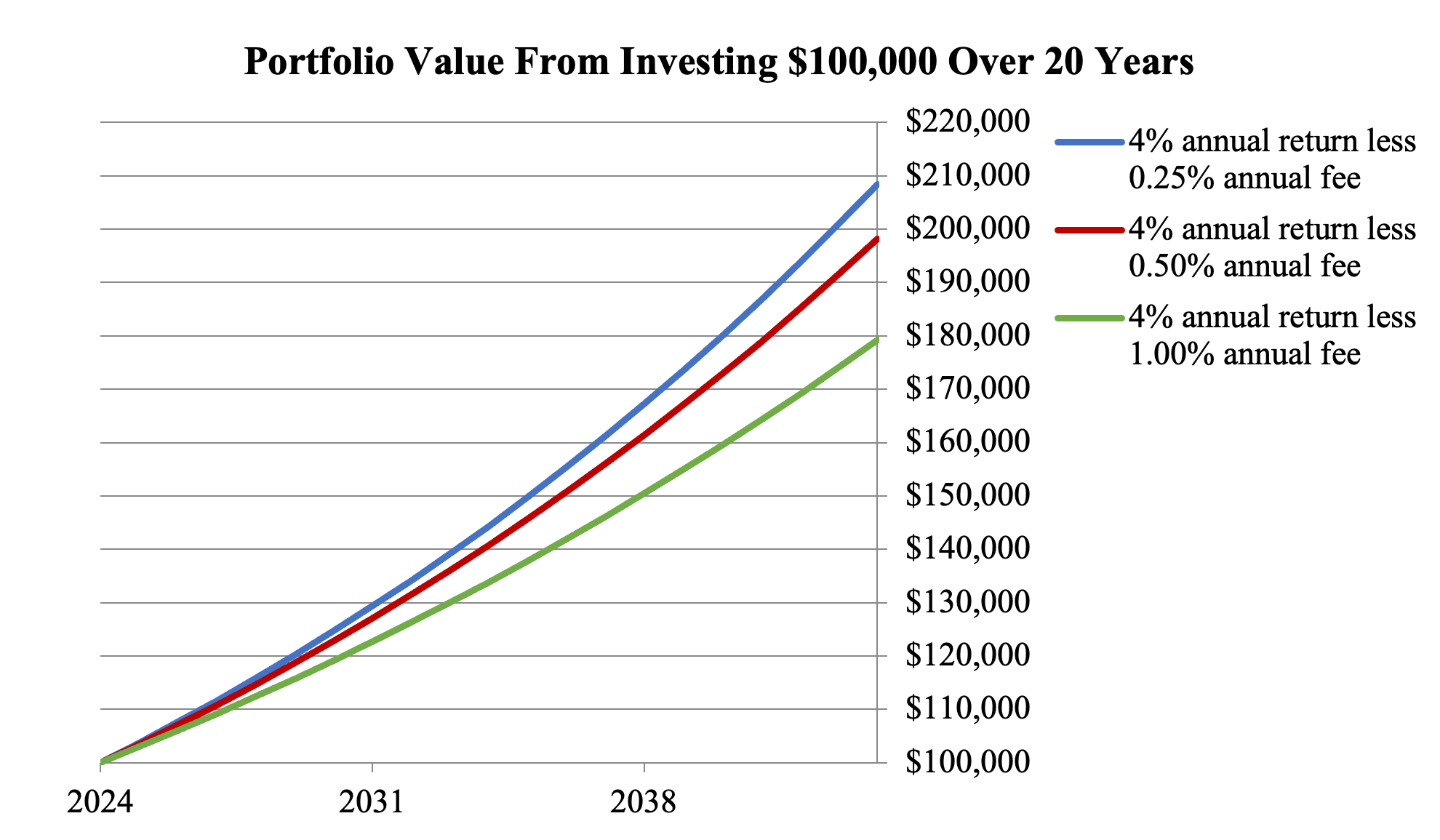
Under “Fees and Expenses Reduce Your Investment Returns,” read from the opening explanation of fees through the chart introduction; then inspect the chart and its three stated end values. Under “What types of fees are there?”, read fee categories, including the transaction-fee and ongoing-fee examples. Focus on which costs reduce every period's growth and which instead change an individual deposit or withdrawal.
Here is a deliberately simplified, hypothetical tax rule for the mortgage example. Suppose an investment has:
- a gross nominal annual return , applied monthly;
- an ongoing fee of nominal annually, charged monthly on the opening account balance;
- a tax charged each month on positive investment earnings after that fee; and
- no purchase, sale, or other charges.
For this model, the net monthly rate is:
Set it equal to the required and solve:
The arithmetic is easier to inspect in annual nominal-rate terms: gross less a ongoing fee leaves before tax; retaining of that gain leaves the required net nominal rate. Under these stated rules, an investment would need a constant gross nominal annual return to match prepayment financially.
That figure is not a general hurdle for a mortgage. It belongs to this fee, tax, and cash-flow model. In particular, the monthly tax in this illustration is an assumption, not a claim that investments are generally taxed this way. Also check whether a quoted fund return already reflects its ongoing expense ratio; subtracting the same fee again would understate its net return.
When the shortcut no longer applies
The net-return tie is valuable as a check, but its proof relied on both accounts growing at one constant net monthly rate, with no other cash-flow differences. Realistic costs and tax rules may not fit that description.
For example, if tax is paid only when investments are sold at month 120, an account compounds without that monthly tax reduction. The two strategies also make deposits at different times, so they will generally have different accumulated gains and different final tax bills. A front-end purchase charge reduces each deposit when it is made, rather than lowering every month’s return. If mortgage interest produces an actual tax benefit, prepaying may forgo some of that benefit; the timing and eligibility of the benefit matter.
In those cases, retain the equal-budget mortgage and account schedules, but model each cost when it occurs. For a hypothetical tax on gains at sale, track each strategy’s cumulative deposits alongside its account balance . If the stated tax rule is a fraction of positive gains at the endpoint, its after-tax account value is:
Apply the rule to both strategies’ accounts, since prepayment also leads to investing after payoff. Then vary the assumed gross return until their after-tax account-minus-remaining-debt values match at the chosen horizon. A spreadsheet’s goal-seek function can do that search; a few trial rates and narrower intervals work as well. The result should state whether it is gross or net, nominal or effective, and exactly when fees, taxes, deposits, and any sale occur.
A break-even return tells you what an investment would have to deliver under those assumptions. It does not tell you whether it will deliver it, or whether an accessible account and reduced mortgage debt are equally useful to the household.
Takeaways
With an equal monthly budget, end-of-month deposits, no mortgage-interest tax benefit, and no other cash-flow differences, this example ties when the investment earns per month after taxes and fees: nominal annual, or approximately effective annual. Under the lesson’s specific annual fee and monthly tax-on-after-fee-gains rule, that requires gross nominal annual.
The method is more important than the number: hold the budget and horizon fixed, include investing after early payoff, place each cost at its actual assumed date, and solve for equal after-cost outcomes. The next lesson will put uncertain investment outcomes beside the mortgage’s predictable contractual savings, testing downside, flat-return, and growth scenarios rather than relying on one constant return.