Welcome back. In our previous lesson, we explored how Rust uses generics and traits to create powerful, reusable, and type-safe abstractions. We saw that Option<T> and Result<T, E>, which you've encountered before, are prime examples of generic enums. Now, it's time to master them.
This lesson focuses on the idiomatic Rust approach to handling situations where a value might be absent or an operation might fail. Our goal is to handle errors using Result and Option types with combinators and the '?' operator. For someone with your experience designing robust systems, you'll recognize this as a cornerstone of reliability. In the C world, error handling often relies on discipline—checking for NULL pointers or -1 return codes. In languages like Java or Python, exceptions can introduce non-local control flow. Rust's approach is different: it uses the type system to ensure that every possible outcome is considered at compile time, a feature that is absolutely critical in the high-stakes environment of embedded systems.
Representing Success, Failure, and Absence
At the heart of Rust's error handling philosophy are two generic enums from the standard library:
-
Option<T>: Represents a value that could be present or absent.enum Option<T> { Some(T), // A value of type T is present None, // No value is present }This is the tool you'll use for functions that might not return a value, like finding an element in a collection or accessing an optional configuration parameter. It's Rust's safe alternative to null pointers.
-
Result<T, E>: Represents the outcome of an operation that could succeed or fail.enum Result<T, E> { Ok(T), // The operation succeeded, returning a value of type T Err(E), // The operation failed, returning an error of type E }This is used for any fallible operation, such as opening a file, parsing data, or communicating with hardware. The compiler forces you to handle both the
OkandErrvariants.
Let's begin with a foundational reading that frames these concepts for a developer with a C background.
Rust for Embedded C Programmers
This section from the OpenTitan documentation provides a concise, technical overview of Option and Result.
Please read the entire section on error handling. Focus on the definitions of the two types and the brief introduction to the ? operator.
The Verbosity of match
As you saw in a previous lesson, the most fundamental way to handle enums is with a match expression. This is explicit and exhaustive, but it can become verbose, especially when you have a sequence of operations that can each fail.
This video from "Let's Get Rusty" demonstrates the initial, match-based approach to handling errors, which quickly shows its limitations.
Watch the following segments: Introduction to Result: This shows a basic file-opening example handled with match. Nested matching: Pay attention to how quickly the code becomes nested and complex when trying to handle a specific error (file not found) by attempting a recovery action (creating the file). This complexity is what we aim to solve.
The nested match statements you just saw are a classic sign that there's a more ergonomic way to write the code.
Propagating Errors with the ? Operator
More often than not, if an operation within a function fails, you don't want to handle the error right there. Instead, you want to stop execution of the current function and propagate the error up to the caller. This is where the ? operator becomes indispensable.
The ? operator is syntactic sugar that you can append to an expression that returns a Result or Option.
- If the value is
Ok(T)orSome(T), it unwraps the value to give youT. - If the value is
Err(E)orNone, it performs an early return from the enclosing function, passing theErr(E)orNonevalue back to the caller.
This can only be used in functions that themselves return a Result or Option compatible with the error being propagated.
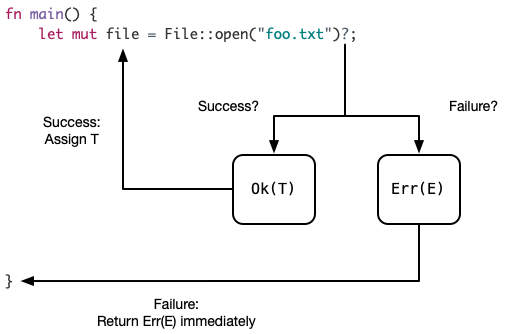
Let's continue with the "Let's Get Rusty" video to see how the ? operator cleans up the file-reading example.
Watch the segment on error propagation. Observe how the multi-level match statements are replaced by a clean, linear chain of operations, each terminated with ?.
The difference is dramatic. Code that was a nested series of match blocks becomes a straightforward sequence of steps. This is the idiomatic way to handle operations that can fail in sequence.
// Before: Verbose matching
fn read_username_from_file_verbose() -> Result<String, io::Error> {
    let f = File::open("hello.txt");

    let mut f = match f {
        Ok(file) => file,
        Err(e) => return Err(e),
    };

    let mut s = String::new();

    match f.read_to_string(&mut s) {
        Ok(_) => Ok(s),
        Err(e) => Err(e),
    }
}

// After: Clean propagation with `?`
fn read_username_from_file_clean() -> Result<String, io::Error> {
    let mut f = File::open("hello.txt")?;
    let mut s = String::new();
    f.read_to_string(&mut s)?;
    Ok(s)
}

// Even better: Chaining
fn read_username_from_file_chained() -> Result<String, io::Error> {
    let mut s = String::new();
    File::open("hello.txt")?.read_to_string(&mut s)?;
    Ok(s)
}
Functional Error Handling with Combinators
The ? operator is for propagating errors. But what if you want to stay within the flow and transform values or provide defaults? For this, Rust provides combinators: higher-order methods that operate on Option and Result values.
This approach is more functional in nature and allows you to chain operations together in a declarative way, often eliminating the need for intermediate variables.
How to Implement Error Handling with Result and Option ...
This article from the OneUptime blog provides excellent, clear examples of the most common combinators.
Please read the section titled Combinators. Focus on understanding the purpose of each one: map: To transform the inner value of a Some or Ok. and_then: To chain operations that each return an Option or Result. unwrap_or and unwrap_or_else: To provide a default value if the result is None or Err. ok_or: To convert an Option into a Result. map_err: To change the error type of a Result.
Let's see this in action. The following video refactors a messy, imperative piece of code into a clean, functional pipeline using combinators.
Improving Rust code with combinators
This "Let's Get Rusty" video perfectly illustrates the power of combinators by refactoring a complex function.
Watch the entire video. First, notice the imperative code from the initial example with its nested if checks. Then, see how it's transformed using map (map), ok to convert Result to Option (ok combinator), and flatten to remove None values (flatten). The combination of iterators and Option/Result combinators is a very common and powerful pattern in Rust.
The Option type has a rich set of these methods. This diagram provides a helpful visual summary.

When to Panic: unwrap and expect
Finally, there are two methods that you should use with great caution: unwrap() and expect(). Both will cause your program to panic (the Rust equivalent of an unrecoverable crash) if called on a None or Err value.
unwrap(): Retrieves the inner value. If called onNoneorErr, it panics with a generic message.expect("message"): Does the same, but panics with a custom message you provide.
In general application code, you might use expect at program startup for things that must exist, like a configuration file. The custom message serves as documentation for this assumption. In embedded systems, panicking is usually unacceptable in production firmware, as it can leave the device in a non-functional state. These methods are best reserved for prototypes, tests, or situations where a code invariant guarantees the value is present.
How to Implement Error Handling with Result and Option ...
Let's revisit the OneUptime article for its best practices on this topic.
Read the final section, Best Practices. The advice here is crucial: unwrap is a code smell in production logic. Proper handling with ?, match, or combinators is almost always the right choice.
Conclusion
In this lesson, we've taken a deep dive into Rust's structured approach to handling errors and optional values. By making potential failures an explicit part of the type system, Rust eliminates a whole class of runtime bugs that plague other systems languages.
Here are the key takeaways:
Option<T>andResult<T, E>are the fundamental enums for representing absence and failure.- The
?operator is the idiomatic tool for propagating errors up the call stack, dramatically cleaning up sequential, fallible operations. - Combinators like
map,and_then, andunwrap_or_elseprovide a powerful, functional way to transform and handleOptionandResultvalues without explicitmatchstatements. unwrap()andexpect()should be avoided in production logic, especially in embedded systems, as they can lead to program panics. They are tools for prototypes or for enforcing invariants that are logically impossible to violate.
You now have a solid grasp of Rust's core tools for writing robust code. This is the last of the fundamental Rust language features we will cover in this module.
In our next lesson, we will tackle a concept that is uniquely Rust: lifetimes. We will learn to explain lifetime annotations and their role in preventing dangling references. Lifetimes are the final piece of the ownership puzzle, ensuring that all the references we pass around—including those inside Option and Result—always point to valid data.