Hello. In the previous lesson, you identified contacts and contacts of contacts in a vaccination ring without treating those connections as proof of infection. This final lesson brings the course together: how can you tell whether an outbreak report’s evidence supports its claim that transmission is being contained?
You will read a real situation update, then compare its measured facts with a shorter, fictional news-style account. The central habit is to keep three questions separate: Which virus is involved? How could it spread? What does the reported response actually demonstrate?
Read the situation update as a dated snapshot
A situation report describes what investigators knew at a particular time. Case totals, the number of people currently ill, and contact-monitoring figures answer different questions. None alone establishes that an outbreak is over.
Read the selected parts of this WHO report on a 2022 outbreak caused by Sudan virus. It is our primary source for the appraisal; the later fictional account is not a quotation from it.
Ebola disease caused by Sudan ebolavirus – Uganda
Read this World Health Organization situation update to see how an outbreak report states the virus identity, presents dated case and contact figures, and distinguishes response measures from plans for clinical trials.
In the situation update immediately above the “Public health response” heading, begin at the sentence about a new confirmed case reported on 27 November. Read the case update through the paragraph on contacts as of 5 December. Keep the dates attached to each figure. Under “Public health response,” find the paragraph beginning with WHO expert consultations. Read the vaccine plans, then the paragraph beginning “WHO continues to support” through the IPC measures. Finally, under “WHO advice,” read the control package and the sentence beginning “There are no licensed vaccines for SUDV.” Notice which activities were underway and which vaccines were candidates for a trial.
The report says that no active cases were known as of 5 December 2022. It also says that 36 contacts were still being followed, with a 100% follow-up rate for that group. Those are encouraging observations, but they are not the same as saying every possible contact had been found or that every monitoring period had ended. The report separately lists 2,167 contacts who had completed 21-day follow-up out of 2,564 listed. These figures do not, by themselves, explain the status of every person on the cumulative list; a careful reader does not fill that gap with a guess.
The timing matters as much as the counts. The update describes a confirmed case reported on 27 November. On 5 December, it was still too early to conclude from the absence of active cases alone that everyone potentially exposed in the ensuing period had passed 21 days since their last exposure. “No active cases today” is a snapshot, not a guarantee about the next three weeks.
Check the virus before evaluating the tools
The report uses the historical name Sudan ebolavirus and the abbreviation SUDV; in the terminology used elsewhere in this course, the causative virus is Sudan virus. That is not Ebola virus (EBOV), often called “Zaire” in older reporting. Both cause Ebola disease, but a vaccine licensed specifically for EBOV cannot be assumed to protect against SUDV.
Use WHO’s vaccine overview as a brief cross-check rather than treating the word Ebola on a vaccine label as sufficient evidence.
Read the World Health Organization’s vaccine Q&A to verify which virus has a licensed vaccine and what other measures outbreak control requires.
At the start of “Ebola vaccines,” read the species distinction. Near the end of the Q&A, find the paragraph beginning “Control of an Ebola disease outbreak relies” and read the intervention package. Focus on why vaccination is one possible tool within a broader response, not a substitute for detecting cases and interrupting exposure.
The 2022 situation update describes candidate SUDV vaccines for a planned ring-vaccination trial and says doses had arrived for evaluation in a clinical trial. It does not say that a licensed EBOV vaccine had been shown to protect against SUDV. Nor does the arrival of trial doses demonstrate that vaccination had already stopped transmission. This is where the previous lesson’s network distinction becomes useful: even a report that correctly identifies contacts and contacts of contacts must still establish that the particular vaccine is appropriate before claiming protection.
Match transmission claims to actual exposures
A report can also overstate risk. Ebola disease spreads through contact with infectious body fluids of a person who is ill or has died, when the virus reaches broken skin or the eyes, nose, or mouth. Contaminated objects can provide another route of contact. Ordinary proximity to someone who feels well is not, by itself, evidence of transmission. Conversely, caregiving without adequate protection and handling a deceased patient can present serious risks.
The ECDC illustration maps plausible routes in its upper half and corresponding ways to interrupt them in its lower half. Use it as a transmission schematic, not as evidence that any depicted event occurred in the outbreak described by WHO.
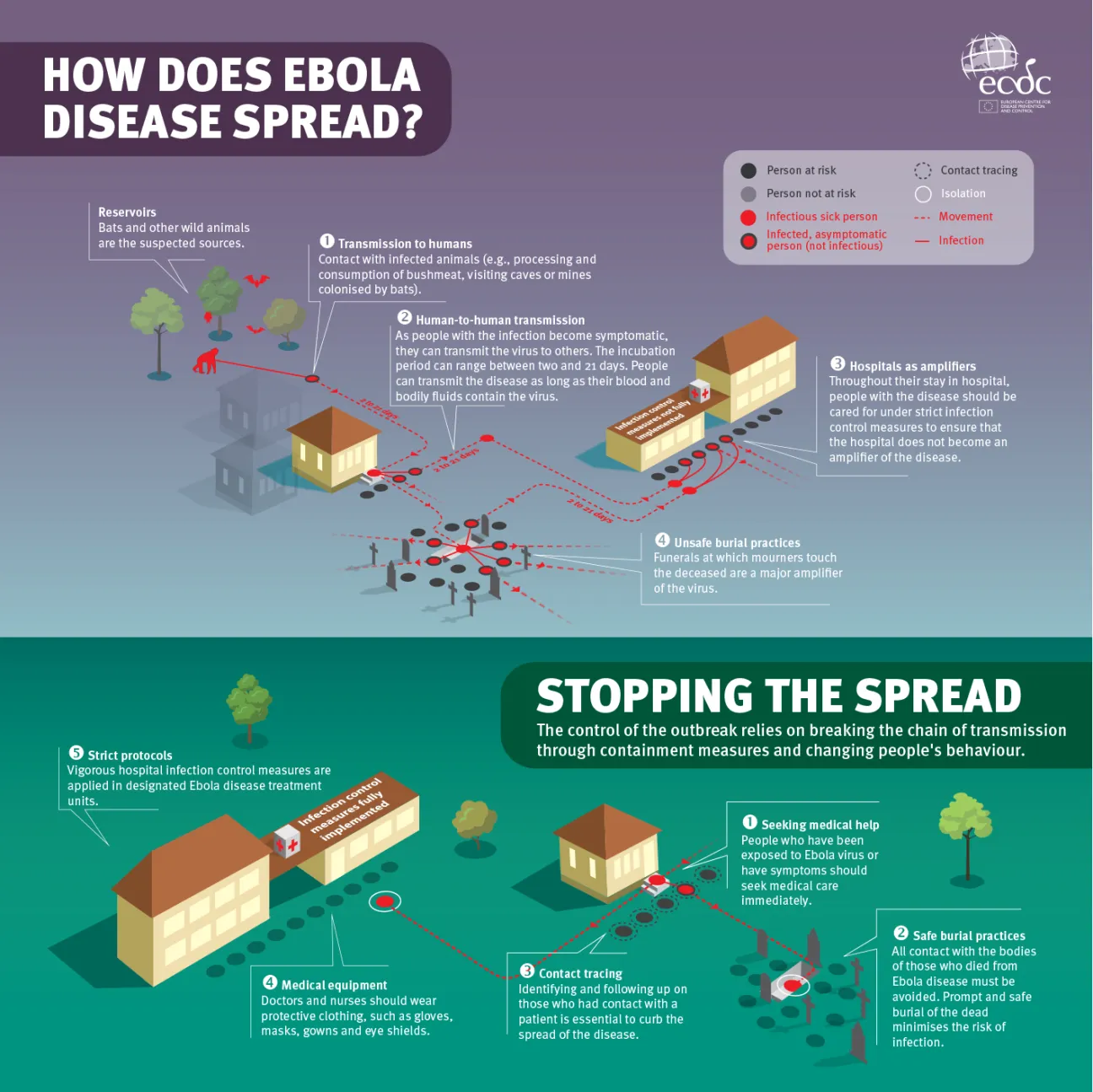
Notice the pairing: protective equipment and infection-control procedures address exposures during care; safe, dignified burial practices address contact with a deceased patient; contact tracing finds people whose actual exposure histories warrant follow-up. A headline about “Ebola spreading through a community” tells you little unless it identifies plausible encounters and explains how investigators are finding and interrupting them.
Appraise a short report without accepting its conclusion
Here is a fictional news-style summary, constructed from some of the dated WHO figures. Its final sentence deliberately makes claims that the source does not establish:
“By 5 December 2022, no active Sudan Ebola cases remained. Of 2,564 listed contacts, 2,167 had finished their 21-day follow-up; all 36 contacts currently under follow-up were being reached. Health facilities were screening and isolating suspected cases, and candidate vaccines had arrived for a ring-vaccination trial. With no patients left in treatment and the Ebola vaccine protecting the ring, officials had ended transmission.”
The first two sentences largely preserve the report’s dated observations, though “Sudan Ebola” is less precise than Sudan virus disease. The third compresses actions reported at different dates: the update describes screening and isolation measures, while it says candidate trial doses arrived on 8 December, not by 5 December. Its final sentence makes two unsupported leaps. “No patients left in treatment” does not establish that transmission had ended while contacts still required monitoring. And “the Ebola vaccine protecting the ring” misrepresents candidate SUDV vaccines under trial as demonstrated protection.
A useful appraisal keeps four levels of claim distinct:
| Question | What the source supports | What it does not establish |
|---|---|---|
| Virus identity | This outbreak involved SUDV. | That EBOV-specific vaccine evidence automatically applies. |
| Transmission | Exposures involving infectious body fluids warrant investigation and prevention. | That every social connection represents an infection or that casual proximity spreads the virus. |
| Response | Screening, isolation, contact follow-up, infection prevention, and vaccine-trial planning were described. | That every measure reached every person at risk, or that a trial vaccine was proven effective. |
| Containment | No active cases were reported on 5 December, and the 36 contacts then under follow-up had a reported 100% follow-up rate. | That all possible exposures had been identified, all follow-up had finished, or no further cases could occur. |
This does not mean the response was failing. It means a bounded conclusion is stronger than an absolute one: as of the report’s date, no active cases were known, contact follow-up and infection-control work continued, and the available information did not yet establish that onward transmission had ended.
When reading future reports, look especially for denominators and dates. “100% follow-up” sounds comprehensive until you ask, “100% of which group, on which day?” Then ask whether the report describes a measure as planned, underway, completed, or demonstrated effective. Those verbs can change the meaning of a containment claim.
Takeaway
To appraise an Ebola outbreak report, identify the specific virus, check that its transmission claims describe plausible exposures, and compare its containment conclusion with the dated evidence for case detection, contact follow-up, infection prevention, safe care and burials, and any virus-appropriate vaccine use. An encouraging snapshot is meaningful; it is not proof that every chain of transmission has ended.
This completes the course. The most reliable reading habit is to distinguish what a report observed, what responders did or planned, and what its conclusion infers.