Hello! Welcome to your first lesson in the "AI in Dentistry" course. I'm excited to guide you on this journey.
Given your goal to understand AI from a clinician's perspective, we'll start with the absolute fundamentals. This first module, "AI Fundamentals for Clinicians," will give you the vocabulary and core concepts you need to understand everything that follows.
In this lesson, we will focus on defining the three most important terms in this field—Artificial Intelligence (AI), Machine Learning (ML), and Deep Learning (DL)—and, most importantly, explain how they all fit together. Mastering these definitions is the essential first step to being able to read about, discuss, and evaluate AI tools in a clinical context.
Let's begin.
1. Artificial Intelligence (AI): The Big Picture
Artificial Intelligence is the broadest and oldest of the three terms. At its core, AI is a field of computer science dedicated to creating machines or systems that can perform tasks that typically require human intelligence.
Think of it as the overarching dream: building machines that can reason, solve problems, learn, perceive, and interact with the world.
To get a clear definition, please watch the first minute of this video from IBM Technology.
This clip from the video "AI vs Machine Learning" gives a concise and high-level definition of what Artificial Intelligence aims to achieve.
Watch from 00:30 to 01:30. Focus on the definition of AI as systems that match or exceed human capabilities like discovery, inference, and reasoning.
As the video explains, AI encompasses many capabilities. However, the idea of a single machine that perfectly mimics a human brain—often called "General AI"—is still mostly in the realm of science fiction.
In the real world, and especially in medicine and dentistry, we work with "Narrow AI." These are AI systems designed to perform a specific, narrow task exceptionally well, sometimes even better than a human expert.
A great dental example is an AI designed specifically to detect caries on a bitewing radiograph. It doesn't know how to book an appointment or diagnose periodontal disease (unless it was also trained for that); its intelligence is narrow and focused on one job.
The following reading from VideaHealth, a dental AI company, explains this distinction.
AI 101 for the Dental Industry
This short excerpt from the article "AI 101 for the Dental Industry" provides context on the difference between the 'Hollywood' version of AI and the practical, 'narrow' AI used in applications like dentistry.
Read the first two paragraphs of the article, ending just before the heading "AI vs. Machine Learning vs. Deep Learning.". Pay attention to the concept of 'narrow AI' and the examples given.
So, to summarize:
Artificial Intelligence (AI) is the broad discipline of making machines smart, with most modern applications being "Narrow AI" systems that excel at a single task.
2. Machine Learning (ML): The Engine of Modern AI
So, how do we make a machine "smart" for a narrow task? One of the most common ways is through Machine Learning (ML).
Machine Learning is a subset of AI. It represents a fundamental shift from traditional programming.
- Traditional Programming: A developer writes explicit, step-by-step rules for the computer to follow. (e.g., "If this specific pixel pattern appears, label it 'incipient caries'.") This is brittle and impossible for complex tasks.
- Machine Learning: A developer provides the computer with a massive amount of data and an algorithm that allows the machine to learn the rules for itself.
Instead of being explicitly programmed, the machine is "trained." For a dental AI, this means showing it thousands of radiographs that have been expertly labeled with diagnoses (e.g., "caries," "no caries," "crown," "bone loss"). By analyzing these examples, the ML model learns to recognize the patterns associated with each diagnosis on its own.
This next video clip explains this key idea.
Continuing with the IBM video, this section explains what makes Machine Learning a distinct approach within the broader field of AI.
Watch from 01:30 to 02:51. Focus on the core idea that ML involves 'predictions or decisions based on data' and that the system 'learns' rather than being explicitly programmed.
Machine Learning (ML) is a subfield of AI that uses algorithms to learn patterns from data and make predictions, without being explicitly programmed with rules. It's the "engine" that powers most of the AI tools you'll encounter.
3. Deep Learning (DL): A Powerful Technique for Complex Data
Within the field of Machine Learning, there has been a major breakthrough that has supercharged AI capabilities, especially in areas like image and language analysis. This is Deep Learning (DL).
Deep Learning is a subfield of Machine Learning. It uses a specific type of algorithm called a neural network. These networks are inspired by the structure of the human brain, with many interconnected layers of "neurons" that process information. When a network has many layers, it's considered "deep"—hence the name Deep Learning.
The key advantage of Deep Learning, particularly for dentistry, is its incredible ability to analyze complex, unstructured data like images. A deep neural network can learn to identify very subtle and intricate patterns in a radiograph or a CBCT scan that would be almost impossible to define with traditional programming. It automatically learns to detect edges, shapes, textures, and other features relevant to making a diagnosis.
This final clip puts all three concepts together.
Artificial Intelligence In Healthcare Course | Introduction To AI In Healthcare | Simplilearn
This clip from Simplilearn provides a clear, hierarchical explanation of how AI, ML, and DL relate to each other, emphasizing the role of neural networks in Deep Learning.
Watch from 04:49 to 08:14. Pay close attention to the nested relationship described and how Deep Learning's use of multi-layered neural networks makes it powerful for tasks like image recognition.
Deep Learning (DL) is a specialized type of Machine Learning that uses deep neural networks to learn from vast amounts of complex data. It is the technology behind most state-of-the-art dental imaging AI.
Putting It All Together: The Nested Dolls Analogy
The best way to remember the relationship between AI, ML, and DL is to think of them as a set of Russian nested dolls or concentric circles.
- Artificial Intelligence (AI) is the largest, outermost doll: the entire field of creating intelligent machines.
- Machine Learning (ML) is the next doll inside: a specific approach to AI that relies on learning from data.
- Deep Learning (DL) is the smallest, innermost doll: a powerful technique within ML that uses deep neural networks.
Therefore, all Deep Learning is a form of Machine Learning, and all Machine Learning is a form of AI.
This diagram provides a perfect visual summary of this relationship.
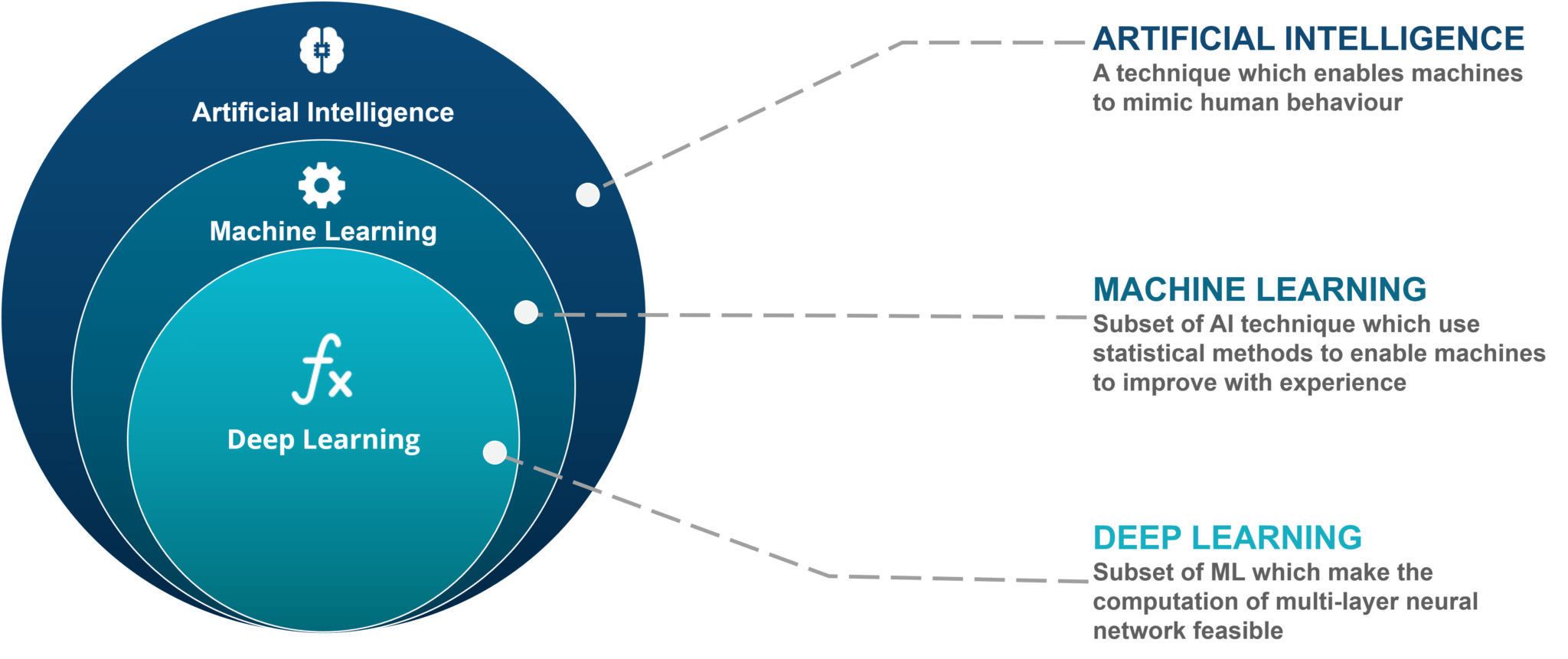
This relationship is also how these terms are presented in scientific literature. The research paper "Application of machine learning in dentistry" uses the exact same concentric circle analogy (see its Figure 1) to define these terms for a dental audience. This shows how fundamental this concept is for understanding AI research.
Test your understanding!
A dental technology company announces a new product. They state it uses "a deep learning algorithm trained on over 500,000 anonymized bitewing radiographs to detect interproximal caries."
Based on this description, can you say the product uses:
- Artificial Intelligence?
- Machine Learning?
- Deep Learning?
Explain your reasoning for each.
Show answer
Yes, it uses all three! Here's why:
- Deep Learning: The company explicitly states it uses a "deep learning algorithm."
- Machine Learning: Since Deep Learning is a subset of Machine Learning, any system that uses DL is, by definition, also using ML. The description of it being "trained on... radiographs" is the classic sign of an ML approach.
- Artificial Intelligence: Since Machine Learning is a subset of Artificial Intelligence, the system is also an example of AI. It's a "Narrow AI" designed to perform the human-like task of interpreting a radiograph to detect caries.
Conclusion
Congratulations on completing your first lesson! We've established a crucial foundation for the rest of the course.
Key Takeaways:
- Artificial Intelligence (AI): The broad scientific field of creating machines that can simulate human intelligence. In practice, this usually means "Narrow AI" built for specific tasks.
- Machine Learning (ML): A subfield of AI where systems are not explicitly programmed with rules but instead learn patterns from large amounts of data.
- Deep Learning (DL): A subfield of ML that uses complex, multi-layered "deep" neural networks. It is particularly effective for analyzing complex data like dental images.
- The Relationship: The concepts are hierarchical: DL is a type of ML, and ML is a way of achieving AI.
In our next lesson, we will dive deeper into Machine Learning. Now that you know what it is, we'll explore the different ways a machine can learn by discussing the three main types: supervised, unsupervised, and reinforcement learning, using dental examples for each.