Introduction
Welcome to the first lesson of our new module, "Evaluating Commercial AI Products." In the previous module, we honed your skills in critically appraising AI research. You learned how to assess a study's methodology, identify potential bias in datasets, and, most importantly, evaluate the generalizability of a model's performance to real-world clinical settings.
Now, we will apply those academic appraisal skills to the commercial marketplace. When a company markets a new AI product for your dental practice, how can you determine if its promises are backed by solid proof?
This lesson will equip you to tackle that very question. Our goal is to learn how to distinguish between marketing claims and evidence-based performance claims from AI manufacturers. By the end of this lesson, you will be able to look at a product advertisement or a company website with a critical eye, knowing exactly what questions to ask and what kind of evidence to look for.
The Two Types of Claims: Marketing vs. Evidence
When you encounter a new dental AI product, you'll be met with two kinds of statements: those designed to persuade you and those designed to prove something to you. Understanding the difference is your first line of defense against adopting ineffective or unreliable technology.
1. The Marketing Claim
Marketing claims are designed to be appealing and easy to understand. They often use exciting language, focus on high-level benefits, and present impressive-looking numbers without much context.
Let's look at a typical example.
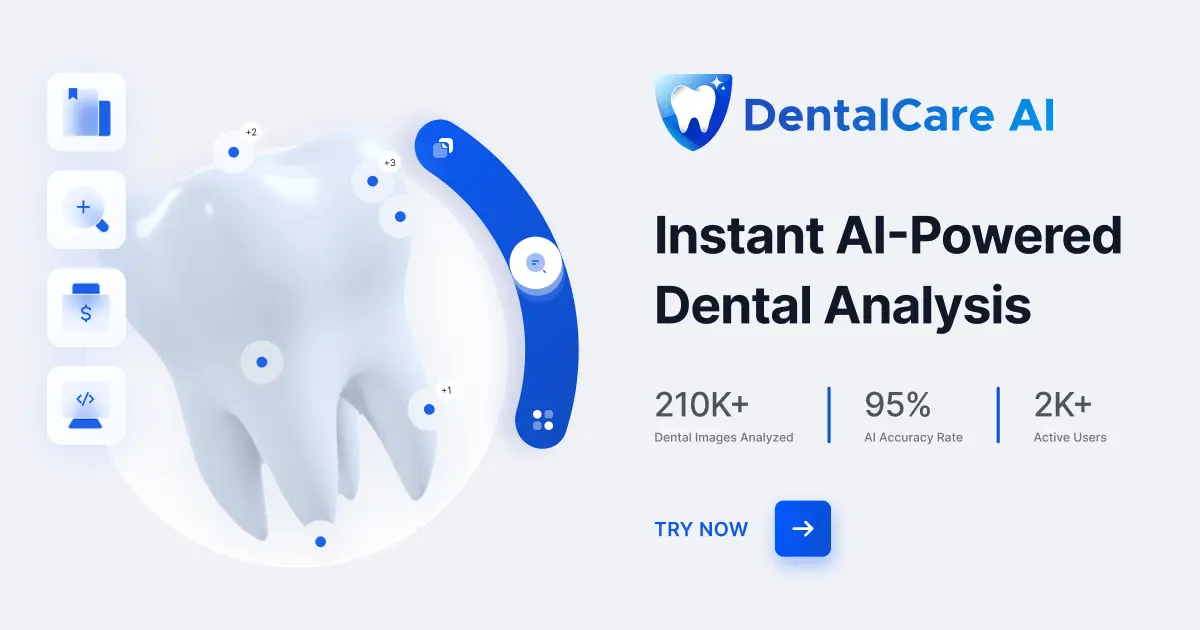
This ad is a perfect illustration of marketing claims. It's visually appealing and makes the product sound highly effective. But as a critical evaluator, you should immediately ask:
- "95% AI Accuracy Rate": Accuracy at doing what? Detecting caries? Measuring bone loss? Numbering teeth?
- What does "accuracy" even mean here? As we discussed in Module 3, overall accuracy can be a misleading metric. Is this sensitivity, specificity, or something else?
- On what kind of data was this measured? Radiographs from one clinic or thousands? Were they from a diverse patient population?
- Compared to what? Was the AI's performance measured against a single dentist's opinion or a consensus of multiple expert radiologists?
Marketing claims are not necessarily false, but they are incomplete. They are the start of a conversation, not the end.
2. The Evidence-Based Claim
In contrast, an evidence-based claim is specific, verifiable, and provides the context needed for you to make a professional judgment. One of the strongest forms of evidence a company can offer is regulatory clearance.

The claim "FDA-cleared" is fundamentally different from "95% accuracy." It’s a statement of fact that can be verified and implies that the manufacturer has submitted performance data to a government body for review.
Why Regulatory Clearance Matters
For medical devices, including software, regulatory bodies like the U.S. Food and Drug Administration (FDA) act as crucial gatekeepers. Their purpose is to ensure that products sold to clinicians are safe and effective for their intended use.
To understand why this is so important for evaluating AI products, let's read the introduction to a recent review paper that cataloged all FDA-cleared AI solutions in dental imaging.
FDA-Approved AI Solutions in Dental Imaging: A Narrative Review ...
This paper, 'FDA-Approved AI Solutions in Dental Imaging,' provides an essential overview of the regulatory landscape. This section explains the critical role the FDA plays in validating AI platforms.
Please read the Introduction section. Start from the beginning and read down to the 'Materials and methods' heading. Focus on how the authors describe the role of the FDA and why FDA clearance is a 'critical benchmark.'
As the paper highlights, FDA clearance distinguishes clinically validated AI platforms from experimental technologies. To get this clearance, a manufacturer can't just make a marketing claim; they must submit detailed evidence demonstrating their product's performance.
Let's take a look at the kind of evidence they provide. The same paper includes tables summarizing the information submitted to the FDA.
- Table 1 lists the specific products and even the individual modules within a product that have received FDA clearance.
- Table 3 details the actual performance metrics from the validation studies.
FDA-Approved AI Solutions in Dental Imaging: A Narrative Review ...
Now, let's examine the evidence itself. These tables from the review paper are where you can find the data behind the claims.
Please review Table 1 and Table 3. You don't need to memorize them, but get a feel for the information they contain. In Table 1, notice how specific companies like Overjet or Pearl have multiple entries for different modules (e.g., 'Caries Assist', 'Calculus Assist'). This shows that clearance is specific to a task. In Table 3, look at an entry for a caries detection product, like Overjet's 'Caries assist'. Note the specific metrics reported: sensitivity, specificity, and the results of a reader study showing how clinician performance changed with AI assistance. Compare this level of detail to the '95% accuracy' marketing claim we saw earlier.
The data in Table 3 is a prime example of an evidence-based claim. For instance, instead of a vague "high accuracy," Overjet's submission for its Caries Assist module shows:
- Standalone Performance: Sensitivity of 72.0% and Specificity of 98.1%.
- Reader Study Performance: When dentists used the AI, their sensitivity improved from 57.9% to 76.2%, while specificity only slightly decreased (from 99.3% to 98.4%).
This is a rich, nuanced, and verifiable claim. It tells you what the AI does, how well it performs on its own, and how it impacts a clinician's diagnostic performance. This is the kind of data you need to make an informed decision.
From Marketing to Evidence: Your Evaluation Framework
So, when you encounter a new product, how do you move past the marketing and get to the evidence? You can use a simple fact-checking process, applying the critical appraisal skills you've already learned.
Let's begin by reviewing a simple framework for appraising clinical papers, which we can adapt for our purpose.
How to Critically Appraise A Research Paper: A Simple 10-Minute Framework
This video from Dr. Ollie Burton provides a straightforward framework for critically appraising any clinical paper. The principles apply perfectly to evaluating the evidence behind a commercial product.
Please watch from the beginning to 01:30 and then from 04:56 to 10:47. Focus on the structured approach: assessing the methods and then the results. This is the same mindset you'll use to scrutinize a company's evidence.
Here is a practical framework for evaluating a company's claims, inspired by the video and our previous lessons:
Step 1: Identify a Specific, Verifiable Claim
Look past slogans and find a concrete statement. For example, in a popular TEDx talk, the CEO of VideaHealth makes a very specific claim.
Eradicating the Dental Divide with AI: new era of preventive care | Florian Hillen | TEDxBoston
Here, Florian Hillen, CEO of VideaHealth, makes a quantifiable claim about his company's product during a TEDx talk. This is the kind of specific statement you can investigate.
Please watch the segment from 09:00 to 09:25. Listen for the specific percentage he claims for reducing missed cavities.
The claim is: "we were able to reduce the missed cavities by 43%." This is a number that must have come from a study.
Step 2: Ask for the Evidence
Your next question should always be: "Where is the data that supports this claim?" The evidence could be:
- An FDA 510(k) summary document.
- A peer-reviewed publication in a reputable journal.
- A company "white paper" (be cautious with these, as they are not peer-reviewed).
Step 3: Scrutinize the Evidence
This is where you put your research appraisal skills to work.
- Is the product FDA-cleared for that specific claim? Not all products on the market are. The review paper we studied earlier includes a table of commercially available platforms without verified FDA clearance.
FDA-Approved AI Solutions in Dental Imaging: A Narrative Review ...
It's crucial to know that many commercially marketed AI tools have not undergone FDA review. This section of the 'FDA-Approved AI Solutions' paper lists several examples.
Please read the section 'Commercially available non–FDA-cleared dental AI solutions' and glance at Table 5. This drives home the point that marketing and regulatory approval are two very different things.
- Does the evidence stand up to scrutiny? If the company provides a study, ask the questions from Module 8:
- Was there an independent test set?
- Was the study conducted on data from multiple centers?
- Are there signs of bias in the data?
- How generalizable are the findings to your patient population?
The FDI World Dental Federation's white paper on AI emphasizes that clinicians have a responsibility to critically appraise these tools.
[PDF] Artificial Intelligence for dentistry - FDI World Dental Federation
The FDI's 'Artificial Intelligence for dentistry' white paper reinforces the professional responsibility of dentists to be critical consumers of this new technology. It summarizes the key risks and what to look for.
Please read the section '6. Risks and limitations of AI', paying special attention to the topics of 'Bias and limited generalizability' and 'Truthfulness'. Then, review Table 1, which provides a great summary of risks. Finally, read the 'Conclusions for clinical practice' section.
As the FDI paper states, "the final responsibility for any decisions emanating from using a diagnostic support system remains with the user, i.e. the oral healthcare provider." This underscores why these evaluation skills are not just academic, but essential for professional practice.
Conclusion
You are now equipped with the foundational skill for evaluating any commercial AI product: the ability to look past the marketing and demand evidence.
Key Takeaways:
- Marketing claims are often vague, persuasive, and lack context (e.g., "95% accuracy").
- Evidence-based claims are specific, verifiable, and tied to data from studies or regulatory submissions (e.g., "In a multi-reader study, sensitivity for caries detection improved from 65% to 80%").
- FDA clearance is a critical indicator of an evidence-based product, as it requires manufacturers to submit performance data for review.
- Many AI products are marketed without having FDA clearance.
- Your job as a clinician is to ask for the evidence and use your critical appraisal skills to judge its quality, paying close attention to the study design, data, and generalizability.
Preview of the Next Lesson
In this lesson, we learned what to look for. In the next lesson, we will learn how to find it. We will focus on the next step in our evaluation framework: "Cross-reference a manufacturer's claims with their published validation studies or regulatory filings (e.g., FDA, CE)." We will take a hands-on look at how to search the FDA database and dissect the summary of a real AI product's submission.