Introduction
Welcome back to the course. In our last lesson, we examined the critical importance of how data is split for training and testing an AI model. You learned about the distinct roles of the training, validation, and test sets, and we explored how "data leakage" can create a dangerously false sense of high performance. The key takeaway was that an independent test set, containing patients the model has never seen, is essential for an honest evaluation.
Today, we'll build on that foundation by addressing a different but related problem: what if the data itself, even if split perfectly, is a flawed representation of reality? This brings us to the crucial topic of bias. Just as a human clinician can have unconscious biases, an AI system can inherit and even amplify biases present in its training data, leading to systematically unfair or inaccurate outcomes for certain groups of people.
This lesson directly addresses the learning outcome: Recognize common sources of bias in dental AI systems and how they can affect performance. Understanding bias is a core part of being a responsible and critical user of AI. It’s the difference between blindly trusting a tool and understanding its potential limitations for the specific patients you treat.
What is Algorithmic Bias?
At its core, algorithmic bias refers to systematic and repeatable errors in an AI system that result in unfair outcomes, such as privileging one group of users over others. It's important to understand that the bias doesn't typically come from the algorithm itself being "malicious." Instead, it almost always originates from the data we feed it or the human decisions made during its development.
To get a foundational understanding of the main causes of bias, let's start with a short, clear overview.
Algorithmic Bias in AI: What It Is and How to Fix It
This video from IBM Technology explains what algorithmic bias is and breaks down its primary causes using straightforward examples.
Please watch from the beginning to 03:38. Focus on the four main causes of bias discussed: Biases in the training dataset. Flaws in the algorithmic design. Biases in proxy data. Biases in evaluation and interpretation.
As the video explained, bias isn't a single problem but can arise from several sources. For our purposes as clinical users, the most critical source to understand is biased training data. If an AI model is trained on data that is not representative of the real-world patient population, it will not perform reliably for everyone.
A Framework for Understanding Bias
To organize these ideas, it's helpful to categorize the points at which bias can enter an AI system. The following diagram illustrates the main types of bias, grouping them by the stage at which they occur.

Let's focus on the most common and impactful category for healthcare: Data Bias.
- Representation Bias: This occurs when the data used to train the model does not accurately reflect the diversity of the population it will be used on. For example, if a caries detection model is trained almost exclusively on radiographs from adults, it may perform poorly when used on children's radiographs due to differences in tooth morphology and eruption patterns.
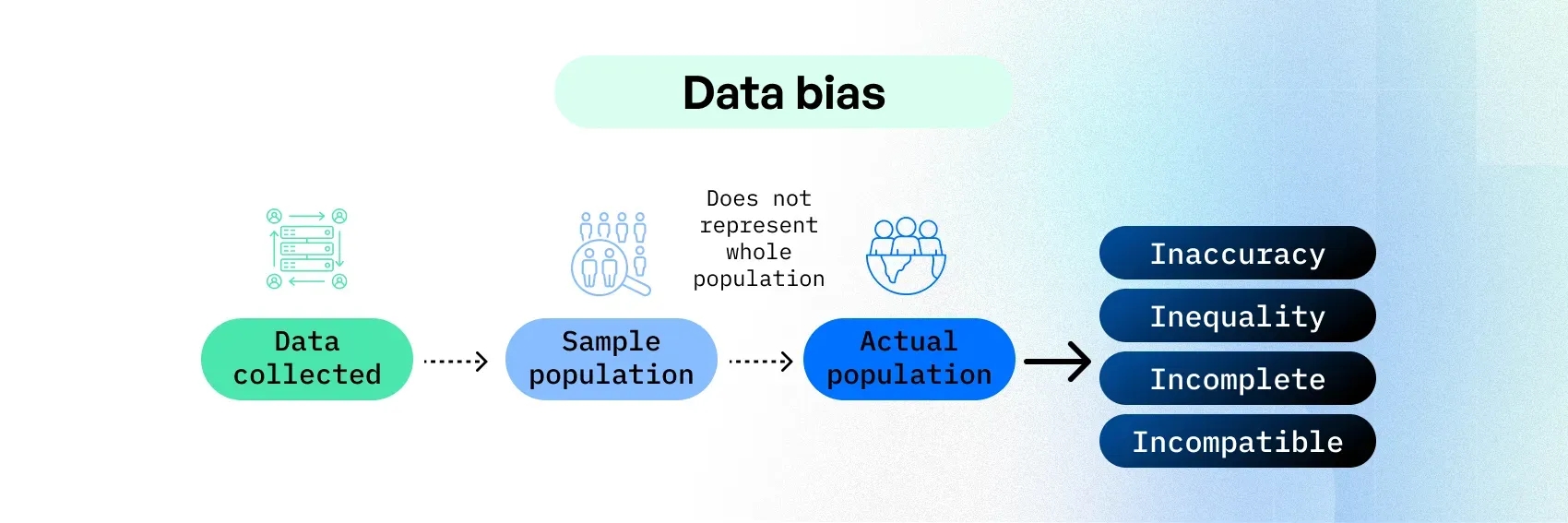
- Measurement Bias: This happens when the data is collected or labeled in a systematically flawed way. For example, if radiographs from one clinic are taken with an older, lower-resolution sensor, while another clinic uses a state-of-the-art sensor, the AI might learn to associate image quality with pathology, rather than learning the pathology itself.
This issue is not theoretical. Bias in healthcare AI is a well-documented problem, as the next short video clip emphasizes.
The Pitfalls of Artificial Intelligence in Healthcare | Medical Appraisals
This clip from Medical Appraisals directly addresses bias in healthcare AI, giving a concrete example of how models trained on one demographic can fail on another.
Please watch from 00:27 to 01:23. Notice the specific sources of bias mentioned: historical data bias, algorithmic bias, and labeling bias.
How Bias Manifests in Dentistry
Now, let's apply these concepts directly to dentistry. Our field is filled with anatomical and pathological diversity, making dental AI particularly susceptible to bias if datasets are not carefully curated.
The following reading selection provides specific, real-world examples of how this plays out.
Ethical Use of Artificial Intelligence in Dentistry
This chapter from the book 'Ethical Use of Artificial Intelligence in Dentistry' is an excellent resource that connects the general concept of AI bias directly to dental practice.
Please read the following three short sections: Start at '2.1.2 Risks associated with AI implementation in dental practice'. Read this section to understand the anatomical and pathological reasons why dataset diversity is critical in dentistry. Continue to the next paragraph that begins 'For example...'. This provides a perfect example of bias in orthodontic AI. Finally, read the section that starts with 'And how does this bias occur?'. This part reinforces how AI learns from human-labeled data and can pick up human prejudices. Focus on identifying the specific reasons why a lack of diversity in dental data can lead to poor AI performance.
The article highlights several key points that are essential for a clinician to know:
- Anatomical Variation: There are known morphometric differences in teeth and facial bone structure based on sex, age, and ethnicity. An AI trained on a narrow demographic might fail to account for this natural variation. The orthodontic example is powerful: an AI that recommends teeth extractions based on cephalometric landmarks learned only from Caucasian men could provide inappropriate treatment plans for patients of other ethnicities.
- Disease Variation: Oral diseases present differently and progress at different rates across populations due to a mix of genetic and environmental factors (e.g., diet, smoking). An AI might not recognize these varied presentations if its training data is too homogenous.
- Confounding Variables: AI models are excellent at finding patterns, but sometimes they find the wrong ones. This introduces confounding bias. A famous example from outside dentistry illustrates this perfectly. An AI was built to predict COVID-19 severity from chest X-rays. The model appeared highly accurate, but researchers discovered it wasn't analyzing the lungs. Instead, it had learned that patients with severe disease were often imaged while lying down, while healthier patients were imaged standing up. The AI learned to associate the patient's position with severity—a classic confounding variable.
The FDI World Dental Federation's white paper discusses this very example and reinforces the danger of unrepresentative datasets.
[PDF] Artificial Intelligence for dentistry
This white paper from the FDI offers a global perspective on AI in dentistry, with a strong focus on risks and limitations. It provides further excellent examples of bias.
Please read the section titled '1. Bias and limited generalizability' (on page 12). Pay close attention to the examples given, including the one about COVID-19 classification I just mentioned.
The Clinician's Role in Identifying and Mitigating Bias
As the person responsible for patient care, the dentist is the final checkpoint before an AI's output influences a clinical decision. This means you have an ethical duty to be a critical user.
The resources we've reviewed offer clear guidance on the clinician's role. It's not about being an AI expert, but about asking the right questions.
- Question the Data: When evaluating a commercial AI product or reading a research paper, your first question should be: "Who was this model trained on?" The FDI white paper (LINK) notes that 71% of AI for health applications in the US were trained on data from just three states. Does a model trained in California and New York necessarily work well for your patient population?
- Monitor Performance: The IntechOpen article (LINK) stresses that dentists must "supervise and continuously monitor the performance of AI-based system in their group of patients." If you notice an AI tool consistently making errors on a certain type of patient, that could be a sign of underlying bias.
- Ensure Equity: The ultimate goal is to ensure AI reduces health disparities, not widens them. As a user, you are in the best position to assess whether a tool is helping all your patients equitably.
Conclusion
In this lesson, we've moved from the mechanics of data splitting to the substance of the data itself. We've seen that AI is not inherently objective; it is a mirror that reflects the data it was trained on, including any biases or blind spots within that data.
Key Takeaways:
- Algorithmic bias leads to systematic errors that can result in unfair or inaccurate outcomes for specific patient groups.
- The most significant source of bias in healthcare AI is unrepresentative training data (Data Bias), where the dataset does not reflect the full diversity of the patient population.
- In dentistry, bias can arise from a lack of diversity in training data related to anatomy (age, sex, ethnicity), disease presentation, and environmental factors.
- As a clinician, you have an ethical responsibility to be a critical user of AI. This involves questioning a model's training data and monitoring its performance in your own patient population to protect against the negative effects of bias.
Preview of the Next Lesson
Understanding the potential for bias leads us directly to our next topic. If a model was trained on one population, how can we know if it will work for another? In the next lesson, we will learn to assess the generalizability of a study's findings to different patient populations and clinical settings. This will equip you with the skills to read a research paper and decide whether its impressive results are likely to hold true in your own clinic.