Hello! Welcome to the next lesson in our module on AI-Assisted Treatment Planning.
In our last session, we saw how AI uses 3D data from CBCT scans to create a precise surgical plan for dental implants, automating tasks like nerve segmentation and proposing an ideal implant position. We established the core theme of the "AI-clinician partnership," where technology handles complex data analysis, and the clinician provides the final expert judgment.
Today, we'll continue exploring this theme in one of the most AI-driven fields in modern dentistry: orthodontics. We will focus on clear aligners, a treatment modality that relies heavily on digital planning from start to finish.
Our learning outcome for this lesson is to explain the role of AI in creating and optimizing clear aligner treatment plans. We will break down how AI transforms a simple intraoral scan into a complete, staged treatment plan and how it helps make that plan more predictable, efficient, and personalized.
1. Creating the Digital Blueprint for Treatment
Just as implant planning begins with a CBCT scan, clear aligner therapy begins with a high-fidelity 3D model of the patient's teeth, typically acquired from an intraoral scanner. This "digital twin" of the dentition is the raw data that AI algorithms will process.
The initial and most critical task is to create a workable digital plan. This involves far more than just showing the final desired tooth position. It requires generating a predictable, step-by-step sequence of movements that will guide the teeth from their current state to the final alignment.
How Artificial Intelligence Is Transforming Aligners and Orthodontics
To start, let's read about how AI automates the initial analysis and planning stages. This article from Oblu Healthcare, 'How Artificial Intelligence Is Transforming Aligners and Orthodontics', gives a great, practical overview of the workflow.
Please read the section titled 'AI in Case Analysis and Treatment Planning'. As you read, notice how AI automates tasks that were once done manually, such as: Segmenting each tooth as an individual object. Identifying anatomical landmarks. Analyzing root and bone structure to understand the limits of movement.
As the article explains, the first step is automated segmentation. The AI algorithm identifies and separates each individual tooth in the 3D scan, including its root structure if CBCT data is integrated. This is analogous to the automated nerve tracing we saw in implant planning.
Once each tooth is a distinct digital object, the AI can assist in generating a treatment plan. This AI-generated proposal is not just a final outcome; it is a full sequence of incremental movements, with each step corresponding to a new aligner.
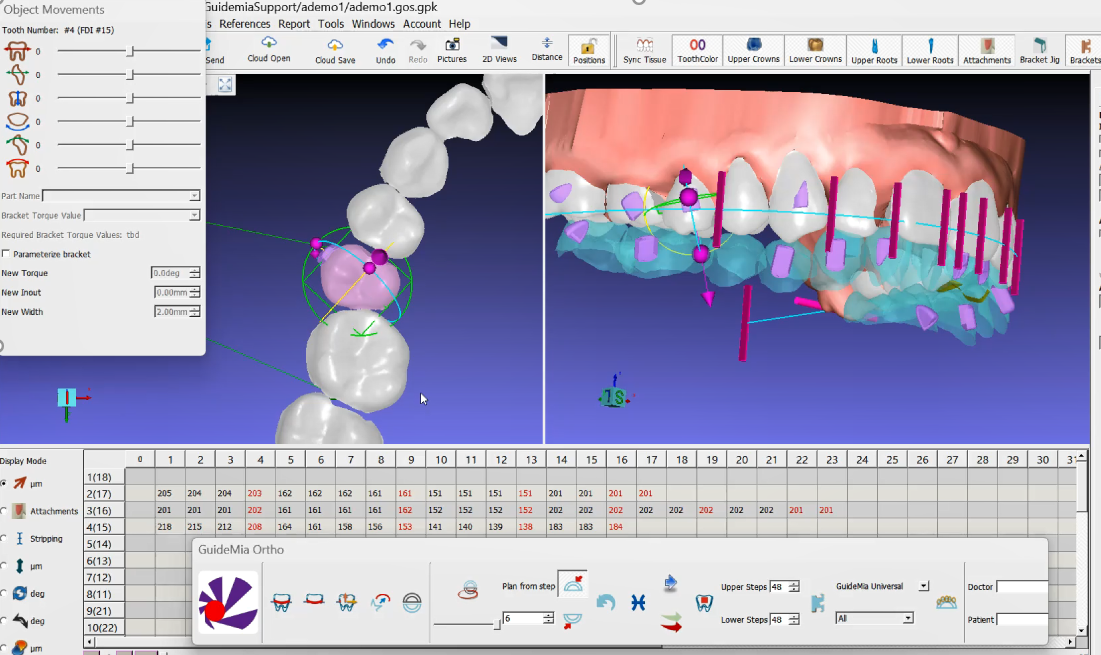
This initial AI proposal is where the clinician's expertise becomes crucial. The software, like the one shown above, provides tools for the orthodontist to review, modify, and approve every single movement. They can adjust the sequence, change the final position, and design attachments—small composite buttons bonded to teeth—that give the aligner the necessary grip to perform difficult movements like rotations or extrusions.

2. Optimizing the Plan: Beyond Just Straight Teeth
Creating the plan is only the first step. The true power of AI lies in its ability to optimize that plan, making it more predictable, efficient, and better integrated with the patient's overall oral health. Let's explore three key ways AI achieves this.
A. Predicting Outcomes and Visualizing the Journey
One of the biggest challenges in orthodontics is predicting how teeth will actually respond to applied forces. AI helps by analyzing massive datasets from millions of previous cases to simulate the most likely outcome for each stage of treatment.
How Artificial Intelligence Is Transforming Aligners and Orthodontics
Let's return to the Oblu Healthcare article to see how this predictive capability works.
Please read the sections 'AI in Predictive Tooth Movement' and 'AI for Smile Design and Patient Visualization'. Focus on how these simulations de-risk the treatment for the clinician and improve communication with the patient.
By simulating the treatment, the AI can flag potentially difficult or unpredictable movements, allowing the orthodontist to proactively adjust the plan. This also provides a powerful communication tool: the patient can see a 3D simulation of their future smile before even starting, which significantly improves case acceptance and motivation.
B. Integrating Orthodontics with Restorative Dentistry
Orthodontic treatment doesn't happen in a vacuum. Often, the goal of moving teeth is to create the ideal space and foundation for future restorative work like veneers, crowns, or implants. AI is now being used to create comprehensive plans that integrate these goals from the very beginning.
New AI technologies that will improve how you use Invisalign clear aligners
Let's watch a video from The CLEAR Institute that showcases a groundbreaking software from Invisalign called Smile Architect. This is a perfect example of AI optimizing a treatment plan by combining orthodontic and restorative planning.
Please watch the segment on Smile Architect (11:22 - 16:48). Pay close attention to how the software allows the dentist to: Visualize the final restorations (e.g., veneers) together with the planned tooth movement. Use the 'tooth mass analysis' tool to see how much tooth structure would need to be removed with and without orthodontic pre-alignment. This demonstrates the value of minimally invasive dentistry.
As you saw, this integrated approach represents a major leap in treatment optimization. By planning orthodontics and restorative care together, the AI helps the clinician be more conservative, preserving healthy tooth structure and achieving a better final outcome.
C. Monitoring Progress and Adapting the Plan
Finally, AI helps optimize treatment by ensuring the plan stays on track. Traditionally, an orthodontist would only know if a patient's teeth weren't "tracking" with the aligners when they came in for their appointment. AI-powered remote monitoring changes this.
[PDF] AI-Enabled Innovations in Orthodontics
This academic paper, 'AI-Enabled Innovations in Orthodontics', provides a scholarly perspective on how remote monitoring works. It solidifies the concepts we'll see in the next video.
Please read the section 'Advanced patient oversight and adaptive adjustments'. It explains how patients use smartphone apps to upload images, which are then analyzed by AI to check treatment progress.
Now let's see a commercial example of this technology.
New AI technologies that will improve how you use Invisalign clear aligners
The same video from The CLEAR Institute also introduces Invisalign's Virtual Care technology. This is a real-world application of the remote monitoring concept we just read about.
Please watch the first segment of the video (07:04 - 10:54). Notice how the AI analyzes the patient's home-taken photos to assess how well the aligners are fitting. If a problem is detected, it alerts the dentist, who can intervene early.
This ability to monitor and adapt the plan in near real-time is a powerful form of optimization. It reduces the number of office visits, keeps the treatment on schedule, and allows the clinician to address problems before they become significant, ultimately leading to a more efficient and predictable result.
3. From Digital Plan to Physical Aligners
Once the clinician finalizes the digital treatment plan, the data for each sequential 3D model is sent for manufacturing. AI's role extends here as well, optimizing the 3D printing and thermoforming process to ensure each aligner is fabricated with high precision and quality. This integration of AI from scan to plan to production is what makes modern clear aligner therapy so scalable and consistent.
Conclusion
In this lesson, we explored the integral role of AI in the world of clear aligners. We saw that AI is not just a futuristic concept but a technology that is deeply embedded in the daily practice of orthodontics.
Key Takeaways:
- AI's primary role is to create a staged treatment plan by automatically segmenting teeth from 3D scans and generating an initial sequence of movements.
- The clinician remains central to the process, using their expertise to refine and approve the AI's proposal within sophisticated planning software.
- AI optimizes treatment in several ways:
- Predicting tooth movements to increase predictability and visualize outcomes for patients.
- Integrating orthodontic plans with restorative goals to enable comprehensive, minimally invasive dentistry.
- Monitoring treatment progress remotely to allow for early intervention and adaptive planning.
- The entire workflow, from digital design to physical manufacturing, is enhanced by AI, leading to more efficient, predictable, and personalized orthodontic care.
Preview of the Next Lesson
We've now seen how AI assists in planning for tooth movement (orthodontics) and tooth replacement (implants). In our final lesson of this module, we will explore AI applications in digital design for prosthodontics, focusing on the creation of crowns and dentures. You will see how the same core principles of scanning, digital design, and AI-driven proposals apply to restoring the form and function of individual teeth.