Introduction
In our last session, we successfully connected your DDJ-FLX4 and configured Rekordbox, ensuring your hardware and software are communicating perfectly. Your DJ setup is now a fully operational station, ready for music. But what music? While you can technically play any song, certain tracks are structured in a way that makes them much easier to mix, especially when you're starting out.
This lesson focuses on exactly that: what makes a track "DJ-friendly." We will move from the technical setup to the musical foundation of DJing. By the end of this session, you'll be able to listen to a piece of dance music and identify its core rhythmic structure and key sections. This skill is fundamental, as it will guide your music selection and prepare you for our next lesson, where we'll start building your first practice library.
The Rhythmic Foundation: The 4/4 Count
The vast majority of music you'll be mixing—from house and techno to funk and disco—is built on a simple, repeating pulse. This is the bedrock of dance music, and learning to hear and count it is your first step into the DJ's perspective on music. This pulse is called the 4/4 time signature.
Don't let the term "music theory" put you off; as you'll see, it's really just about counting to four. Let's watch a video from DJ Shortee that breaks this down.
How to Count Beats & Bars | Music Theory Tutorial for DJs
This video provides a clear and simple explanation of the 4/4 time signature, which is the standard for almost all DJ music.
First, watch the section explaining the concept of a bar and the 4/4 time signature from the beginning. The analogy of a dollar and four quarters is a great way to think about it. Next, watch the practical demonstration of counting the beats from this part. Try to count along: "one, two, three, four... one, two, three, four..." You'll notice the kick drum often lands on each of these counts, providing a steady anchor. This constant pulse is what people dance to, and it's what you will use to line up your tracks.
Building Blocks: Beats, Bars, and Phrases
Now that you can identify the individual "1-2-3-4" beats, the next step is to see how they are grouped together to form larger musical ideas. This is where your sense of storytelling and structure will start to connect with the music.
- Beats: The individual counts (1, 2, 3, 4).
- Bars: A group of four beats makes up one "bar" (or "measure").
- Phrases: DJs typically group bars into "phrases." A standard phrase is often 4 or 8 bars long, which equals 16 or 32 beats of music.
Think of it like this: Beats are letters, bars are words, and phrases are sentences. Musical "events"—like a new instrument entering, a vocal line starting, or the energy dropping—almost always happen at the beginning of a new phrase. Recognizing these phrases is the key to mixing at the right time.
This image provides a perfect visual summary of this hierarchy.
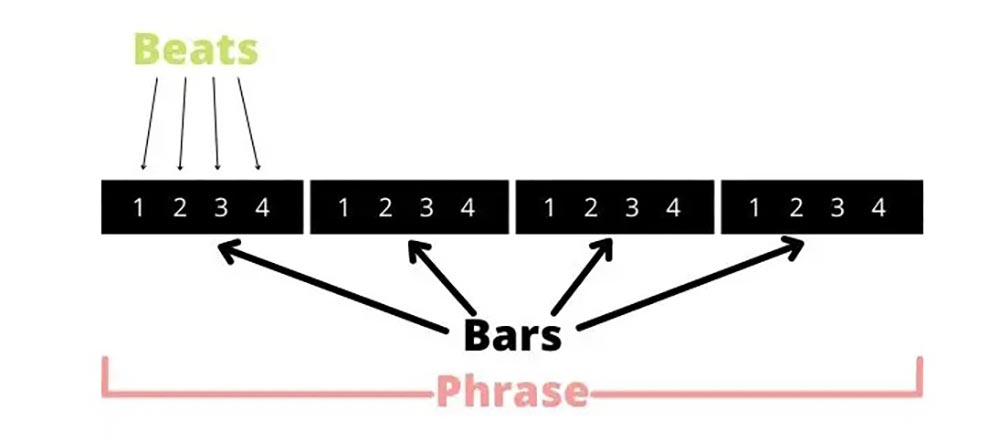
Let's return to DJ Shortee's tutorial, where she explains how to count these larger groups and, crucially, how they are visualized in DJ software like Rekordbox.
How to Count Beats & Bars | Music Theory Tutorial for DJs
This final clip from DJ Shortee will connect the concept of counting bars to what you see on your computer screen.
Watch the section from this point. Pay close attention to two things: The counting technique she introduces: "one-two-three-four, two-two-three-four, three-two-three-four..." This is the standard method DJs use to keep track of where they are in a phrase. How the software visually marks the start of each bar with a thicker line and a number. This is your visual guide in Rekordbox, confirming what you are hearing.
The DJ's Playground: Intros, Outros, and Structure
So, why is this structure so important? Because it creates predictable, open spaces that are perfect for mixing. A DJ-friendly track is designed with these spaces built-in. The two most important are the DJ intro and DJ outro.
These are typically 8 or 16 bars (32 or 64 beats) at the beginning and end of a track that are purely instrumental and rhythmic. They usually consist of just drums and maybe a simple bassline, deliberately leaving out complex melodies or vocals.
This sparse arrangement gives you a "runway" to seamlessly blend the new track with the track that is currently playing. Trying to mix two tracks with clashing vocals or competing melodies sounds messy. Mixing a percussive outro with a percussive intro sounds powerful and clean.
This short video from Crossfader explains this perfectly.
Getting Started With The DDJ FLX4 - Beginner DJ Tutorial
The team at Crossfader briefly explains why track structure, and specifically intros and outros, are so important for learning to DJ.
Watch this clip from this section. They summarize the key idea: songs with obvious structures, including intros and outros, are the best to learn with because they are designed to be blended together.
Summary: Your Checklist for a DJ-Friendly Track
You now have a clear set of criteria for identifying music that will be easy to practice with. When you're listening to a potential track, you're looking for:
- A Clear 4/4 Beat: Can you easily count "1-2-3-4" along with the song? Is there a steady kick drum?
- A DJ Intro: Does the song start with at least 32 beats (8 bars) of drums and percussion before the main melody or vocals kick in?
- A DJ Outro: Does the song end with at least 32 beats of just drums and percussion after the main elements have faded out?
- Predictable Phrasing: Do the musical changes (like a new synth coming in or a breakdown starting) happen in neat 8 or 16-bar sections?
If the answer to these questions is "yes," you've found a great track to practice with.
Conclusion
Today, you learned to listen to music like a DJ. You can now identify the fundamental 4/4 pulse that drives dance music, understand how beats are grouped into bars and phrases, and recognize the critical importance of instrumental intros and outros for mixing. This structural knowledge is the foundation upon which all your future mixing skills will be built.
In our next lesson, we will put this knowledge into practice. Armed with your checklist for a DJ-friendly track, we will go online to find and download a selection of free, high-quality practice tracks that are perfectly suited for a beginner. You will then import them into Rekordbox, creating the first playlist for your DJ journey.