Hello! Welcome to the next lesson in our journey to becoming a more dynamic and charismatic communicator.
In our last session, we focused on the FORD method, a fantastic tool for discovering what to talk about—the raw material for great conversations. We learned how to find topics related to Family, Occupation, Recreation, and Dreams.
Today, we'll build directly on that foundation. It's not enough to just have a topic; you need to present it in a way that captivates your listener. This lesson will teach you how to transform a simple experience into a compelling personal story. Our goal is to structure personal anecdotes using the setup-conflict-resolution model to create engaging narratives.
This skill is central to building the deeper bonds you're aiming for. A well-told story makes you more memorable, relatable, and charismatic. It turns a simple fact about yourself into an experience you share with someone else.
1. The Blueprint of a Story: Setup, Conflict, Resolution
Think of a story as more than just a sequence of events. A list of "this happened, then this happened" is a report, not a story. A story has a shape, an emotional arc that draws the listener in. The most fundamental and universal structure for this is the 3-Act Structure, which we can simplify for anecdotes as Setup, Conflict, and Resolution.
In economics, you use models to simplify complex systems and understand their underlying mechanics. This storytelling structure works in the same way: it's a model for simplifying human experience to reveal its meaning and emotional core.
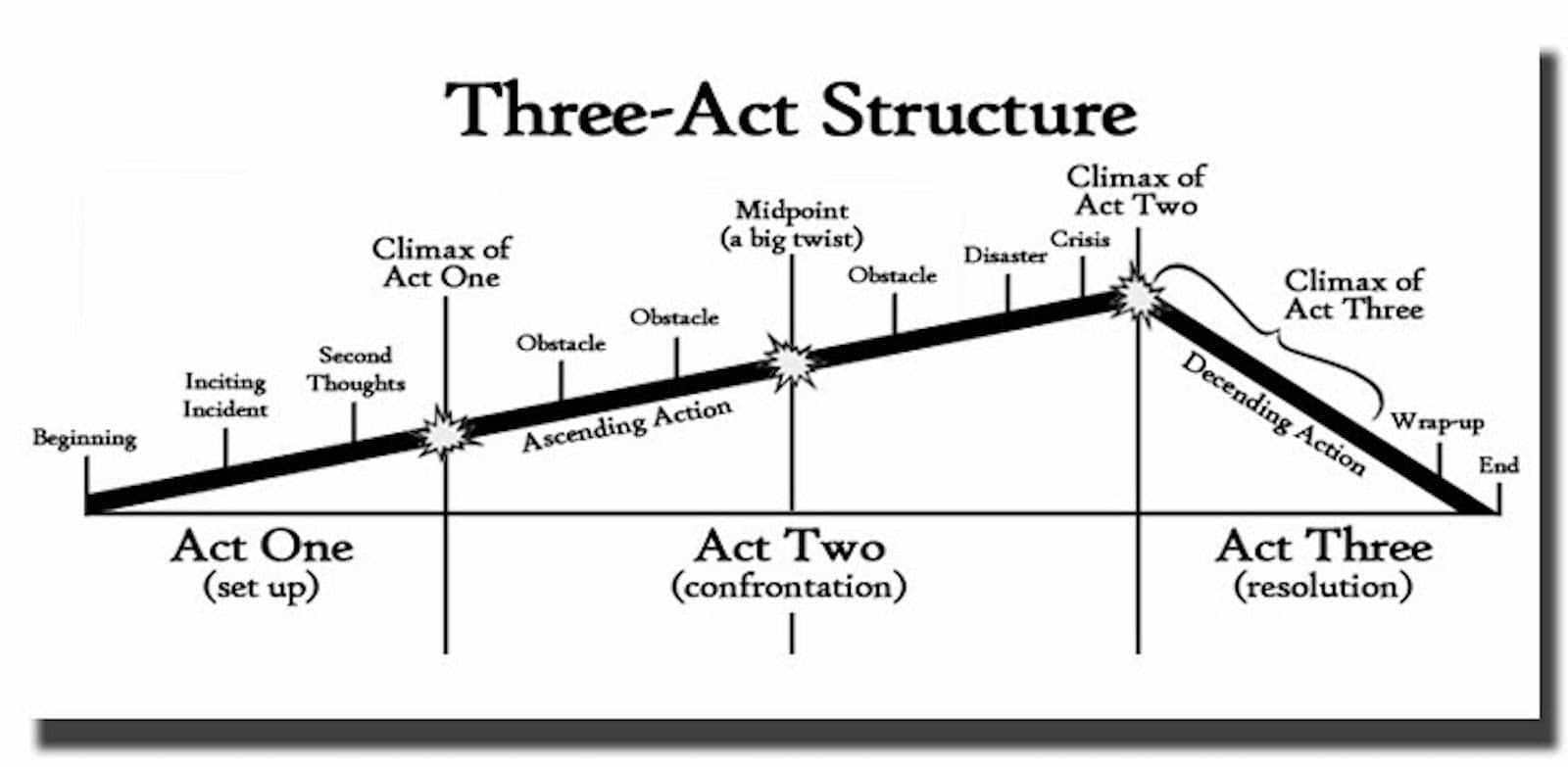
Let's start with a resource that breaks this down brilliantly. The author simplifies the entire 3-act structure into a single, powerful idea: "I was wrong." This captures the essence of a story—a journey that leads to a change in perspective.
3-Act Structure: Outline & Examples for Your Story
The article '3-Act Structure' by Mary Adkins provides a simple yet profound way to understand storytelling. We'll focus on its core definition of the three acts.
Please read the first section of the article, from the beginning down to 'How to write toward the 3-act structure'. Pay close attention to the breakdown of the three acts into simple statements: 'I have a problem,' 'I think I know how to solve it,' and 'I was wrong.'
As the article explains, this simple framework gives your anecdote a purpose. It's not just a fun thing that happened; it's about a journey from one state of being to another.
Let’s define these three parts for our purpose:
- Act 1: Setup ("I have a problem.") This is the beginning. You introduce the context: Who was involved? Where and when did it happen? What was the "normal world" of the story, and what did the main character (you) want?
- Act 2: Conflict ("I think I know how to solve it.") This is the middle and the engine of the story. An obstacle appears, disrupting the normal world. It's the challenge, the unexpected twist, or the struggle you faced. This is where the tension builds.
- Act 3: Resolution ("I was wrong.") This is the end. The conflict is resolved, for better or worse. The key here is that something has changed. You learned a lesson, gained a new perspective, or the situation is different now. This provides the satisfying takeaway for the listener.
2. A Practical Five-Line Method
The 3-act structure is the theory. Now, let's look at a very practical way to apply it. The following video breaks down any story into just five essential lines. This is an excellent tool for quickly outlining an anecdote you want to share.
The ONLY 5 Lines You Need To Tell Any Story
In his video 'The ONLY 5 Lines You Need To Tell Any Story,' Tim Runia provides a simple, actionable method that aligns perfectly with our Setup-Conflict-Resolution model.
Please watch from 01:51 to 05:55. The first segment (01:51 - 02:43) outlines the five lines. The second (03:03 - 04:02) applies it to 'The Lion King.' The third (04:21 - 05:55) explains why each line is crucial for the audience.
Let's map these five lines to our three acts:
- Situation + Desire = Setup (Act 1)
- Conflict = Conflict (Act 2)
- Change + Result = Resolution (Act 3)
This 5-line method gives you a quick and dirty "story skeleton." If you can summarize your anecdote in these five lines, you have a solid structure to build on.
3. The Indispensable Role of Conflict
As you've seen, conflict is the heart of the story. Without it, you don't have an engaging narrative. Your listener has no reason to care what happens next. A story about a smooth, easy day where everything went according to plan is boring. A story about a day where everything went wrong is interesting.
This is a key insight that separates master storytellers from novices. They understand that tension is what keeps people listening.
Let's watch a short, energetic TED talk that makes this point very clearly.
The Secret to Telling a Great Story — in Less Than 60 Seconds | Jenny Hoyos | TED
In 'The Secret to Telling a Great Story,' Jenny Hoyos demonstrates why conflict is non-negotiable for an engaging story.
Please watch the segment from 01:13 to 02:25. Notice her emphasis on why 'if everything is smooth sailing, then nobody cares' and how she deliberately introduced conflict into her own story.
When you look for anecdotes to share, don't just think about happy or successful moments. Think about the struggles, the embarrassing moments, the times you failed. These are often the best sources for compelling stories because they are rich with conflict and opportunities for resolution.
4. An Anecdote in Action: The Law School Story
Now let's see how this structure works in a complete personal anecdote. We'll return to the "3-Act Structure" article, which contains an excellent, multi-part story about the author's experience in law school.
3-Act Structure: Outline & Examples for Your Story
This resource provides a perfect example of a personal anecdote told using the 3-act structure. We'll read the story in three parts, corresponding to each act.
Please read the author's law school story as it unfolds through the article: Act 1 (Setup): In the section 'How to Write a Strong Act 1,' read her personal story about her insecurity in law school. Act 2 (Conflict): In 'How to Write an Engaging Act 2,' read the continuation where she describes her attempt to solve her problem. Act 3 (Resolution): Finally, in 'How to Write an Authentic and Satisfying Act 3,' read the conclusion of her story and the final realization.
Let's break down her story:
- Setup: She's in law school and has a problem: she's convinced she's the "dumbest person there" and feels like a fraud. Her desire is to succeed, or at least survive.
- Conflict: She tries to solve the problem by changing her habits—sitting in the front row, taking notes by hand. This attempt builds her confidence, and she starts feeling optimistic. The tension is in whether this solution will work.
- Resolution: Her worst fear is publicly realized—she's ranked last in the class. But this leads to a crucial realization (the "I was wrong" moment): she was wrong to think everyone was judging her. In reality, everyone is too busy worrying about themselves. She learns a powerful lesson about self-perception.
This is a perfect anecdote. It's relatable, has clear emotional stakes, and offers a valuable insight at the end. The frameworks we've discussed are all present, working invisibly to make the story powerful. The article "How to Outline a Speech" refers to this as the Challenge-Conflict-Resolution structure, which is just another name for the same powerful model.
Test your understanding!
Think back to a recent challenge you faced, big or small. It could be related to your studies, a hobby, or even just a difficult day. Using the topics from our last lesson (Family, Occupation, Recreation, Dreams) can help you brainstorm.
For example:
- A time you struggled with a concept in your Applied Economics major (Occupation).
- A travel plan that went completely wrong (Recreation).
- A time you tried to learn a new skill and failed spectacularly at first (Dreams/Recreation).
Your task: Choose one experience and outline it using the 3-act structure. Just write 1-2 sentences for each part.
- Setup (The situation and your goal):
- Conflict (The obstacle and your attempt to overcome it):
- Resolution (The outcome and what you learned):
Show answer
Here's an example based on a student experience:
- Setup: I had a major presentation for my econometrics class that I was really nervous about. I wanted to impress my professor and get a good grade.
- Conflict: The night before, my computer crashed and I lost my final slides. I panicked and stayed up all night trying to recreate them from my notes, but they were a mess.
- Resolution: I had to present with just a whiteboard and my memory. It was terrifying, but it forced me to speak more naturally instead of reading from slides. I ended up getting a better grade than I expected, and I learned that I know my material better than I think and don't need to hide behind a perfect presentation.
Conclusion
You now have the fundamental blueprint for telling a great story. By consciously applying the Setup-Conflict-Resolution model, you can transform everyday experiences into engaging anecdotes that reveal something about who you are. This structure makes storytelling less intimidating by giving you a clear path to follow, reducing the cognitive load in social situations.
Key Takeaways:
- A story isn't just a list of events; it's a structured narrative with an emotional arc.
- The core structure is Setup (the initial situation), Conflict (the problem or struggle), and Resolution (the outcome and change).
- Conflict is the engine. Don't shy away from stories of failure or difficulty; they are the most engaging.
- The resolution should ideally involve a change in perspective or a lesson learned (the "I was wrong" moment).
Preview of the Next Lesson:
We've built the skeleton of a story. But a skeleton alone isn't very compelling. In our next lesson, we will focus on adding the "flesh" to this skeleton. We will explore how to incorporate sensory details (sight, sound, feeling) to make stories more vivid and memorable, bringing your anecdotes to life for your audience.