Hello! Welcome to the first lesson in our module on Building Deeper Connections.
In our last module, we focused on navigating difficult conversations. You learned how to maintain composure and civility, which is crucial for creating the psychological safety that allows relationships to thrive even through disagreement. When people feel safe disagreeing with you, they also feel safer being their authentic selves around you. This lesson builds directly on that foundation of trust.
Today, we'll explore the primary engine for turning acquaintances into genuine friends: self-disclosure. Your learning outcome for this lesson is to manage the process of gradual self-disclosure to build trust and intimacy.
This skill is about intentionally and strategically sharing parts of yourself to build a bond. For you, as someone who finds socializing can be draining, mastering gradual self-disclosure is a powerful tool. It allows you to build deep connections in a controlled, deliberate way, which is far more energy-efficient than trying to maintain dozens of superficial relationships.
1. The "Onion Theory" of Relationships
To understand how intimacy develops, we'll start with a core framework in communication studies called Social Penetration Theory. It proposes that relationships deepen as people gradually reveal more about themselves, much like peeling back the layers of an onion.
To get a clear overview of this theory, let's watch a video from Study Hall that explains it beautifully.
Social Penetration Theory (Ogres Are Like Onions) | Intro to Human Communication | Study Hall
This video, 'Social Penetration Theory (Ogres Are Like Onions),' will introduce you to the key concepts of breadth, depth, and the four stages of self-disclosure that guide a relationship's development.
Please watch the video from 01:32 to 09:19. This covers the following key sections: Self-Disclosure: Breadth and Depth (01:32 - 03:41) The Onion Metaphor (04:44 - 05:50) The Four Stages of Disclosure (05:50 - 09:19) As you watch, focus on understanding the difference between the breadth and depth of topics, and how each of the four stages represents a deeper level of trust and intimacy.
As the video explained, the development of a relationship through self-disclosure can be understood through two dimensions and four key stages:
- Breadth: The number of different topics you discuss with someone.
- Depth: How personal and intimate the information you share within those topics becomes.
The four stages represent a progressive journey toward intimacy:
- Orientation: The "small talk" phase. You stick to safe, superficial topics (e.g., work, weather, hobbies). The breadth can be wide, but the depth is shallow. This is low-risk and helps you find initial common ground.
- Exploratory Affective Exchange: You start sharing more personal opinions and feelings, but still cautiously. You might move from saying where you grew up to sharing how you felt about growing up there. Both breadth and depth begin to increase.
- Affective Exchange: Comfort and trust have grown. Communication is more spontaneous. You might share personal information, use idioms or inside jokes, and even begin to have conflicts, knowing the relationship is strong enough to handle them. This is where you might disclose personal vulnerabilities, like social anxiety.
- Stable Exchange: The deepest level of intimacy, reserved for our closest relationships. There's a high degree of openness, and you can predict each other's emotional responses. You share your deepest fears, hopes, and personal challenges.
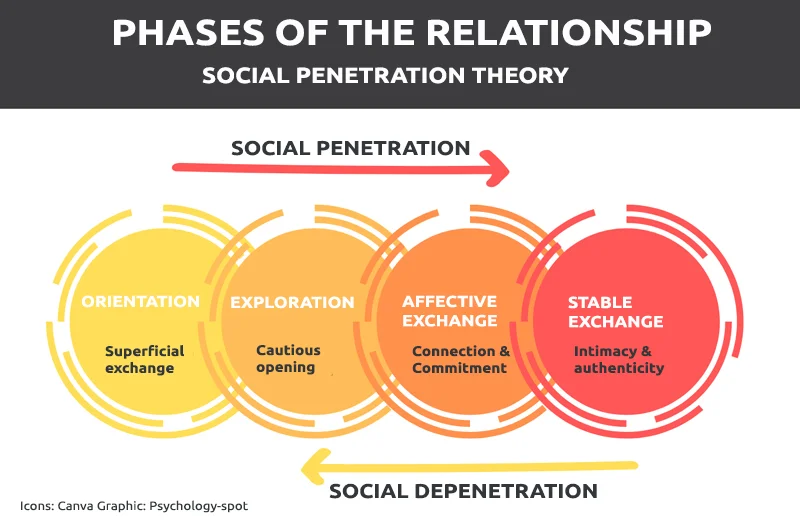
2. The Mechanics of Connection: Vulnerability and Reciprocity
Peeling the onion is not a one-person job. True connection is a "two-way street," built on the pillars of vulnerability and reciprocity. When you share something personal, you are being vulnerable. This act of vulnerability is an invitation for the other person to trust you and share in return.
Let's read a short article that delves into the research behind why this works.
The One Trick to Building Deep Connections
The article 'The One Trick to Building Deep Connections' from Explearning synthesizes research on self-disclosure, explaining how it fuels liking and affection, and why the process must be mutual.
Please read the following two sections: Start at 'Part 3: The Dance of Intimacy, Navigating the Interpersonal Process' and read to the end of that section. Then, read the section 'The Heartfelt Connection. How Self Disclosure Fuels Affection.' Focus on the concepts of intimacy as a 'two-way street' (Reis & Shaver) and the link between disclosure and 'liking' (Collins & Miller).
As the article highlights, researchers have confirmed two critical points:
- Disclosure leads to liking: When you share personal information with someone, they tend to like you more. And when you are on the receiving end of a disclosure, you tend to like the person who shared. It's a powerful bonding agent.
- Reciprocity is essential: For intimacy to develop, the vulnerability must be returned. If you share something personal and the other person responds with a blank stare or a superficial comment, the connection stalls. This back-and-forth exchange is called reciprocal self-disclosure.
This idea of reciprocity is a fundamental rule of building connections. Let's watch a very short clip that summarizes this point.
How to Connect With Others in A Meaningful Way
This brief segment from Psych2Go explains the importance of reciprocal self-disclosure in a simple and direct way.
Please watch from 02:22 to 03:12. Notice the advice to 'reveal your layers slowly' to make the other person comfortable.
3. A Practical Guide for Introverts
As an introvert, the idea of being vulnerable and opening up can seem particularly daunting or energetically costly. However, the concept of gradual self-disclosure is perfectly suited to your nature. It's not about suddenly baring your soul; it's about making small, calculated steps to build trust over time.
This next resource is written specifically for introverts and directly addresses how to approach this process.
Exploring the Benefits of Vulnerability: A Guide for Introverted ...
The article 'Exploring the Benefits of Vulnerability: A Guide for Introverted...' from Happiness in Solitude provides excellent, tailored advice on navigating the challenges of vulnerability.
Please read the section titled 'Breaking Down Walls: Navigating Vulnerability Challenges.' Pay close attention to the concepts of 'gradual self-disclosure' and setting boundaries.
This brings us to a crucial set of practical strategies for managing self-disclosure effectively.
Actionable Strategies for Gradual Self-Disclosure:
- Pace Yourself and Test the Waters: Don't jump from the Orientation stage to the Stable Exchange in one conversation. Start with a small, low-risk disclosure (e.g., "I was a bit nervous about this presentation, but I'm glad it went well"). This is a "bid" for connection.
- Watch for Reciprocity: After you share, pause. Give the other person space to respond. Do they share something similar? Do they ask a thoughtful follow-up question? Or do they change the subject? Their response is data. It tells you whether it's safe to proceed.
- Match the Level of Intimacy: A common mistake is "oversharing"—disclosing something deeply personal when the other person is still in the superficial stage. A good rule of thumb is to match their level of disclosure. If they share a frustrating work story, it's appropriate to share a similar-level story, not a deep childhood trauma.
- Keep it Relevant: Weave your disclosures into the existing flow of conversation. An abrupt, non-sequitur disclosure can feel jarring. Find a natural link between what's being discussed and what you'd like to share.
- Assess the Context: The right time, place, and person are critical. A quiet, one-on-one coffee chat is a better setting for deeper disclosure than a loud group dinner. Trust your intuition about who feels like a safe person to open up to.
Test your understanding!
You're talking to a colleague you'd like to build a better relationship with. You've only ever engaged in "Orientation" stage small talk (the weather, weekend plans). During a coffee break, they mention they're a bit stressed because they're struggling to learn a new software program for work.
Using the principles of gradual and reciprocal self-disclosure, how could you respond to move the relationship toward the "Exploratory Affective Exchange" stage? What would you look for in their response to know if you should continue?
Show answer
A great response would follow the principles of matching and gradual disclosure.
Your Response:
Instead of a generic "Oh, that's tough," you could offer a small, relevant disclosure of your own. You might say:
"I know what you mean, that program can be tricky. I actually felt pretty overwhelmed when I first had to use it for the Q3 report. It took me a while to get the hang of the data visualization part."
Why this works:
- It validates their feeling: You start by acknowledging their stress ("I know what you mean").
- It's a matched disclosure: They shared a mild professional stress, and you shared a similar, past experience. It's not oversharing.
- It's vulnerable but low-risk: You're admitting a moment of professional struggle, which makes you more human and relatable.
- It opens a door: It invites them to talk more about their specific struggle without putting them on the spot.
What to Look for in Their Response:
You would then pause and listen.
- A positive sign (reciprocity): They might lean in and say, "Oh really? The data viz is exactly what's getting me! How did you figure it out?" This is a clear signal that they accept your bid for connection and are willing to engage on a slightly deeper level.
- A neutral/negative sign: If they just say, "Yeah, well..." and change the subject back to the weather, that's valuable information. It signals they are not ready or willing to deepen the connection right now. You should respect that and pull back to the Orientation stage, without judgment.
Conclusion
Building deep, meaningful connections is not a matter of luck; it's a process you can learn and manage. By understanding the principles of gradual self-disclosure, you can intentionally cultivate trust and intimacy in your relationships.
Key Takeaways:
- Relationships deepen in layers: Social Penetration Theory's "onion model" shows that we move from superficial topics (breadth) to personal revelations (depth) through distinct stages.
- Vulnerability is an invitation: Sharing something personal signals trust and invites the other person to connect on a deeper level.
- Reciprocity is the key: The foundation of a growing connection is a back-and-forth exchange of disclosure. Share, then listen.
- Gradual disclosure is an introvert's strength: This process allows you to build bonds intentionally and at a comfortable pace, conserving your social energy for the connections that matter most.
Preview of the Next Lesson:
Now that you understand the theory behind gradual self-disclosure, our next lesson will give you a highly practical and famous tool for putting it into action. We will explore the principles of the '36 Questions' framework, a structured method designed to appropriately and deliberately accelerate connection.