Hello! Welcome to your next lesson in building deeper connections.
In our last session, we focused on empathic validation—a powerful, universal skill for understanding and affirming another person's emotional experience. You learned that acknowledging someone's feelings, without judgment or trying to fix their problems, is a fundamental way to build trust and psychological safety.
Today, we're going to add a layer of strategic precision to that foundation. While validation helps you connect with what a person is feeling, today's lesson will help you connect with how they prefer to process and exchange information. Your learning outcome is to identify and align with others' primary communication styles (e.g., analytical, expressive, amiable).
Mastering this will make your interactions smoother and more effective. For you, as someone who finds socializing can be draining, this is a crucial "energy management" skill. By quickly adapting to someone's preferred style, you reduce friction and build rapport more efficiently, making conversations feel less like work and more like a natural connection.
1. The Blueprint of Communication: Two Dimensions, Four Styles
People have habitual ways of interacting. While everyone is unique, our communication behaviors can be understood through a few key patterns. Most models of communication style are built on two fundamental dimensions of observable behavior, first researched by industrial psychologists David Merrill and Roger Reid in the 1960s.
To understand these two dimensions, please watch this short video.
TRACOM's SOCIAL STYLE Model HD Version
This video from the TRACOM Group, which commercialized the Social Style Model, clearly explains the two core dimensions: Assertiveness and Responsiveness.
Watch from 00:59 to 02:10. Focus on understanding the difference between 'Ask vs. Tell' (Assertiveness) and 'Control vs. Emote' (Responsiveness).
As the video explained, these dimensions are:
-
Assertiveness: The degree to which a person is perceived as trying to influence others.
- More 'Telling' (High Assertiveness): They are direct, make strong statements, are fast-paced, and take charge.
- More 'Asking' (Low Assertiveness): They are more reserved, ask questions, listen carefully, and are slower-paced.
-
Responsiveness: The degree to which a person is perceived as expressing their emotions.
- More 'Emoting' (High Responsiveness): They are expressive, animated, openly share feelings, and focus on relationships.
- More 'Controlling' (Low Responsiveness): They are more guarded with their feelings, fact-oriented, and focus on tasks.
When you plot these two dimensions on a graph, you get four primary communication styles.
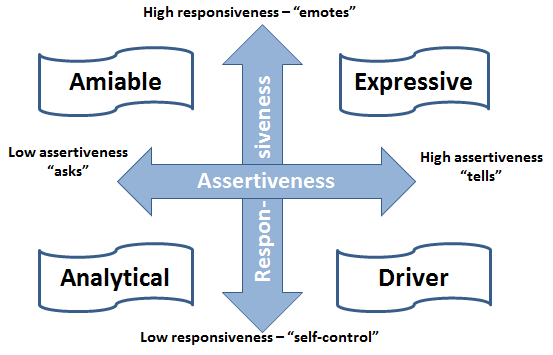
The four styles are:
- Driver: Tell-Assertive + Control-Responsive
- Expressive: Tell-Assertive + Emote-Responsive
- Amiable: Ask-Assertive + Emote-Responsive
- Analytical: Ask-Assertive + Control-Responsive
Let's explore what these styles look like in the real world.
2. Identifying the Four Communication Styles
Being able to spot these styles in conversation is the first step. You'll learn to look for patterns in language, body language, tone of voice, and topic preference.
A very practical and memorable way to think about these styles is by associating them with colors. Let's watch a video that uses this "color" metaphor and brings the styles to life with engaging examples.
How to Talk to ANYONE (Once You Know Their Color!)
In this video, communication coach Vinh Giang uses a color-based system—Red (Driver), Yellow (Expressive), Green (Amiable), and Blue (Analytical)—to explain the styles. The skits are particularly useful for seeing how miscommunication happens when styles clash.
Please watch from the beginning to 09:40. Pay attention to: The core drivers of each color (0:00 - 0:33). The questions you can ask yourself to identify a style (01:34 - 03:44). The skits showing how a 'Red' (Driver) interacts, and often clashes, with other styles (03:44 - 06:32). How each style is perceived by the others, which helps explain potential friction (06:32 - 09:40).
To solidify your understanding, we'll now consult a detailed guide that breaks down the specific verbal and non-verbal cues for each style. This will give you a more analytical checklist to use.
AMIABLE DRIVER ANALYTIC Personal Styles/Social Styles
This handout, 'AMIABLE DRIVER ANALYTIC Personal Styles/Social Styles,' offers a concise yet detailed breakdown of each style's characteristics. It's a great reference document.
Please read pages 2 through 5 of the PDF. Each page is dedicated to one style: Driver, Expressive, Amiable, and Analytic. For each style, focus on the 'Verbal/Vocal' and 'Non-Verbal Behaviors' sections. These are the concrete cues you can observe.
Here is a summary of the four styles, combining insights from the resources:
| Style | Driver (Red) | Expressive (Yellow) | Amiable (Green) | Analytical (Blue) |
|---|---|---|---|---|
| Core Need | Results, Control | Recognition, Fun | Harmony, Security | Accuracy, Being Right |
| Focus | Task & Action | People & Ideas | People & Relationships | Task & Process |
| Pace | Fast, Decisive | Fast, Spontaneous | Slow, Steady | Slow, Deliberate |
| Talks About | What? (Goals, outcomes) | Who? (People, stories) | Why? (Feelings, team) | How? (Data, procedure) |
| Non-Verbal | Direct eye contact, purposeful gestures, controlled expression. | Animated expression, open gestures, lots of energy. | Relaxed posture, warm expression, indirect eye contact. | Reserved posture, limited gestures, thoughtful expression. |

3. Aligning Your Communication: The Power of Versatility
Identifying someone's style is only half the battle. The true skill lies in versatility—temporarily adapting your own behavior to make the other person more comfortable. This is not about being inauthentic; it's about speaking the other person's language to ensure your message is heard.
As Vinh Giang explained in the video, this is about adjusting your delivery, not your core self.
Let's watch the final part of his video, where he gives actionable tips on how to talk to each style.
How to Talk to ANYONE (Once You Know Their Color!)
This segment provides specific, practical advice for communicating with each of the four 'colors' or styles.
Watch from 12:34 to 15:37. For each style, note the key recommendations. For example, 'skip the fluff' for Reds (Drivers) and 'come prepared' for Blues (Analytics).
Now, let's turn back to our PDF guide for a more structured set of tips. The table on page 6 and the tips on page 9 are incredibly valuable for practical application.
AMIABLE DRIVER ANALYTIC Personal Styles/Social Styles
We will now focus on the 'how-to' sections of the handout. These provide clear do's and don'ts for interacting with each style.
First, carefully study the table on page 6, 'Overview of Personal Styles Characteristics.' Pay special attention to the rows 'Best Way to Deal with' and 'Key Trust Issue to Meet.' Then, read page 9, 'Versatility Tips to Apply to Other Styles,' which gives direct advice for adapting your communication.
Summary of How to Align with Each Style:
-
When speaking to a Driver (Red):
- Be direct and to the point. Focus on the "what."
- Present options so they feel in control.
- Focus on results and outcomes, not long stories or excessive data.
- Your goal: Show you respect their time and are competent.
-
When speaking to an Expressive (Yellow):
- Show enthusiasm and energy. Focus on the "who."
- Talk about the big picture, ideas, and stories.
- Be sociable and friendly; don't get bogged down in details.
- Your goal: Show you appreciate their ideas and creativity.
-
When speaking to an Amiable (Green):
- Be warm, supportive, and patient. Focus on the "why."
- Ask for their opinions and listen without interrupting.
- Provide assurances and minimize perceived risks.
- Your goal: Show you are trustworthy and care about them as a person.
-
When speaking to an Analytical (Blue):
- Be precise, structured, and fact-based. Focus on the "how."
- Provide data and evidence to support your claims.
- Give them time to think; don't rush them for a decision.
- Your goal: Show you are thorough, accurate, and have done your homework.
Test your understanding!
Imagine you are at a networking event for your field of Applied Economics. You want to start a conversation with three different people.
- Person A is speaking quickly, with direct eye contact, and just told someone, "Okay, cut to the chase—what was the key finding?"
- Person B is talking with animated gestures, laughing loudly, and says, "Forget the models, I'm more interested in the crazy stories of what people actually do with their money!"
- Person C is listening quietly to a conversation, nodding slowly. When asked for an opinion, they say, "I'd need to see the data first before I could form a conclusion. There are several methodologies that could apply here."
For each person, identify their most likely communication style and draft a one-sentence opening line that would align with their style.
Show answer
-
Person A (Driver/Red): Their focus on the "bottom line" and fast pace points to a Driver style.
- Aligned Opening: "I have a question about the direct outcome of your latest project; it seems you get results."
-
Person B (Expressive/Yellow): Their energy, focus on stories, and enthusiasm signal an Expressive style.
- Aligned Opening: "That's a fascinating point about stories—the most interesting part of economics is definitely the human drama behind it!"
-
Person C (Analytical/Blue): Their caution, need for data, and systematic thinking are hallmarks of an Analytical style.
- Aligned Opening: "I was interested in your comment about methodologies; I've been thinking about the specific pros and cons of different models for forecasting."
Conclusion
You now have a robust framework for understanding and adapting to different communication styles. This skill moves you beyond one-size-fits-all communication and allows you to tailor your approach for maximum impact and connection. By meeting people where they are, you build rapport faster, avoid unnecessary misunderstandings, and make your social interactions more predictable and less exhausting.
Key Takeaways:
- Communication styles can be understood through two dimensions: Assertiveness (Ask vs. Tell) and Responsiveness (Control vs. Emote).
- These dimensions create four primary styles: Driver (task-focused, decisive), Expressive (idea-focused, enthusiastic), Amiable (relationship-focused, supportive), and Analytical (data-focused, precise).
- Identification is key: Observe a person's pace, focus (task vs. people), and language (facts vs. feelings) to diagnose their style.
- Versatility is the goal: Adapt your communication by aligning with their preferences—be direct with Drivers, enthusiastic with Expressives, supportive with Amiables, and precise with Analytics.
Preview of the Next Lesson:
Today, you learned to adapt your style to create an initial connection. In our next lesson, we will build on that connection by learning how to demonstrate genuine curiosity through insightful follow-up questions. Once you've established rapport by speaking their language, asking the right questions is how you transform a simple interaction into a substantive, memorable, and deeper conversation.