Hello! Welcome to the final lesson of your course on developing deeper conversational skills.
In our last session, we did the crucial internal work of identifying your personal social boundaries and recognizing the situations that call for them. You learned that your feelings of resentment or exhaustion are valuable signals, and you now have a framework for translating those signals into clearly defined boundaries for yourself.
Today, we complete this journey by tackling the learning outcome: to communicate social boundaries and needs clearly and respectfully without apology. This is where the internal work of self-awareness meets the external world of communication. Mastering this skill is the key to sustainable social engagement, allowing you to manage your energy, prevent burnout, and build more authentic relationships—all central to your goals.
This lesson marks the culmination of your efforts, integrating principles of self-awareness, emotional intelligence, and strategic communication that we've covered throughout the course.
1. The Mindset: Assertive, Not Aggressive or Passive
Before we get into scripts and techniques, we need to establish the right mindset. Communicating a boundary isn't about starting a fight (aggression) or swallowing your needs to keep the peace (passivity). It's about finding the balance: assertiveness.
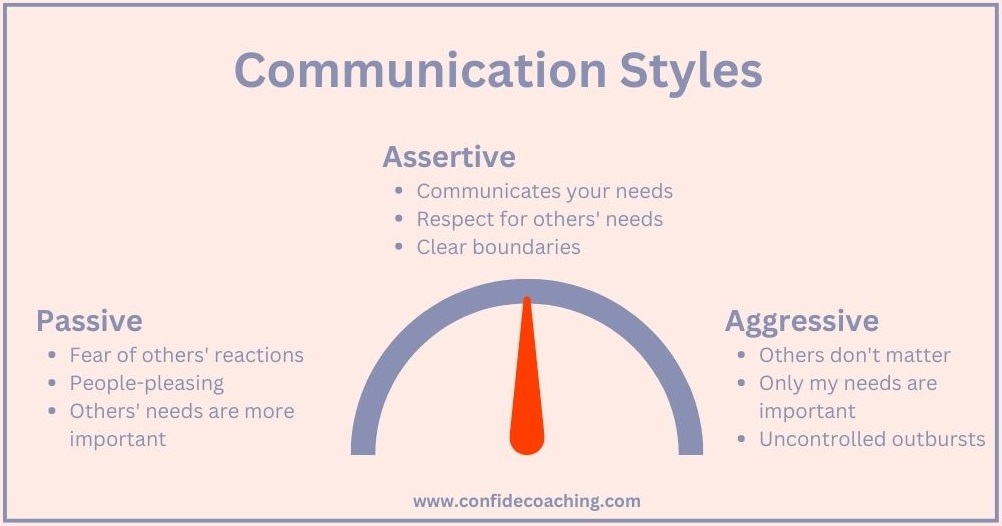
A common hurdle, especially for those who are conflict-averse or introverted, is the fear that setting a boundary is mean or selfish. The opposite is true. Unspoken boundaries lead to resentment, which slowly poisons relationships. Communicating your needs clearly is an act of kindness to both yourself and the other person.
To understand this better, let's watch a short clip.
Setting Boundaries with Kindness
In this clip from the video 'Setting Boundaries with Kindness' by Therapy in a Nutshell, the speaker reframes boundaries not as acts of selfishness, but as essential for preventing resentment and strengthening relationships.
Watch from 01:45 to 03:51. Notice the shift in thinking from 'a boundary is mean' to 'it's selfish if you don't set a boundary.'
This brings us to the "without apology" part of our goal. We often use apologetic or deferential language ("I'm so sorry, but would it be okay if maybe...?") because we've been taught it's polite. However, in the context of setting boundaries, this can weaken your message and signal that your needs are negotiable.
There's a crucial difference between being respectful and being overly polite or deferential.
How To Be Assertive and Speak Powerfully (Don't Be too Polite)
Let's explore the psychology behind this. The video 'How To Be Assertive and Speak Powerfully' from How Communication Works explains the relationship between politeness and perceived power.
Watch from 00:13 to 03:14 and then the short conclusion from 03:44 to 04:08. The key idea is that excessive politeness can be interpreted as deference, undermining your assertiveness. Being direct doesn't mean being rude; it means being clear and removing apologies and hedges.
The takeaway is to be direct and respectful, not apologetic and deferential. You are stating a need, not asking for permission to have one.
2. The Core Principle: Boundary vs. Request
This is the single most important concept for communicating boundaries effectively. Many people get frustrated when they say, "I set a boundary, and they didn't respect it!" This frustration often comes from a misunderstanding of what a boundary is.
- A Request asks another person to change their behavior. They have the right to say no. (e.g., "Could you please not call me after 10 PM?")
- A Boundary is a rule you set for yourself about what you will do. It is entirely within your control. (e.g., "I don't take calls after 10 PM.")
Understanding this distinction is empowering because it shifts the locus of control from them to you. You can't force someone to respect your request, but you can always enforce your own boundary.
The following video clip explains this distinction with a very clear example.
Setting Boundaries with Kindness
Let's return to 'Setting Boundaries with Kindness' for a crucial explanation of the difference between a boundary and a request.
Watch from 11:46 to 15:49. Pay close attention to the example of the mother-in-law moving closer. The daughter-in-law was making a request ('don't move within 30 miles'), not setting a boundary she could control. Notice how the speaker re-frames it around what the daughter-in-law can control (e.g., not allowing unannounced visits).
3. A 3-Step Process for Communicating and Upholding Boundaries
Now let's put it all together into an actionable process. This framework combines identifying what you control, communicating it clearly, and following through.

Step 1: Get Clear on Your Action (Internal Work)
Before you say anything, you must be clear on two things:
- The Limit: The specific boundary you identified in the last lesson.
- Your Behavioral Change: What action you will take if the limit is crossed. This is the "consequence" or the enforcement of your boundary.
Example:
- Limit: I need my weekends to recharge, so I do not do work-related tasks on Saturdays.
- Your Behavioral Change: If my boss contacts me on a Saturday, I will not respond until Monday morning.
Step 2: Communicate Clearly (The Conversation)
When you're ready to communicate, you don't need to be cold or harsh. You can be both kind and firm. Here are a few proven formulas to help you find the right words, especially when you feel put on the spot.
A. The "Sandwich" Method
This technique is great for existing relationships where you want to affirm your connection.
- Lead with warmth: Start with a positive statement about the relationship.
- State the boundary: Clearly and simply state your limit.
- End with reassurance (optional): Reaffirm the connection or offer an alternative.
Setting Boundaries with Kindness
Let's watch a practical example of the 'sandwich' method in action.
Watch from 09:17 to 11:46. The speaker gives an excellent example of telling a grandmother when she needs to leave. Notice the structure: 'Yes, we would love to have you over...' (warmth), '...we just need you to leave by 7:00' (boundary), and the implied reassurance.
B. The "I-Statement" Formula
"I-statements" are a cornerstone of assertive communication. They focus on your feelings and needs without blaming the other person, which reduces defensiveness. The academic paper "The four pathways of assertiveness" identifies using "I-Statements" and "Saying No" as core verbal skills for social assertiveness.
A common structure is: "I feel [emotion] when [behavior] because [impact]. I need/want [specific need]."
- Example: "I feel overwhelmed when I receive texts about work late at night because my evenings are my only time to disconnect. I need to keep my work communication within business hours."
C. The "Feeling + Want + Don't Want + Question" Script
This formula, from "The Introvert's Guide to Setting Boundaries Without Guilt," is another excellent tool that invites collaboration.
The Introvert's Guide to Setting Boundaries Without Guilt
Let's look at a very practical script you can adapt. This article provides a formula that is especially useful for introverts who want to avoid direct confrontation while still being clear.
Read the section titled 'A Script That Makes Boundary-Setting Easier'. Focus on the 'Feeling + Want + Don’t Want + Question' formula and the example provided.
- Formula: Feeling + Want + Don’t Want + Question
- Example (adapted): A friend constantly vents to you without asking how you are. You could say: "I feel drained after our calls lately (Feeling). I want our conversations to feel more like a two-way street (Want). I don't want to feel like I'm only here to absorb negativity (Don't Want). How can we make our chats more balanced? (Question)."
Step 3: Follow Through (Minding Your Boundary)
This is the most critical step. A boundary is meaningless if you don't uphold it. Following through is how you "teach people how to treat you," as the Introvert's Guide puts it. It requires consistency.
If you told your boss you won't respond after hours, don't respond. If you told your friend you're ending conversations that turn disrespectful, end the conversation calmly when it happens. This reinforces your boundary through your actions, not just your words.
Test your understanding!
Let's use a scenario from our last lesson: A coworker often starts long, non-work-related conversations in the last 30 minutes of the day, draining your energy and making you late.
Using the frameworks above:
- What is your boundary and your planned behavioral change (Step 1)?
- Write a script to communicate this using either the "Sandwich Method" or the "I-Statement" formula (Step 2).
- What is the follow-through action (Step 3)?
Show answer
Here is one possible way to approach this:
-
Boundary & Behavioral Change:
- Boundary: The last 30 minutes of my workday are for focused wrap-up to ensure I can leave on time.
- Behavioral Change: If a non-urgent, personal conversation starts during this time, I will state my need to focus and end the conversation politely after a few minutes.
-
Communication Script (Sandwich Method):
- (Next time it happens) "Hey, I always enjoy catching up with you (Warmth). Right now, though, I need to focus on wrapping up my day so I can head out on time (Boundary). Can we maybe chat about this at lunch tomorrow? (Reassurance/Alternative)."
-
Follow-Through:
- The next time they try to start a chat during that window, you must execute your script. If they persist, you must politely disengage and turn back to your work. Consistency is key.
4. Managing the Reality: Guilt, Fear, and Consequences
Setting boundaries can be emotionally difficult. You might feel guilty, your voice might shake, or you might even cry. This is normal, especially when you're out of practice. Let's get some advice on how to handle it.
Setting Boundaries with Kindness
This final clip provides compassionate, practical advice for managing the difficult emotions that can arise when you set a boundary, and what to do about potential negative consequences.
Watch from 23:09 to 26:19 and then from 34:39 to 37:56. The first part addresses the reality that setting boundaries can have unwanted outcomes. The second part gives tips for what to do if you feel guilty or get emotional.
Key advice for managing the reality:
- Reframe Guilt: Guilt doesn't mean you're wrong; it means you care. It's a sign you're not a jerk. Acknowledge it, and know that the discomfort is temporary.
- Handle Emotions: If you get emotional, it's okay. You can even use it: "I'm emotional because this is hard for me, and I value our relationship, but I also need to honor my own needs." Rehearsing your script beforehand can help.
- Accept Consequences: Setting boundaries clarifies the nature of your relationships. Some people ("takers") may drift away. This can be painful, but it ultimately leaves you with more energy for people who respect you. In a work context, it provides clarity on the company's true values, allowing you to make more informed decisions about your career.
Conclusion and Course Wrap-Up
Congratulations on completing not just this lesson, but the entire course! Today, you've learned the practical skills to communicate your needs and protect your energy, the final piece in the puzzle of sustainable social engagement.
Key Takeaways from this Lesson:
- Communicating boundaries is an act of assertiveness and kindness, not aggression or selfishness.
- The key is to focus on what you can control: your own behavior (a boundary), not theirs (a request).
- Use structured formulas like the Sandwich Method or I-Statements to communicate clearly, respectfully, and without apology.
- Following through with your stated action is what gives a boundary its power.
- Feeling guilt or fear is normal; reframe it as a sign that you care, and remember that the discomfort will pass.
Over the past 12 modules, you have built a comprehensive toolkit for communication. You started with the foundations of context and goals, moved through the critical skills of emotional intelligence and active listening, and practiced the mechanics of conversation, storytelling, and impromptu speaking. You've explored charisma, persuasion, and argumentation, and now you have the tools to navigate difficult conversations and build deeper connections while managing your own energy.
Your goal was to become a more charismatic and effective communicator, able to build deeper bonds. The final skills of setting and communicating boundaries are what make this goal sustainable. By protecting your energy, you ensure you have the capacity to show up authentically and connect deeply when you choose to.
The journey of a great communicator is one of lifelong practice. Continue to observe, reflect, and apply these principles. You have the frameworks and the knowledge—now go out and build the relationships you desire. Well done