Hello! Welcome to the first lesson of Module 6: Quick Thinking and Impromptu Speaking.
In our last lesson, you learned how to use the pivot technique to steer conversations, giving you a powerful tool for managing conversational flow and your own social energy. That was about redirecting. Today, we focus on what to do when you're put on the spot and need to respond directly. This lesson is designed to help you with your goal of delivering convincing answers in "hot-seat" situations and feeling more confident in impromptu speaking competitions.
Our learning outcome is to apply the PREP structure (Point, Reason, Example, Point) for clear and concise impromptu responses.
PREP is a mental framework that acts like a blueprint for your thoughts. Instead of feeling overwhelmed by a question and trying to organize everything at once, you can rely on this structure to build a coherent, impactful answer, one piece at a time. This reduces the cognitive load of speaking on the spot, which is a key strategy for managing social energy.
1. Why You Need a Framework for Quick Thinking
Have you ever been asked for your opinion in a meeting or a conversation and found your thoughts coming out in a jumble? This is a common experience. It doesn't mean you're a slow thinker; it just means your brain is trying to process too much at once without a clear path forward.
A framework provides that path. Much like economic models help simplify complex market behaviors into understandable patterns, communication frameworks help organize complex thoughts into a clear, logical structure.
Let's watch a short video that explains this challenge and introduces the value of having mental models for communication.
The PREP Framework: How To Communicate Confidently In Any Situation!
In this clip from 'The PREP Framework' by speaker and magician Vinh Giang, he explains why our brains can feel 'stuck' when asked a question and how frameworks provide a solution.
Please watch from the beginning to 00:57, and then from 02:12 to 02:55. Notice his point that having a structure prevents 'waffling' and allows you to deliver a meaningful piece of communication instead of just talking without saying anything.
As Vinh Giang highlights, having a tool like PREP means you can focus your mental energy on the content of your message, because the structure is already taken care of.
2. Deconstructing the PREP Framework
PREP is an acronym for a simple, four-step structure that makes your responses logical and easy for others to follow.
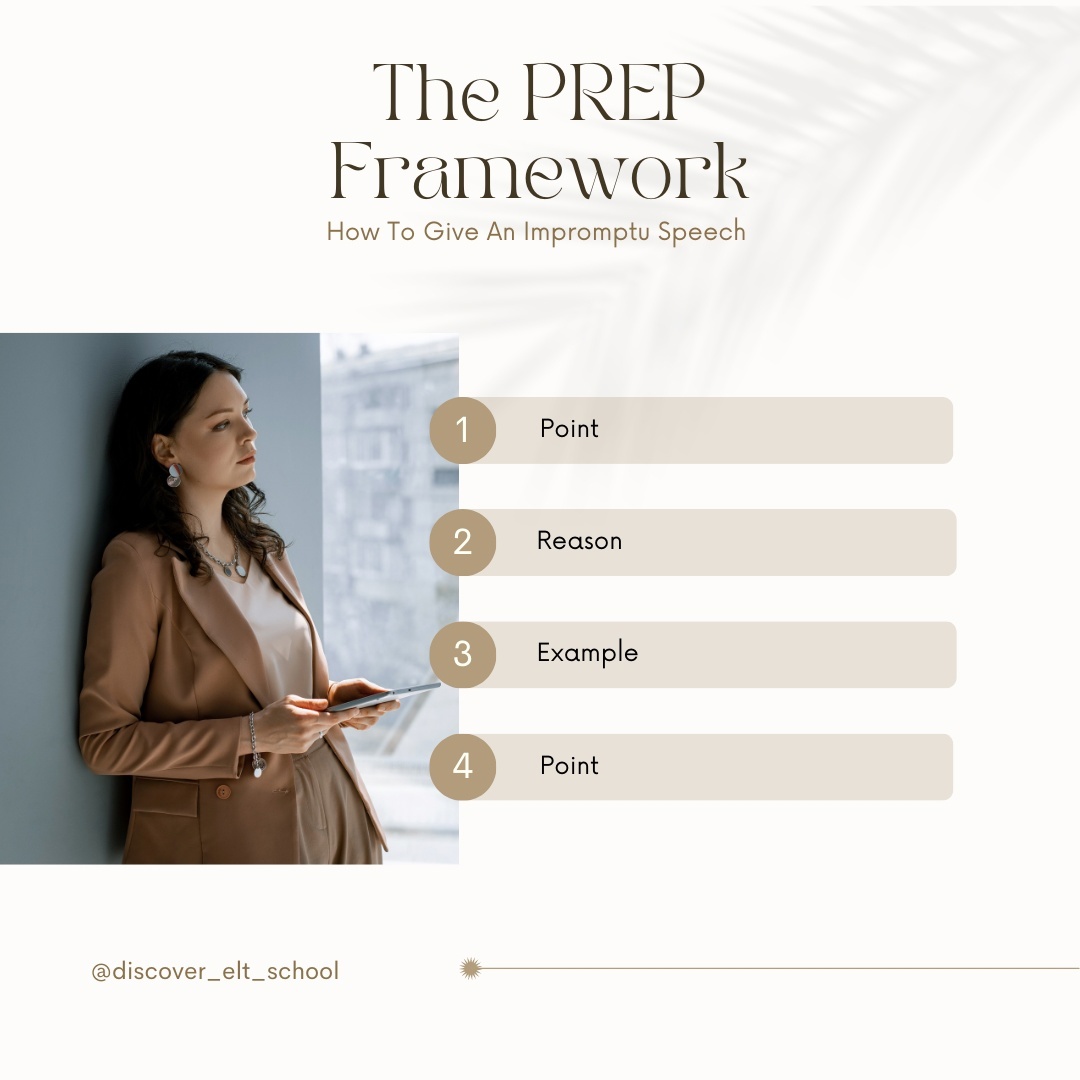
Let's look at what each part means.
- P - Point: Start by stating your main point directly. This is your core message or the direct answer to the question.
- R - Reason: Explain why you believe your point is true. This is the logical underpinning of your argument.
- E - Example: Give a specific example that illustrates your reason. This can be a personal story, a fact, a statistic, or an analogy. Examples make your point tangible and memorable.
- P - Point: Conclude by restating your main point, often in slightly different words. This reinforces your message and provides a clear ending.
To see how this works in its simplest form, let's watch a brief explanation from Toastmasters International, an organization you're already familiar with.
Impromptu Speaking: How to Get Better at Speaking on the Spot
This clip from Toastmasters International's 'Impromptu Speaking' video gives a concise overview of the PREP formula.
Watch from 02:08 to 03:26. Pay attention to how the simple example about 'internet outages' follows the four-step structure. They explicitly state this is a great fit for professional settings and interviews.
3. Applying PREP: From Theory to Practice
Now that you have the basic definition, let's dive deeper into how to apply each step effectively. We'll use a textual resource to get more detailed guidance and see another example in action.
The PREP Speech Structure for Confident Responses to ...
The article 'The PREP Speech Structure for Confident Responses' from Vocate provides excellent, practical advice on how to implement each stage of the framework.
Please read the sections titled 'How to Apply The PREP Speech Structure Effectively' and 'An Example of PREP in Action'. Note the advice to get straight to the point and how the 'tea vs. coffee' example brings the structure to life with a simple, everyday topic.
As the article demonstrates, the power of PREP lies in its combination of logic (Reason) and narrative (Example). The reason makes your argument sound, while the example makes it resonate. Your interest in neuroscience is relevant here: our brains are wired to remember stories and concrete examples far better than abstract claims.
Let's walk through another example, this time on a more substantial topic.
Question: "What is one skill you think everyone should learn?"
- P (Point): "I believe the most crucial skill everyone should learn is financial literacy."
- R (Reason): "My reason is that understanding basic financial principles, like budgeting, saving, and investing, is fundamental to achieving personal freedom and security in the modern world. Without this knowledge, it's very difficult to make informed decisions about your future."
- E (Example): "For instance, I have a friend who started a great-paying job right after college but never learned to budget. Within a few years, despite a high income, they were in significant debt from lifestyle inflation. In contrast, another friend with a more modest salary who understood compound interest started a small, automated investment plan early on. A decade later, they are in a much stronger financial position. This shows that it's not just about how much you earn, but how well you manage what you have."
- P (Point): "So, that's why I'm convinced that financial literacy is the single most empowering skill someone can acquire."
This structure takes a simple opinion and transforms it into a clear, persuasive, and memorable mini-speech.
Test your understanding!
Imagine you are in a group discussion and someone asks you: "Do you think remote work is here to stay, or will everyone eventually go back to the office?"
Take a moment to outline a response using the PREP structure. You don't need to write a full script, just jot down the key idea for each of the four steps.
Show answer
Of course, there are many possible answers. Here is one example:
- P (Point): "I believe a hybrid model, not a full return to the office, is the future of work."
- R (Reason): "The main reason is that the pandemic forced both companies and employees to invest heavily in the technology and culture for remote work, and many have seen benefits like increased flexibility and access to a wider talent pool. It's inefficient and unpopular to completely discard that progress."
- E (Example): "For example, my cousin's tech company tried to mandate a full five-day return to the office last year. They lost nearly 15% of their top engineering talent to competitors offering flexible arrangements. They quickly reversed the policy and now use a three-day in-office, two-day remote model, which has boosted both morale and retention."
- P (Point): "So, because of the investment we've all made and the clear demand for flexibility, I'm confident that the hybrid model will be the new standard, not a full return to the old way."
4. Nuances and Adaptations
While PREP is incredibly effective, it's a framework, not a cage. As you get comfortable with it, you can adapt it.
Short and Easy Impromptu Frameworks: The PREP ...
Let's look at an article that not only reinforces the core PREP structure but also introduces some simple variations.
Please read the main section explaining PREP (from 'The PREP framework goes like this:' down to the summary of the dog example). Then, briefly skim the variations like 'PREREREP'. You don't need to master these now, just notice that you can expand the framework by adding more reasons and examples for longer responses.
The most important thing is to sound natural, not robotic. The goal of PREP isn't to sound like you're reading a formula, but to ensure your thoughts are presented with clarity and logic. The more you practice, the more naturally you'll move through the steps.
Conclusion
In this lesson, you've learned a foundational technique for quick thinking and clear communication. The PREP structure is a reliable tool that you can use in any situation that calls for an impromptu response, from job interviews to debates to casual conversations.
Key Takeaways:
- Mental frameworks like PREP reduce cognitive load, allowing you to deliver clear responses under pressure.
- The PREP structure consists of four steps: Point, Reason, Example, and a concluding Point.
- This structure makes your argument logical, persuasive, and easy for your audience to follow.
- The combination of a rational Reason and a narrative Example is particularly powerful.
- With practice, PREP can become a natural and adaptable part of your communication toolkit.
By mastering this framework, you have taken a significant step toward your goal of handling "hot-seat" questions with confidence and charisma.
Preview of the Next Lesson:
PREP is perfect for answering a question directly. But what if the question is hostile, tricky, or something you simply don't want to answer? In our next lesson, we will explore the bridging technique, which allows you to acknowledge a question and then skillfully redirect the conversation toward a message you do want to deliver. It's the perfect complement to PREP in your quick-thinking arsenal.